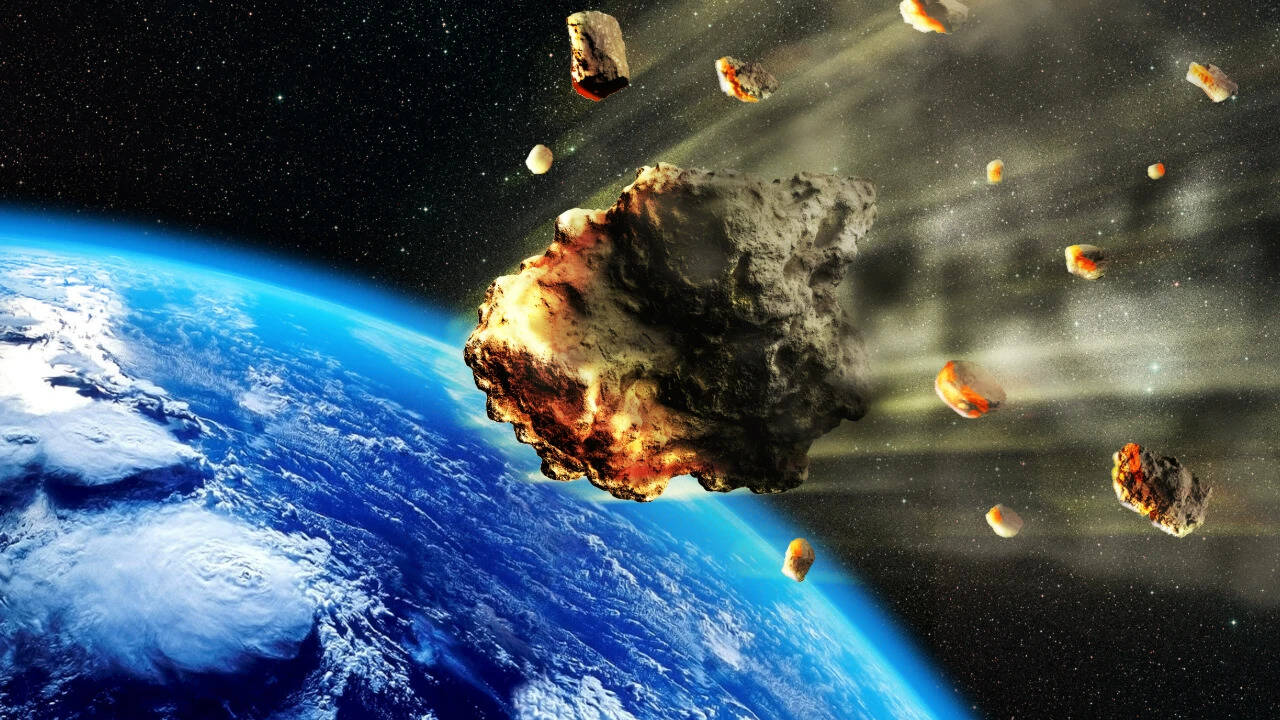
Geology is a discipline built on the humility of correction. For decades, textbooks and scientific papers treated the Ames impact structure—a massive, circular scar buried miles beneath the wheat fields and oil wells of Major County, Oklahoma—as a veteran of an ancient cosmic barrage. Discovered by the petroleum industry in the early 1990s, this subterranean bowl was neatly slotted into a crowded chapter of Earth history: the Ordovician Meteor Event, a cluster of impacts dated to roughly 467 million years ago that once prompted wild hypotheses about a planetary ring of debris encircling the early Earth.
That timeline is wrong.
New radioisotopic data reveals that the Ames meteor struck the crust nearly 100 million years later than previously believed, pinning the event closer to 370 million years ago during the Late Devonian. The correction, led by researchers at The University of Texas at Austin and published in Meteoritics & Planetary Science, does more than relocate a single hole in the ground. It dismantles a pillar of North American impact chronology and forces a hard look at how scientists read the fragmentary archives of the deep past.
The Fossil Trap
To understand why geology got Oklahoma so wrong for thirty years, you have to look at what was pulled out of the drill cores.
When geologists attempt to date an impact structure buried beneath thousands of feet of sedimentary overburden, they rarely have the luxury of staring at an exposed crater rim. They rely on proxy data. In the case of Ames, researchers previously anchored the impact timeline using conodonts—tiny, microscopic teeth belonging to an extinct, eel-like vertebrate. These fossilized remains were recovered from rocks associated with the structure, placing the host strata squarely in the Ordovician period.
It seemed like solid science. Fossils provide a relative clock, a biological index of when a specific layer of sediment accumulated. But an impact event is an act of violent geological recycling. When an asteroid miles wide slams into the continental crust at hypervelocity, it does not politely displace local rock; it vaporizes, melts, shatters, and churns everything within a massive radius.
The conodont fossils did not date the impact. They dated the older rock that the asteroid happened to pulverize.
The impact event scooped up ancient Ordovician sediments, mixed them into the chaotic slurry of the crater, and inadvertently preserved the durable microfossils inside younger deposits. The fossils were ancient voyagers, trapped in a geological frame-up that tricked generations of specialists into misreading the crater's birth certificate.
Reading the Zircon Clocks
To bypass the fossil trap, a team led by Elizabeth J. Catlos turned away from biological proxies and looked straight at the atomic scale within the crater's melted bedrock. They targeted zircon, an extraordinarily resilient silicate mineral that acts as a microscopic time capsule.
Zircon incorporates uranium into its crystal lattice when it forms, which then decays into lead at a predictable, constant rate. When an impact shatters the crust, the extreme temperatures and pressures can reset these atomic clocks entirely, or spur the growth of fresh zircon grains in the impact melt. By analyzing these tiny crystals using high-precision secondary ion mass spectrometry and laser ablation techniques, the researchers extracted 37 separate measurements from the Ames impact-melt rocks.
The results were stubborn and uniform. No matter which analytical angle the team pursued, a distinct population of the youngest zircon crystals kept pointing to a weighted mean age of roughly 370 million years.
Ten of the eleven youngest dates converged tightly on that window. Corroborating this with advanced imaging to check for impact-induced microstructures—such as specific low-angle grain boundaries and granular arrays cutting through crystal growth zones—confirmed that these grains recorded the physical trauma of a collision. The rock was not 467 million years old. It was a product of the Late Devonian.
Collateral Damage in the Timeline
Shifting the Ames crater forward by nearly 100 million years creates immediate ripples across planetary science.
For years, the supposed mid-Ordovician spike in North American craters was used to support hypotheses of an ancient asteroid breakup—an event that allegedly littered near-Earth space with a dense cluster of projectiles. By removing Ames from that cluster, one of the primary structural anchors of the Ordovician hypothesis vanishes. It is a stark reminder of how fragile statistical groupings are in geochronology when individual data points rest on untested assumptions.
More intriguingly, the new date drops the Ames impact right into the neighborhood of the Frasnian-Famennian boundary. This interval coincides with the Upper Kellwasser Crisis, one of the planet's major mass extinction events, which severely battered shallow marine ecosystems and wiped out vast percentages of tropical reef builders and ancient fish species.
The researchers are careful to draw a bright line here. Establishing that a meteor struck Oklahoma 370 million years ago does not prove that the strike caused or contributed to the global Devonian die-off. Correlation is not causation, and science is littered with the corpses of neat narratives built on coincidental timing. Yet, mapping the precise chronology of terrestrial impacts against the timeline of biological crises remains an essential exercise. If we are to understand the drivers of past mass extinctions—balancing the ledger between massive volcanic outpourings, climatic shifts, and extraterrestrial impacts—we need the dates to be right.
The Economic Paradox
There is an ironic footnote to the history of the Ames structure. Long before academic journals debated its isotopic signature, the crater was famous for an entirely different reason: money.
The circular depression, roughly nine miles across with a central uplift, created an extraordinary structural trap for hydrocarbons. Over the decades, the Ames structure yielded hundreds of millions of dollars in oil and natural gas, turning a geological curiosity into a lucrative industrial asset. Prospectors drilled blindly into the chaotic, fractured breccia of a forgotten explosion, extracting energy stored in rocks torn apart by a visitor from deep space hundreds of millions of years prior.
That the structure spent decades generating wealth while its basic birth date remained fundamentally misunderstood speaks volumes about how science progresses. Industry maps the geometry of the subsurface to move commodities, while academia struggles to piece together the narrative arc of planetary evolution. Sometimes, the physical proof waits in silence beneath the drill bits, locked inside crystals smaller than a grain of sand, waiting for better tools to ask the right questions.
The wheat grows tall over Major County now, masking the violent heritage buried miles below. The crater remains where it has always been, but its place in the history of the solar system has been violently redrawn.


