Cardboard boxes look like nothing until they hold everything you have ever loved.
Picture a Tuesday afternoon in Tennessee. The air smells like damp red clay and diesel exhaust from the highway running parallel to a long, windowless row of corrugated steel doors. You slide a heavy brass padlock through a galvanized hasp, give it a sharp tug to hear that reassuring metallic click, and walk back to your truck. You drive away believing a simple, unspoken covenant has just been sealed. You pay your monthly fee; they keep the wolves at the gate. If you found value in this piece, you should look at: this related article.
For one Tennessee couple, that covenant shattered into splinters, empty space, and a $57,200 courtroom reckoning.
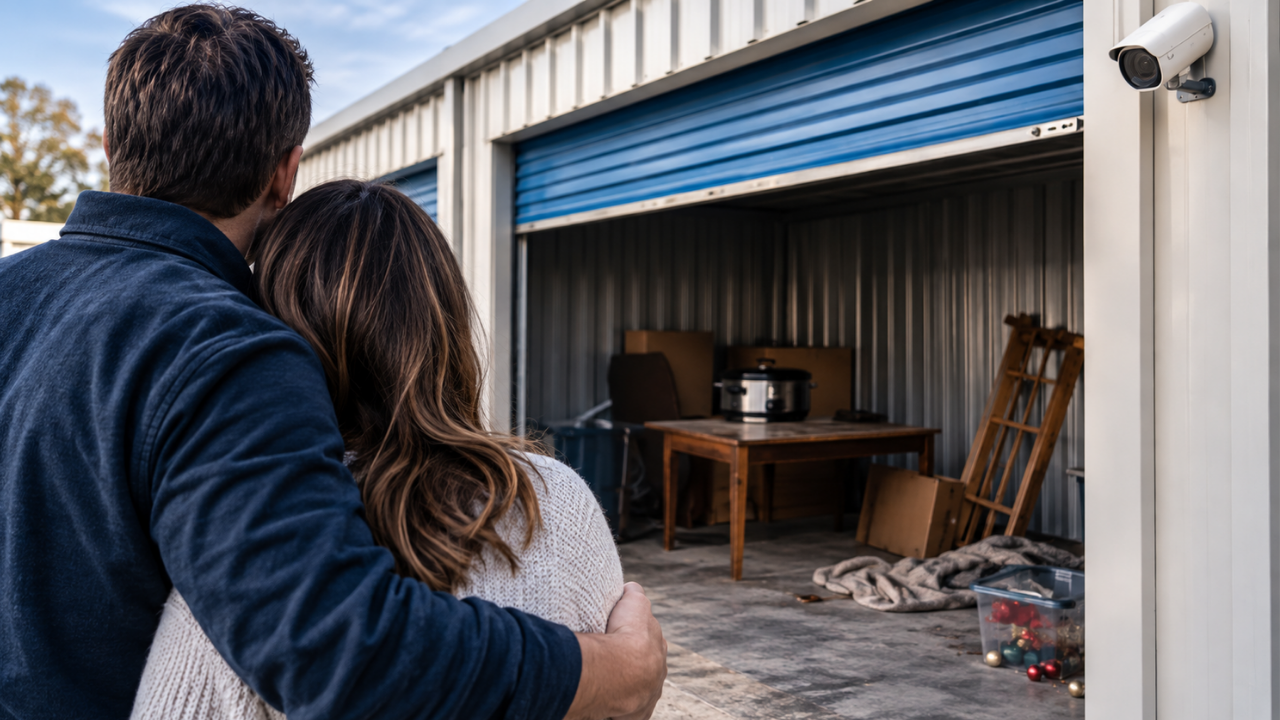
When they returned to their rented unit, the heavy steel door rolled up to reveal a concrete void. Their life—accumulated over decades of quiet labor, careful saving, and irreplaceable family milestones—had simply vanished. It wasn't a freak tornado or a sudden electrical fire. It was a breach of trust engineered long before the first box was ever carried across the threshold. The storage facility had promised fortress-level protection, advertising security measures that existed only on paper and in sales pitches. When the couple took the company to court, a judge looked past the fine print of standard rental agreements and awarded them $57,200 for false security claims and the total loss of their property. For another look on this development, refer to the latest update from The Guardian.
The Architecture of a False Promise
We rarely rent a storage unit during the calmest chapters of our lives. We rent them in the middle of transitions. A parent passes away, and you need six months to sort through forty years of cedar chests and framed photographs. A job relocates you across state lines before the new house closes. A divorce forces a sudden, painful division of square footage.
In those moments of vulnerability, we don't interrogate the security protocols of a self-storage facility. We look for signs of safety. We see a keypad at the front gate, a few dome cameras bolted under the eaves, and a glossy brochure promising round-the-clock monitoring. We hand over our credit card number and exhale.
Consider a hypothetical scenario that mirrors what happens every week in facilities across the country. Imagine a facility manager named Marcus watching a blinking red light on a security console. The gate sensor is broken—again. Fixing it requires calling a specialized technician and spending eight hundred dollars out of the quarterly maintenance budget. So Marcus props the gate open with a concrete cinderblock so paying customers won't get locked out over the weekend. Meanwhile, the cameras mounted on Building C haven't recorded a single frame since last autumn because the hard drive fried during a thunderstorm. To a customer walking past with an armload of winter coats, those plastic domes still look like watchful eyes. To a professional thief scouting the lot at three in the morning, they are just expensive bird perches.
This is the exact gap where the Tennessee couple fell through. The company sold them the theater of security without the substance. When you sell a lock that doesn't latch and a camera that doesn't record, you aren't just failing to prevent a crime. You are actively deceiving the people paying you to protect their lives.
Why Storage Contracts Usually Win
To understand why a $57,200 judgment in Tennessee is such a seismic event, you have to understand how deeply the self-storage industry is insulated from accountability.
Read the back of almost any standard storage lease, and you will find a masterpiece of corporate self-preservation. Most agreements explicitly state that the facility is merely renting you empty space—like a landlord leasing a bare plot of land—and bears zero responsibility for what happens inside. If mice chew through an antique sofa, that is your problem. If a roof leaks onto an heirloom piano, you should have bought insurance. If someone cuts your lock with a pair of thirty-dollar bolt cutters and empties the unit into a U-Haul, the facility's standard defense is a shrug and a pointer toward Clause 14B.
Legally, this is the difference between a landlord-tenant relationship and a bailment. When you valet your car at a hotel, you hand over the keys, creating a bailment; the hotel takes direct custody and owes you a strict duty of care. When you put your own padlock on a storage unit, the facility argues they never took custody of your goods. You hold the key, so you hold the risk.
For decades, that legal shield made self-storage operators nearly untouchable. Even when fences were cut and gates were left wide open, customers walked away empty-handed because they had signed away their right to sue for ordinary negligence.
The Tennessee ruling exposed the fatal flaw in that armor. A contract can waive liability for accidents, bad luck, or even ordinary carelessness. A contract cannot license fraud.
When a business makes specific, affirmative claims about its security—telling consumers that a property is gated, monitored, alarmed, or patrolled when those systems are non-functional or non-existent—it crosses from negligence into deceptive business practices. Under consumer protection laws, lying about the safety of a service strips away the fine-print shield. You cannot trick someone into signing a waiver by promising them a vault when you are actually handing them a tent.
The Invisible Ledger of Loss
Numbers in a lawsuit always feel clean on a spreadsheet. Fifty-seven thousand, two hundred dollars. You can divide it by months, compare it to national averages, or weigh it against legal fees.
Real life refuses to fit inside a ledger.
Have you ever tried to put a price tag on a box of report cards from third grade? What is the fair market depreciation on your grandmother's cast-iron skillet, seasoned over sixty years of Sunday mornings? How do you calculate the replacement value of a wedding album when the photographer died ten years ago and the negatives burned in a studio fire?
Insurance adjusters have a cold term for this: Actual Cash Value. If thieves steal a ten-year-old solid oak dining table that your father built by hand in his garage, an insurance policy might look at a depreciation chart and offer you a hundred and forty dollars—the price of a wobbly particleboard table at a discount warehouse.
I remember helping a close friend clean out the remains of a burglarized storage unit outside Nashville a few years ago. The thieves hadn't even taken everything; they had simply ripped open dozens of taped boxes looking for power tools and electronics, dumping everything else onto the concrete floor. Standing in that dimly lit aisle, watching my friend kneel down to pick up a shattered ceramic lamp his mother had painted before she passed away, I realized that theft isn't just a financial crime. It is an erasure of memory. He didn't care about the stolen television or the missing lawnmower. He sat on an overturned plastic crate, holding two jagged pieces of blue porcelain, completely hollowed out by the realization that a physical piece of his history had been reduced to trash by someone who didn't even want it.
That is the emotional weight sitting behind the Tennessee couple's court victory. The $57,200 wasn't a windfall. It was a partial, imperfect attempt by the justice system to recognize the sheer scale of what was taken when a company broke its word.
How to Audit a Fortress Before You Hand Over the Keys
The self-storage industry in America has exploded over the last twenty years, swelling into a massive, multi-billion-dollar real estate machine. Because demand has been so relentless, facilities have popped up on every suburban corner, run by everything from massive publicly traded trusts to local operators cutting corners to maximize monthly yields.
If you are standing in a rental office today, pen hovering over a digital signature pad, you cannot rely on the glossy brochure on the counter. You have to become your own investigator.
Start by walking the perimeter before you sign a single page. Look closely at the fencing. Is it heavy-gauge steel anchored into concrete, or is it flimsy chain-link pulling away from the posts at the bottom? Check the access gate. Wait by your car for five minutes and watch how it operates. Does it close immediately after a single vehicle passes through, or does it stay open long enough for three tailgating cars to slip inside behind a legitimate tenant?
Look up at the cameras. Ask the manager on duty to show you the live feed on the office monitor. It is a simple, polite request: "I'm storing some family antiques—could you show me which camera covers Building D?" Watch their reaction. If the monitor is turned off, if half the screens show static, or if the manager makes an excuse about the system being "upgraded next week," turn around and walk out. A working security system is a point of pride for a well-run facility; a broken one is a secret they hope you won't ask about.
Examine the lighting and the sightlines. Facilities with blind alleys, overgrown brush backing up to the exterior walls, or flickering sodium bulbs give thieves the two things they need most: time and cover. Notice the locks on the neighboring units. If you see cheap, thin-shackled combination locks everywhere, or worse, doors secured with twisted wire and rusted padlocks, you are looking at a facility that doesn't enforce basic security standards among its own tenants.
The Lock on Your Door Is Only Half the Equation
Even at the best-managed facility in the state, the hardware you bring to the door matters enormously. Most people buy a standard laminated padlock from the nearest hardware store—the kind with a silver body and a thin U-shaped steel shackle. To a thief carrying a pair of long-handled bolt cutters, that lock takes less than three seconds to snap. It barely makes a sound.
If you are locking away anything that matters, buy a heavy-duty disc lock or a closed-shackle cylinder lock. Disc locks are shaped like hockey pucks, leaving almost none of the steel shackle exposed. There is nowhere for the jaws of a bolt cutter to bite. Pair that with a comprehensive, itemized inventory before you close the door. Take a slow, steady video on your phone walking through the packed unit, opening lids, and reading serial numbers aloud. Email that video to yourself so it sits timestamped in the cloud. If the worst happens, you won't have to rely on memory while standing in front of an empty concrete box.
Check your homeowners or renters insurance policy before buying the overpriced coverage pushed at the storage counter. Many standard policies already extend off-premises coverage to belongings kept in a storage unit, often up to ten percent of your personal property limit. If you do buy a separate protection plan, read the exclusions line by line. Make sure it covers theft via forced entry—and pay attention to whether it pays out Actual Cash Value or full Replacement Cost.
The Price of Looking the Other Way
Businesses operate on incentives. For too long, the math for negligent storage operators was brutally simple: fixing gates, hiring night patrols, and maintaining real surveillance cost thousands of dollars every month, while the legal risk of a break-in was practically zero. Why pay for a real guard when a fake camera costs twenty dollars and the contract absolves you anyway?
The Tennessee verdict flips that equation on its head.
When courts hold companies financially liable for the gap between what they promise and what they deliver, security stops being a marketing buzzword and becomes a legal obligation. Every time a consumer pushes back against deceptive fine print, the cost of cutting corners rises. Fifty-seven thousand dollars is enough to make a regional manager check the hard drives on the surveillance system. It is enough to make an owner fix the broken latch on the back gate before dusk.
Trust is a fragile currency in modern commerce. We hand it over every day in small installments—every time we swipe a card, sign a lease, or slide a brass key out of a padlock and walk away into the afternoon sun. We know the world isn't entirely safe, and we know locks can be broken. All we ask is that the people standing on the other side of the counter aren't selling us an empty box before the thieves even arrive.