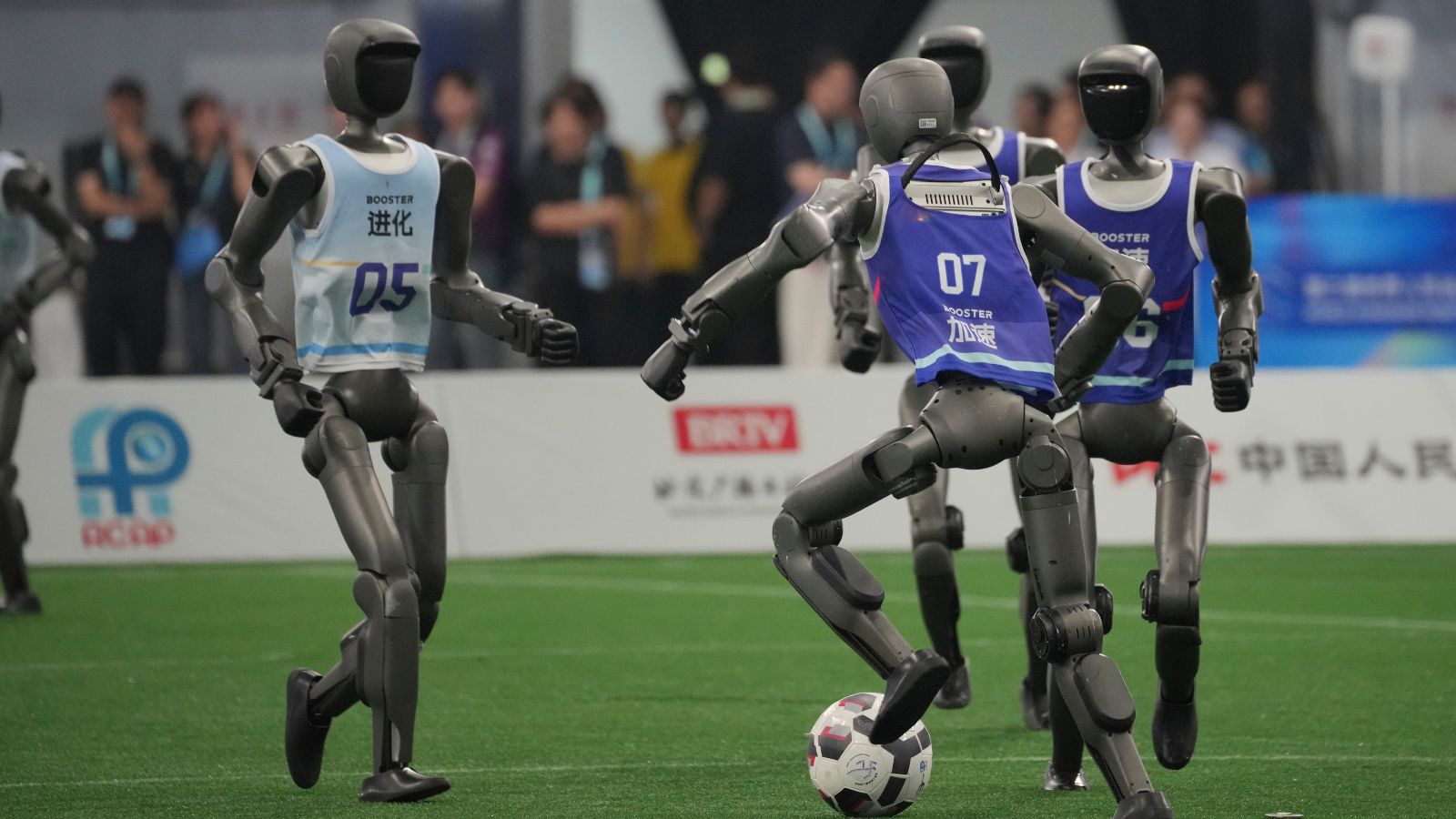
At the World Humanoid Robot Games in Beijing, a mechanical sprinter named Tiangong Ultra tore down a hundred-meter straightaway in 9.39 seconds, eclipsing the legendary 9.58-second benchmark set by Usain Bolt in Berlin. A rival machine, backed by smartphone manufacturer Honor and dubbed Lightning, clocked an even faster 9.32 seconds during preliminary test runs. The headlines write themselves. Flesh and bone have officially fallen behind silicon and steel on the running track.
Except the comparison is fundamentally flawed, deeply misleading, and built on a category error that ignores the messy reality of physical robotics.
Usain Bolt did not merely run a distance; he solved an organic puzzle of friction, fatigue, biomechanical adaptation, and bone density without a tether, external power pack, or remote telemetry link. When Tiangong Ultra crossed the finish line at the National Speed Skating Oval, it did not gracefully ease into a deceleration zone. It plowed directly into a thick safety mat, stumbled wildly into the crowd, and forced spectators to dive out of harm's way. Lightning fared worse, collapsing completely at the finish line and requiring a stretcher to clear the track.
A machine that destroys itself the moment it stops running is not an athletic marvel. It is a controlled projectile.
The Mechanics Behind the Stride
To understand why these machines can post blistering straight-line numbers while remaining practically helpless in a dynamic environment, you have to look at the hardware modifications. Leading up to the Beijing events, engineers lengthened Lightning's legs by ten centimeters, bringing them to an elongated 1.05 meters on a 169-centimeter frame.
This proportions shift introduces extreme mechanical advantage for a linear sprint while destroying generalized utility. A human sprinter builds musculature symmetrically to handle explosive propulsion, stabilization, and lateral shock absorption simultaneously. Bipedal robots engineered strictly for straight-line speed trade away balance redundancy.
Consider a hypothetical comparison: modifying a commercial delivery van by removing the steering mechanism, stripping the cabin, and welding a jet engine to the chassis. It will cross a quarter-mile strip faster than a sports car, but you cannot drive it to the grocery store.
The engineering teams behind these competition platforms are optimizing for a single metric because leaderboards drive venture capital. China’s broader industrial policy heavily favors humanoid robotics as a crown-jewel sector. When a company like Unitree sees its valuation soar past fifty billion dollars on a Shanghai trading debut, the incentive structure shifts away from practical factory deployment and toward spectacle. Speed records generate viral video clips. Viral clips generate state subsidies and retail investor enthusiasm.
The Physics of Stopping
The dirty secret of high-speed bipedal robotics is not propulsion; it is deceleration.
Human legs contain hundreds of muscles and tendons that act as biological shock absorbers, converting kinetic energy into eccentric muscle contractions. Mechanical bipeds rely on rigid actuators, harmonic drives, and fragile gearboxes that shudder under high-impact loads. When a hundred-kilogram metal frame travels at fourteen meters per second, stopping safely requires an intricate dance of computational foresight and thermal dissipation.
Neither Tiangong Ultra nor Lightning possessed the onboard processing architecture to handle deceleration dynamically on Saturday. They relied on brute-force stopping mats because their control loops could not reconcile momentum with structural preservation at that velocity.
This reveals the vast chasm between exhibition performance and real-world utility. Warehouses do not need robots that can sprint a hundred meters in under ten seconds if they shatter their own ankle joints upon encountering a stray pallet. Assembly lines demand endurance, compliance, and multi-modal dexterity. They require machines that can carry a heavy transmission block across a concrete floor without tripping over a seam in the foundation.
The Spectacle Versus the Factory Floor
We have been here before. Decades ago, robotics exhibitions focused heavily on bipedal walking demonstrations that looked agonizingly slow and rigid. Industry critics dismissed them as toys. Then came the era of parkour-jumping quadrupeds and acrobatic humanoids that normalized dynamic balance.
Yet, translating a stunt into a commercial product remains a graveyard of capital.
The machines running down the track in Beijing represent incredible leaps in battery density, torque-to-weight ratios, and motor controller efficiency compared to the twenty-one-second times recorded at the inaugural games just a year prior. That raw velocity improvement is genuine engineering progress. The mistake lies in framing it as a victory over human athleticism.
Bolt's record stands as a triumph of biological evolution honed for survival, heat dissipation, and error recovery. A racing robot is a specialized, fragile instrument designed to exploit a rulebook loophole on a flat, rubberized indoor track.
When these machines begin navigating unmapped construction sites, sorting tangled wires in chaotic electrical closets, and running for twelve-hour shifts without a thermal shutdown or a trip to the repair stretcher, the technology will have truly arrived. Until then, the hundred-meter dash remains a very expensive magic trick.