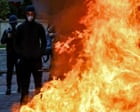
Every Western commentator reading the headline about Albania’s $6,000 fine for standing near a violent protest immediately reaches for the same tired playbook. They scream about creeping authoritarianism. They clutch their pearls over the death of free assembly. They treat a Balkan administrative penalty like the rebirth of Enver Hoxha’s secret police.
They are wrong. And their outrage exposes a complete ignorance of how modern political destabilization actually works.
When Tirana lawmakers moved to slap a 600,000-lek fine—roughly $6,000—on anyone caught remaining at a demonstration after it turns violent, the lazy consensus framed it as a blunt instrument designed to crush dissent. In a country where the average monthly wage hovers around $750, a $6,000 penalty is effectively a year's gross income. It looks brutal on paper.
Look closer at the mechanics of street violence in the Balkans, however, and you realize something uncomfortable. Traditional policing fails miserably when a crowd weaponizes its own peaceful majority as a human shield. Albania isn't trying to ban protests. Albania is trying to price out the bystander effect that makes urban riots possible in the first place.
The Myth of the Innocent Spectator
Human rights watchdogs love to paint demonstrations in binary colors. On one side, you have the peaceful, virtuous citizens exercising their constitutional rights. On the other, a tiny fringe of bad actors throwing Molotov cocktails. According to standard liberal orthodoxy, the state’s job is to surgically extract the rock-throwers while leaving the peaceful crowd completely undisturbed.
Anyone who has ever managed public order—or simply watched how a street riot unfolds in real time—knows this surgical extraction is a fantasy.
Rioters do not operate in an open field. They operate inside the physical density of a sympathetic crowd. A masked agitator hurls a flare or a paving stone at a police line, then takes four steps backward and disappears into a sea of unmasked citizens holding smartphones. When riot police advance to arrest the assailant, the "peaceful" crowd locks arms, blocks the corridor, and films the resulting scuffle to post on social media as evidence of state brutality.
The crowd becomes the camouflage. Without the mass of non-violent bodies providing cover, the violent fringe is isolated, exposed, and arrested within ninety seconds.
By imposing a massive financial penalty simply for remaining present once violence erupts, the state changes the incentive structure for the crowd itself. It forces every individual in the street to make an immediate, cold-blooded calculation. Are you willing to risk twelve months of your salary to provide physical cover for the guy next to you throwing fireworks at municipal buildings?
For ninety-nine percent of normal citizens, the answer is an instant no. They disperse. They go home. And the moment they walk away, the violent agitators are left standing alone in an empty square, completely stripped of their human shield.
Why Batons Fail Where Bank Accounts Succeed
I have spent years analyzing civil unrest and state response strategies across transitioning democracies, and one pattern holds true everywhere. Physical force radicalizes crowds; administrative friction dissolves them.
When police deploy tear gas, water cannons, or batons to clear a square, they hand the opposition a massive propaganda victory. Every bruised protester becomes a martyr. Every cloud of tear gas plays on international news loops, validating the narrative that the government is desperate and oppressive. Worse, physical confrontation triggers an adrenaline response in young men, turning passive observers into active combatants out of sheer tribal instinct.
Financial penalties operate on an entirely different psychological frequency. There is no adrenaline rush in receiving a certified administrative fine in the mail three weeks after a rally. Nobody writes folk songs about a frozen bank account or a garnished paycheck.
Consider the strategic genius of this mechanism from a pure enforcement standpoint. Police do not even need to win a street brawl to impose the penalty. With modern high-definition surveillance cameras, drone feeds, and facial recognition tools standard across European capitals, law enforcement can record the faces of everyone who refuses to leave after a dispersal order is issued. The square clears without a single baton being swung, and the state collects the receipts quietly through the tax and banking system over the next six months.
Dismantling the "Chilling Effect" Argument
Let’s address the elephant in the room. Critics argue that a $6,000 fine creates a massive chilling effect, terrifying ordinary Albanians out of attending any protest out of fear that an agent provocateur might throw a single rock and bankrupt them.
Let’s look at the actual flaw in that argument.
First, legal frameworks governing violent assemblies do not trigger the millisecond a single pebble leaves someone's hand. Standard public order protocols require clear, audible, repeated dispersal orders from law enforcement before presence itself becomes an unlawful act. You have a window. When the police announce over loudspeakers that the assembly is now unlawful due to violent acts and order the crowd to vacate the perimeter, you walk away. If you stay after the warning, you are no longer a peaceful protester caught by surprise. You are actively defying a lawful dispersal order during an active riot.
Second, let's talk about the "agent provocateur" boogeyman. Every political opposition in Eastern Europe claims that the violence at their rallies is secretly instigated by plainclothes government agents trying to discredit them. Suppose that is true. Imagine a scenario where ruling party operatives infiltrate an opposition rally and start smashing windows to trigger the $6,000 fine for everyone else.
If the opposition knows this is a tactic, what is their counter-move? Strict internal crowd discipline.
In functional democracies, protest organizers employ trained marshals who immediately identify, isolate, and hand over anyone attempting to incite violence. In the Balkans, opposition leaders routinely wink at the violence, frame smashed windows as "justified popular anger," and refuse to police their own ranks. A punitive fine for presence forces protest organizers to actually manage their own crowds. If your own supporters risk financial ruin because you let hotheads burn trash cans, you will suddenly discover the willpower to kick the hotheads out of your march.
The Economics of Street Theater in Tirana
To understand why Tirana reached for a $6,000 sledgehammer, you have to understand the specific political economy of Albanian street protests.
For over a decade, political demonstrations in Tirana have followed a predictable, cynical script. Opposition parties bus supporters in from rural districts, pay for their fuel and lunches, and stage theatrical confrontations outside the Prime Minister's office or Parliament. Petrol bombs are tossed at armored doors. Police lines are pelted with hard objects. Cameras roll. Then everyone goes home, and the opposition uses the footage to argue to Brussels and Washington that the country is ungovernable.
It is not a spontaneous uprising. It is a recurring political production with a line-item budget.
When a political party budgets for buses, banners, and bail money for a dozen core agitators, the cost of staging a violent riot is remarkably low. A few thousand dollars covers the legal fees and minor misdemeanor fines for the small squad of young men hired to throw flares. The party absorbs that cost easily.
Now, multiply that financial risk across five thousand attendees. A political party can afford to pay a $200 fine for ten militant youths. No opposition party in Albania can afford to reimburse $6,000 fines for three thousand regular citizens whose bank accounts just got locked by the state treasury. By shifting the financial liability from the violent fringe to the collective crowd, the government broke the business model of manufactured chaos.
What Everyone Gets Wrong About European Legal Norms
Another lazy talking point circulating in the press is that Albania’s law violates European Union human rights standards, potentially derailing its accession talks.
Read the actual jurisprudence of the European Court of Human Rights (ECtHR) before making that claim. The ECtHR has consistently ruled—in cases like Kudrevičius and Others v. Lithuania and Primov and Others v. Russia—that Article 11 of the European Convention on Human Rights protects only the right to peaceful assembly. The Court has repeatedly affirmed that when a demonstration turns violent, the state enjoys a wide margin of appreciation in restoring public order, including imposing proportionate sanctions on individuals who refuse to disperse when ordered to do so.
The legal battleground isn't whether Albania can fine people who stay at a riot. It absolutely can. The only legitimate legal question is proportionality—whether a fine equal to eight months of average wages crosses the line from a deterrent into a confiscatory punishment.
And here is the brutal truth that legal scholars won't say out loud: deterrence only works when the penalty hurts. A $50 fine in a culture of widespread political patronage is just a cover charge for a Saturday afternoon riot. People laugh it off, or a local political boss pays it for them in cash at a café the next morning. A $6,000 fine cannot be casually laughed off. It forces real behavioral compliance.
The Uncomfortable Downsides Nobody Wants to Own
Does this approach carry massive risks? Of course it does. Pretending this policy is a silver bullet without dark side effects would be dishonest.
When you hand local police commanders the authority to declare an assembly violent—and consequently trigger life-altering financial penalties for everyone standing within three blocks—you create an enormous temptation for abuse. If a corrupt official wants to bankrupt a specific political faction, all it takes is a loose definition of "violent behavior" and a selective deployment of cameras.
Furthermore, administrative fines invert the traditional burden of proof. In a criminal trial for assault or property damage, the state must prove beyond a reasonable doubt that you threw the brick. Under a strict-liability presence fine, the state only needs to prove that a brick was thrown by someone and your face was visible in the crowd ten minutes later. That is a massive expansion of executive power, and it shifts the friction of proving innocence onto the citizen, who must now navigate a slow, often biased court system while their assets remain frozen.
If Albania’s judiciary lacks the independence to strike down bogus fines issued by overzealous police chiefs, this law will inevitably mutate from a riot-control tool into a quiet mechanism for political score-settling.
How Protest Movements Must Adapt or Die
If you are organizing political opposition under a regime that uses aggressive financial deterrence, crying about unfairness to foreign journalists is a losing strategy. The rules of engagement have changed, and street tactics have to evolve with them.
- Decentralize the Geography. Massive, stationary crowds trapped in a single square are easy to kettle, film, and fine en masse. Fluid, fast-moving micro-demonstrations across twenty different intersections simultaneously overwhelm surveillance tracking and prevent law enforcement from establishing a clean perimeter for dispersal orders.
- Enforce Zero-Tolerance Crowd Policing. Organizers must treat anyone bringing masks, fireworks, or rocks to a rally as an immediate threat to the financial survival of every other attendee. Film them, unmask them, and physically eject them from the crowd before the police even have a chance to issue a warning.
- Shift from Street Density to Economic Friction. When standing in a square costs $6,000, stop standing in squares. Targeted boycotts, coordinated sick-outs, and digital disruption inflict real pressure on ruling elites without offering a single face to a police drone.
Albania didn't invent a new form of tyranny. They simply realized that in the twenty-first century, you don't need to break a protester's bones to clear a street. You just need to threaten their mortgage.


