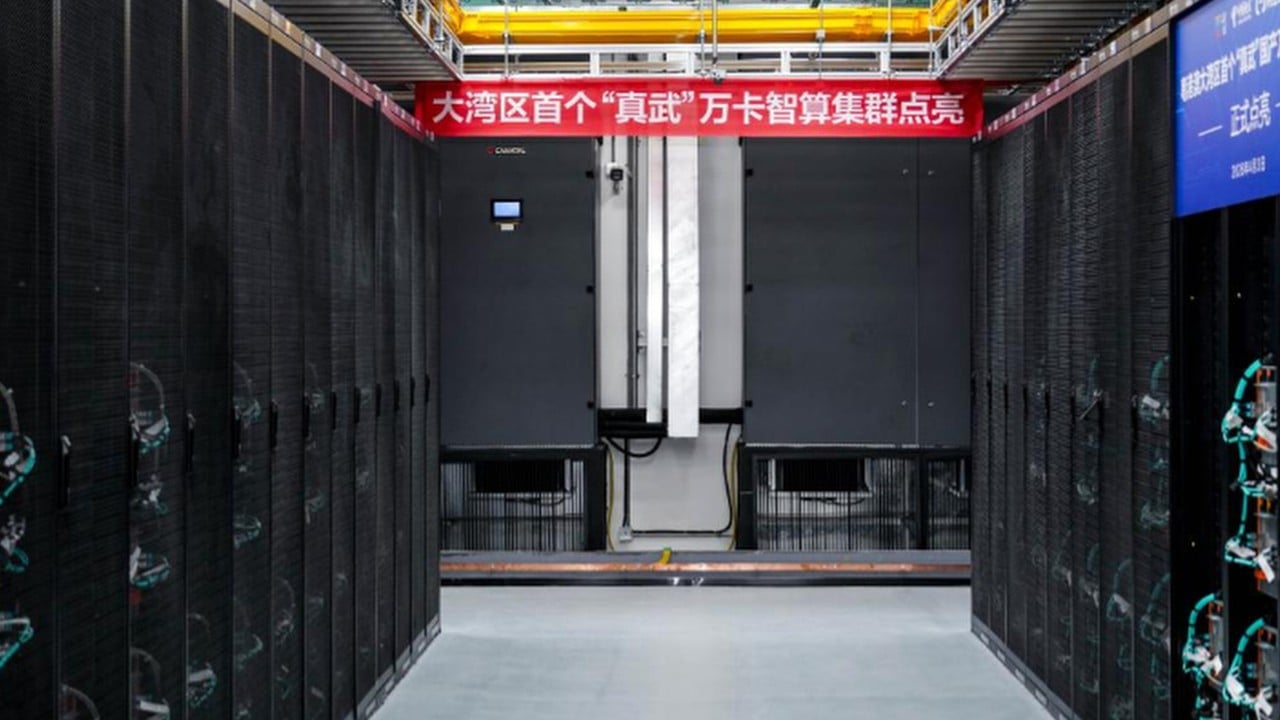
Alibaba Cloud has deployed a massive 10,000-card GPU computing cluster, marking a desperate and technically impressive attempt to maintain Chinese AI competitiveness under the weight of tightening US export controls. This move bypasses the scarcity of high-end Nvidia H100s by stitching together a vast web of lower-tier or domestic silicon into a single, functional powerhouse. By achieving a unified compute fabric of this scale, Alibaba is signaling that it can still train large language models (LLMs) with over a trillion parameters, even if the hardware isn't the gold standard the West enjoys.
The Engineering Behind the Wall
Building a 10,000-card cluster is not a matter of simply plugging in more servers. In the world of high-performance computing, the bottleneck is rarely the raw speed of a single chip. It is the interconnect. When you train a massive model, the data must fly between these thousands of cards at lightning speeds. If the connection lags, the chips sit idle, wasting expensive electricity and time.
Western firms like Meta or Microsoft rely on Nvidia’s proprietary NVLink and InfiniBand technologies to handle this chatter. Alibaba, facing restricted access to the fastest versions of these tools, has had to innovate within the networking layer. They are likely utilizing a combination of their own X-Dragon architecture and specialized Remote Direct Memory Access (RDMA) over converged Ethernet. This allows the cluster to act as one giant "supercomputer" rather than a fragmented collection of nodes.
The engineering feat here is managing the "tail latency." In a 10,000-card environment, if one single card or cable underperforms, it can drag down the efficiency of the entire system. Alibaba’s ability to keep this cluster synchronized suggests they have solved the stability issues that often plague large-scale distributed training on heterogeneous or "nerfed" hardware.
The Reality of Sanctioned Silicon
We need to look at what is actually inside these racks. While the company hasn't shouted the specific model numbers from the rooftops, the math of the current trade climate points toward a mix. We are likely seeing the Nvidia H20, a chip specifically designed to fall just under the US performance caps, or perhaps high-end domestic alternatives like Biren or Huawei’s Ascend 910B.
The H20 is a curious beast. It has high memory bandwidth but crippled compute power compared to the H100. To get H100-level results, Alibaba has to buy more of them, house more of them, and cool more of them. It is a tax on space and power. This 10,000-card cluster is an admission that quantity must now substitute for quality.
This strategy is expensive. It increases the physical footprint of the data center and triples the points of failure. Yet, for a titan like Alibaba, the cost of being left behind in the generative AI race is far higher than the electricity bill for a massive server farm in Zhejiang or Guizhou.
Software as the Great Equalizer
If you can’t get the fastest hardware, you make your software smarter. Alibaba’s PAI (Platform for AI) is the invisible hand making this cluster viable. They have spent years refining "model parallelism" and "pipeline parallelism."
Imagine a massive book that needs to be translated. Instead of one person doing it, you give one page to 10,000 different people. The challenge isn't the translation; it’s making sure everyone uses the same tone and doesn't repeat work. Alibaba’s software stack automates this division of labor. It slices the AI models into tiny fragments and distributes them across the 10,000 cards with surgical precision.
This software layer also handles fault tolerance. In a system this large, hardware components fail every day. Historically, a failure meant restarting the entire training run—a nightmare that could cost weeks of work. Alibaba’s current infrastructure can now "hot-swap" logic, bypassing a dead node and continuing the training without a blink. That is the true moat, not the chips themselves.
The Geopolitical Compute Gap
The United States and its allies are betting that by limiting flops—floating-point operations per second—they can cap the intelligence of Chinese AI. They want to ensure that Chinese models are always one or two generations behind GPT-5 or its successors.
Alibaba is proving that the cap is porous. By scaling horizontally (more chips) rather than vertically (faster chips), they are narrowing the gap. However, this approach hits a wall eventually. There is a physical limit to how many chips you can string together before the communication overhead eats all the gains.
Current industry data suggests that while China is effectively matching the Western "SOTA" (State of the Art) in terms of model parameters, they are doing so at roughly 2.5 to 3 times the capital expenditure. Alibaba is burning cash to stay in the room. This isn't just a tech story; it’s a war of attrition.
Efficiency versus Raw Power
There is a brewing argument that the era of "bigger is better" in AI is nearing its end. If that is true, Alibaba’s massive cluster might be a monument to an old way of thinking. Researchers are finding that smaller, high-quality datasets can produce models that outperform massive, poorly curated ones.
However, for the specific task of foundational model training—the kind that powers Tongyi Qianwen—there is currently no substitute for raw compute. You need the "compute base" to discover the patterns before you can optimize them. Alibaba’s 10,000-card investment is the entry fee for that discovery phase.
The Shadow of Energy Constraints
We cannot ignore the power grid. A cluster of this magnitude consumes as much energy as a small city. In China, where energy security is a top-tier state priority, Alibaba has to balance its AI ambitions with provincial carbon quotas and grid stability.
They are increasingly moving these clusters to western provinces where hydroelectric and wind power are more abundant. This "East-to-West" compute strategy is the only way to sustain 10,000-card arrays without crashing the local industrial grid. It adds another layer of complexity: physical distance. Data now has to travel thousands of miles from the users in Shanghai to the "brains" in the mountains, putting even more pressure on Alibaba’s networking talent.
Why This Matters for the Global Market
When Alibaba offers these 10,000 cards via their cloud platform, they aren't just using them for their own models. They are renting them to startups. This creates an ecosystem where any Chinese developer can access massive compute power without having to navigate the black market for Nvidia chips themselves.
It democratizes sanctioned hardware. It allows a thousand smaller companies to bloom under the umbrella of Alibaba’s engineering. If a startup in Shenzhen has a breakthrough in AI-driven drug discovery or autonomous systems, they will likely have done it on Alibaba’s backbone.
The Interconnect is the New Front Line
The next round of export restrictions will likely move beyond chips and start targeting the networking components that make these clusters possible. If the US restricts high-speed switches and optical transceivers, 10,000 chips will just be 10,000 isolated islands.
Alibaba knows this. They are already heavily invested in domestic photonics and proprietary switching silicon. The 10,000-card cluster is a proof of concept for a self-contained Chinese tech stack. It shows that even if the front door is locked, Alibaba has found a way to rebuild the house from the inside.
Stop looking at the chip count and start looking at the throughput. The real victory for Alibaba isn't that they bought 10,000 cards; it's that they made them talk to each other.