The era of the American blank check for European defense is officially over. If you thought the tension between Washington and Brussels was just pre-election theater, what just happened in Belgium proves otherwise.
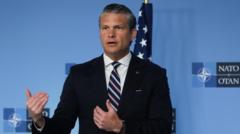
US Defense Secretary Pete Hegseth walked into NATO headquarters in Brussels and delivered what amounts to a structural ultimatum. The Pentagon is launching a sweeping six-month review of its entire military footprint in Europe. It isn't a vague policy assessment. It's an operational audit with teeth, and Hegseth made it clear that some European allies are going to fail it.
For decades, European capitals treated American military protection like a permanent utility bill that someone else was paying. Washington has had enough. The defense secretary bluntly labeled the continent's defense habits as a "one-way street" and called out major economies for clinging to an expired era of free-riding.
The Shockwaves of NATO 3.0
The friction isn't just about money anymore. The real breaking point came during the recent US conflict in Iran, dubbed Operation Epic Fury. Washington expected immediate, lockstep cooperation. Instead, several European nations denied the US military crucial basing and overflight rights, complicating strikes against Iranian targets.
Hegseth didn't hold back, calling the European pushback shameful. He argued that blocking predictable access directly put American service members at risk. If you want the protection of the American nuclear umbrella and 80,000 troops stationed on your soil, you don't shut your airspace when Washington calls.
The newly proposed "NATO 3.0" blueprint strips away the political fluff. The Pentagon wants the 32-nation alliance to pivot away from soft-power initiatives, climate focus, and social engineering, forcing it back to its original identity, a hardline conventional military machine.
The Immediate Impact on the Ground
This isn't a threat about future budgets. The tactical drawdown has already started, and NATO Secretary General Mark Rutte confirmed the cuts are active.
Washington is slashing the military assets it pledges to NATO crisis forces. Reports indicate the US is pulling back a third of the 150 F-16 and F-15 fighter jets previously designated for NATO emergencies. Aerial refueling tankers, reconnaissance planes, strategic bombers, and advanced drones are also being diverted. On top of that, an attack submarine capable of launching cruise missiles and one of America's two regional aircraft carrier strike groups are being removed from the alliance's immediate crisis pool.
The White House faces a stark reality. It can't anchor its finest strategic assets in Europe when the Indo-Pacific region demands constant readiness to deter China. The Pentagon needs to be capable of handling two simultaneous theater conflicts, and it can't do that if it's babysitting nations that refuse to fund their own backyards.
Paying for Performance
The financial pressure is tightening just as fast. The US is tying its direct contributions to NATO's organizational running costs—roughly $790 million—to whether allies hit their spending marks. If a country drags its feet on defense spending, America’s funding drops proportionally.
| NATO Funding Metrics | Current US Policy Reality |
|---|---|
| US Europe Footprint | 80,000 troops currently under review |
| Review Timeline | Six months led by Air Force Gen. Alexus Grynkewich |
| Airpower Reductions | ~50 F-16 and F-15 jets withdrawn from crisis pools |
| NATO Core Budget | US $790M organizational dues now performance-contingent |
While some frontline states have dramatically boosted spending, heavyweights like Germany face massive hurdles. German Defense Minister Boris Pistorius openly warned about dangerous capability gaps, pointing out that Europe lacks deep-strike missiles and advanced electronic warfare tools. Replacing American hardware takes years, not weeks.
The Reality Check for European Security
European capitals need to stop waiting for Washington to change its mind. The shift toward a self-reliant European defense model is an irreversible logistical shift.
Defense ministries across Europe must immediately audit their national inventories and identify exactly how they will replace the specific air-refueling and deep-strike capabilities the US is pulling back. Governments have to prepare their domestic electorates for a massive shift in capital, moving funds away from bloated welfare programs and directly into munitions production, air defense infrastructure, and industrial manufacturing. Relying on American logistical goodwill during a global crisis is no longer a viable security strategy.