A great horned owl surviving a direct impact with a tractor-trailer moving at 65 miles per hour is not a miracle; it is a rare alignment of kinetic energy dissipation, aerodynamic deflection, and anatomical resilience. Standard wildlife reporting treats highway survival events as statistical anomalies or human-interest curiosities, ignoring the underlying mechanics of high-velocity vehicle-wildlife collisions (WVCs). To understand how an apex raptor absorbs or bypasses the forces generated by an 80,000-pound commercial vehicle traveling at 95.3 feet per second, one must deconstruct the collision into three distinct operational phases: pre-impact aerodynamic displacement, structural contact mechanics, and post-impact biological triage.
The Physics of Kinetic Energy Transfer
When a commercial Class 8 tractor-trailer travels at 65 mph, its total kinetic energy exceeds 11 million foot-pounds. In a collision with a 3-to-4-pound bird (Bubo virginianus), the mass differential is roughly 20,000 to 1. Under standard Newtonian mechanics, a direct inelastic collision at this velocity transfers instantaneous, fatal blunt-force trauma to the smaller mass. Survival requires avoiding the primary momentum transfer vector entirely. Recently making headlines recently: Le pasteur aux mains de sang et le fantôme de Port-au-Prince.
Three physical mechanisms govern whether an avian strike results in immediate mortality or survivable entrapment:
- Boundary Layer Deflection: Commercial trucks are aerodynamically blunt objects that push a high-pressure bow wave of air ahead of their front grilles. For low-mass objects, this displaced air acts as a fluid cushion. If an owl enters the outer periphery of this pressure gradient rather than the dead-center stagnation point, the airflow accelerates the bird upward or laterally before physical contact occurs. This reduces the relative velocity differential at the moment of impact.
- Glancing Angle Vectors: Survival depends on a non-perpendicular strike angle. If the owl’s trajectory intersects the truck at an acute angle—such as grazing the upper wind deflector, side mirror assembly, or the beveled edge of a bumper—the force resolves into rotational momentum rather than pure compressive shock. The bird is spun away from the chassis or wedged into a recess rather than crushed against a flat steel plane.
- Structural Crumple and Grille Geometry: Modern tractor-trailers utilize composite plastics, aluminum louvers, and flexible honeycomb grilles designed for airflow management and weight reduction. Unlike rigid steel bumpers of mid-century trucks, these materials deform upon localized impact. When an owl strikes a slatted grille at high speed, the plastic louvers fracture or flex inward, extending the deceleration distance by several inches. Extending the stopping distance by even a fraction of a second drastically reduces peak G-forces applied to the bird's skeletal frame.
Behavioral Vulnerability of Strigiformes on Highway Corridors
Great horned owls exhibit specific hunting and flight behaviors that create high-frequency intersections with interstate freight corridors. Unlike diurnal raptors that soar on thermal updrafts high above roadways, Bubo virginianus is a nocturnal perch-and-pounce predator. Further information into this topic are explored by NBC News.
Highway rights-of-way create artificial edge habitats. Mowed grass medians and drainage ditches attract high densities of small mammals, particularly voles and field mice, which feed on roadside vegetation and spilled grain from agricultural transport. Owls hunt these corridors by gliding low—typically between three and ten feet off the asphalt—to minimize acoustic detection by prey. This flight altitude places the bird directly inside the lethal strike zone of a tractor-trailer’s radiator grille and windshield.
Visual physiology compounds this spatial overlap. Owl eyes are optimized for low-light scotopic vision, packed with rod photoreceptors that maximize light gathering at the expense of rapid light-dark adaptation. When a truck approaches at 65 mph with high-intensity LED or halogen headlights, the sudden influx of lumens temporarily bleaches the owl's retinal photopigments. This induces transient flash blindness. Instead of executing an evasive bank, the disoriented bird frequently freezes, flares its wings to brake mid-air, and presents its maximum surface area to the oncoming vehicle.
Anatomical Resilience and Avian Trauma Mechanics
If the kinetic energy of the strike is reduced via aerodynamic deflection or grille deformation, the owl's specialized anatomy determines whether the remaining blunt force is survivable. Raptors possess structural adaptations built to withstand the high-G impacts of striking prey at speed, which inadvertently provide marginal protection against vehicular trauma.
- Pneumatized Skeletal Architecture: While avian bones are hollow to reduce flight weight, the cortical walls of raptor long bones and the sternum are reinforced with internal struts (trabeculae). The fused thoracic vertebrae (notarium) and the broad, keeled sternum form a rigid cage that shields the heart and lungs from compressive collapse during frontal impacts.
- Feathered Deceleration Buffer: Great horned owls carry dense, soft-edged plumage engineered to silence wingbeats. This thick layer of contour feathers and down acts as a sacrificial energy-absorbing matrix. Upon contact with a truck's grille, the feathers compress and shear, absorbing localized kinetic energy before the underlying epidermis and musculature make contact with hard surfaces.
- Subcutaneous Air Sacs: Birds lack a muscular diaphragm; instead, they utilize a network of thin-walled air sacs extending throughout the body cavity and into major bones. While vulnerable to rupture under extreme pressure, these air-filled cavities provide internal pneumatic cushioning that dampens shockwaves propagating through the torso.
Despite these adaptations, survival at 65 mph almost always involves severe, non-lethal trauma. The most common injuries recorded in highway-strike survivors include coracoid or clavicular fractures (the structural struts connecting the wing to the sternum), severe concussion, retinal detachment or hyphema (blood in the anterior chamber of the eye) caused by rapid deceleration, and soft-tissue lacerations from grille fragments.
Known Facts vs. Operational Hypotheses in Grille-Entrapment Cases
Because highway collisions occur without telemetry or high-speed camera documentation, wildlife rehabilitation teams and transport operators must separate verified physical evidence from biomechanical reconstruction.
Verified Facts:
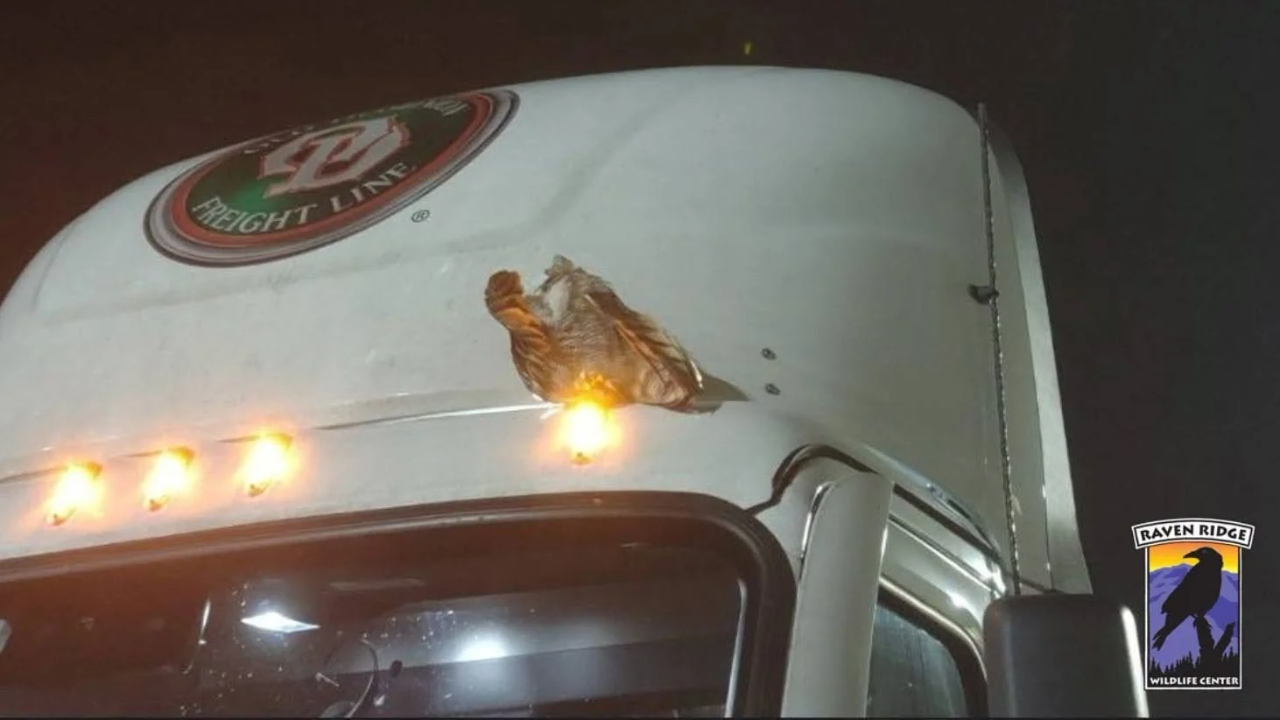
- A collision occurred between a commercial freight vehicle operating at highway speeds (approximately 65 mph in Pennsylvania interstate corridors) and an adult great horned owl.
- The bird became lodged within the front-end assembly of the tractor without passing through the radiator core or striking the spinning mechanical cooling fan.
- The animal remained alive for the duration of the transit segment until discovery during a routine driver inspection, weigh-station stop, or terminal arrival.
Educated Hypotheses:
- Thermal Shielding: Prolonged entrapment behind a truck grille exposes a bird to extreme ambient heat radiating from the engine block and cooling system. Survival indicates the bird was wedged in a peripheral cold-air intake zone or an outer fairing pocket isolated from direct exhaust manifold heat, preventing fatal hyperthermia.
- Shock-Induced Immobilization: A bird trapped in a moving vehicle's grille experiences continuous high-decibel acoustic stress and vibration. The absence of fatal self-inflicted struggle wounds suggests the owl entered a state of tonic immobility or acute concussive stupor immediately post-impact, conserving oxygen and preventing catastrophic hemorrhage from fractured bones until extraction.
- Secondary Impact Avoidance: The truck did not encounter heavy precipitation, freezing temperatures, or subsequent road debris during the remainder of the route, any of which would have killed an exposed, immobilized animal pinned to the front fascia.
Rehabilitation Triage and Recovery Protocols
Extracting a live raptor from a commercial vehicle requires strict adherence to wildlife handling and veterinary triage protocols. First responders—typically state troopers, commercial drivers, or municipal animal control officers—face immediate physical hazards. Even a concussed great horned owl retains the involuntary reflex to clamp its talons, which exert crushing pressures exceeding 300 pounds per square inch.
The operational extraction and stabilization sequence follows four mandatory stages:
- Mechanical Isolation: The vehicle engine must be shut down completely to eliminate radiator fan engagement and reduce thermal output. Responders cover the bird’s head with a heavy towel or canvas bag to eliminate visual stimuli, immediately lowering its heart rate and suppressing defensive talon strikes.
- Structural Disassembly: Rather than pulling the bird backward through fractured plastic louvers—which causes severe feather stripping and compound fractures—technicians unscrew or cut away the surrounding grille segments to extract the animal along the path of least resistance.
- Shock and Fluid Resuscitation: Upon arrival at a licensed wildlife rehabilitation facility, the owl is not immediately placed under anesthesia for X-rays. Birds in acute post-traumatic shock succumb easily to anesthetic respiratory depression. Veterinarians first administer warmed subcutaneous or intraosseous isotonic fluids, analgesics (such as meloxicam or butorphanol), and place the patient in a dark, temperature-controlled oxygen chamber for 12 to 24 hours.
- Orthopedic and Ophthalmic Assessment: Once cardiovascular stability is achieved, radiographs evaluate the pectoral girdle (coracoid, scapula, furcula) and long bones. Crucially, ophthalmologists examine the posterior segment of both eyes. A great horned owl with unilateral blindness cannot hunt effectively in the wild; if retinal damage is irreversible, the bird is deemed non-releasable regardless of how well its skeletal fractures heal.
Limitations of Wildlife Mitigation on Freight Corridors
While high-profile survival cases generate public interest, they mask a systemic ecological failure along North American highway networks. Commercial transport corridors remain a primary driver of localized raptor mortality, and current mitigation strategies exhibit severe operational limitations.
Acoustic deterrents mounted on commercial vehicles—such as ultrasonic "deer whistles"—have repeatedly failed independent empirical testing. High-frequency sound waves attenuate rapidly in open air and are entirely masked by the low-frequency engine roar and tire noise of a 65 mph tractor-trailer. Furthermore, owl auditory systems are tuned to low-frequency rustling sounds (2 to 7 kHz) produced by small rodents, rendering ultrasonic emitters functionally invisible to them.
Roadside habitat modification offers higher efficacy but faces budgetary and jurisdictional bottlenecks. Replacing palatable roadside grasses with unpalatable groundcover reduces prey density, thereby removing the foraging incentive for nocturnal raptors. However, state departments of transportation manage tens of thousands of linear highway miles, making large-scale vegetative conversion capital-prohibitive. Similarly, installing high-visibility flight diverters or elevated perch poles along median strips attempts to force birds to fly above the 14-foot clearance envelope of commercial trucks, yet owls consistently ignore artificial perches when live prey is detected directly on the road shoulder.
Strategic Action for Fleet Operators and Conservation Agencies
Preventing high-speed avian strikes and improving survival outcomes when collisions occur requires shifting from passive public awareness to targeted operational interventions across logistics networks and state wildlife agencies.
Commercial fleet managers and state transportation departments should execute three direct measures:
- Integrate Pre-Trip and Post-Trip Wildlife Inspection Protocols: Mandate that commercial drivers inspect front grilles, bumper recesses, and wind fairings during mandatory Department of Transportation (DOT) rest breaks and weigh-station stops, particularly during peak nocturnal migration and winter foraging months (November through March). Early extraction reduces thermal mortality and secondary trauma from prolonged highway exposure.
- Deploy Modular, Tool-Free Grille Access on Heavy Trucks: Original Equipment Manufacturers (OEMs) designing aerodynamic front-end assemblies for Class 8 tractors should incorporate quick-release fasteners on lower intake louvers. This allows law enforcement and wildlife responders to remove trapped animals in under two minutes without specialized extraction tools or destructive prying.
- Target Roadside Mowing Schedules to Disrupt Prey Cycles: State transportation agencies must synchronize median mowing with seasonal rodent population peaks rather than aesthetic schedules, keeping roadside vegetation below four inches along known riparian and forested highway crossings. Eliminating cover forces small mammals away from the asphalt edge, removing the primary foraging trigger that brings great horned owls into the lethal path of 65 mph freight traffic.