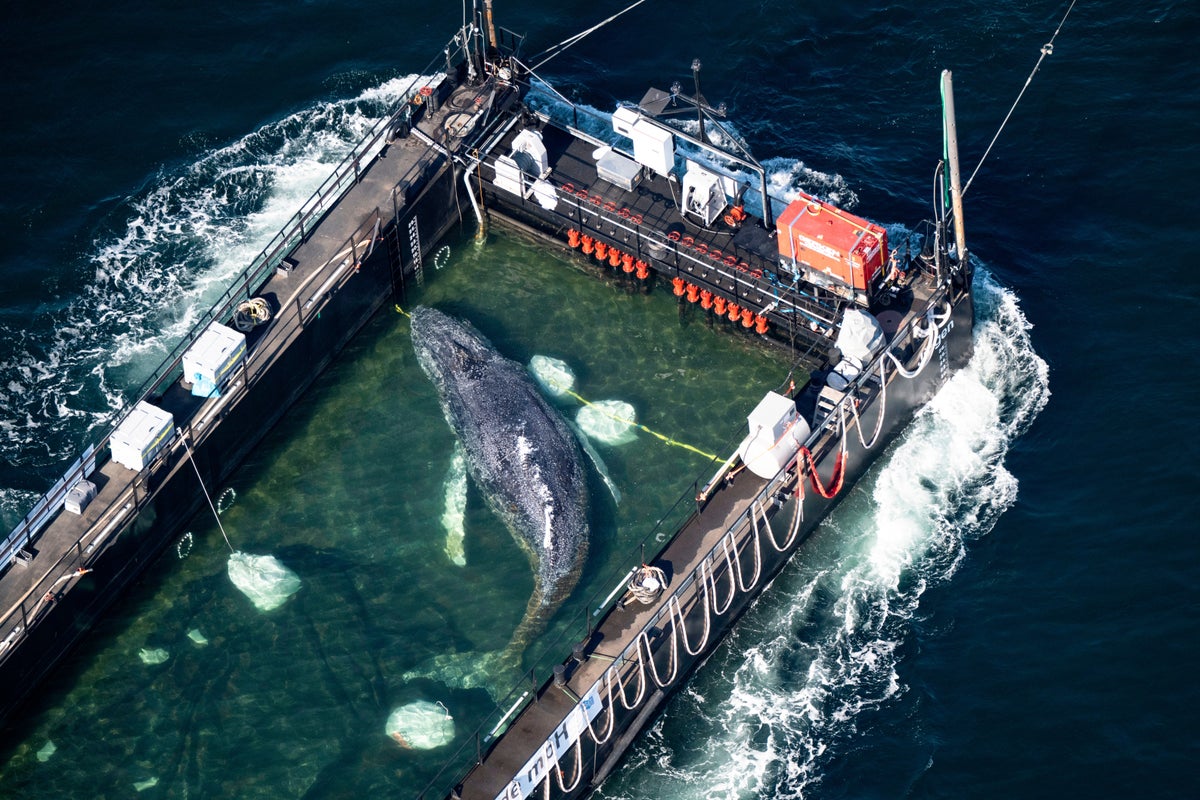
The death of the humpback whale nicknamed Timmy highlights a systemic misalignment between public sentiment and veterinary science. On May 2, 2026, a high-cost, logistically complex operation transported the 12-metric-ton marine mammal via a flooded cargo barge from the shallow waters of the Baltic Sea to a release point 70 kilometers off the coast of Skagen, Denmark. Telemetry data from a transmitter affixed to the dorsal fin revealed that the animal survived for approximately five days, swimming 215 kilometers in a direction counterproductive to reaching its natural Atlantic habitat before succumbing to physiological failure. The outcome was entirely predictable under established marine mammal stranding frameworks.
The failure of the intervention stems from an institutional vulnerability: when public spectacle dictates veterinary triage, the resulting strategy prioritizes optical resolution over biological viability. Analyzing the lifecycle of this intervention reveals the precise mechanisms that converted well-intentioned capital into an acute acceleration of animal mortality.
The Tri-Particle Stress Loop of Cetacean Stranding
The public narrative framed the shallow waters of the Baltic Sea as a temporary physical trap. Mechanistically, a live stranding event is an active systemic failure. For a subadult or adult humpback whale (Megaptera novaeangliae), entering the Baltic Sea sets off a cascading biological degradation governed by three compounding stressors.
+---------------------------------------------------------+
|                  Low-Salinity Osmotic Stress            |
|  - Epithelial barrier breakdown                         |
|  - Dermal blistering & opportunistic bacterial entry    |
+---------------------------------------------------------+
                            |
                            v
+---------------------------------------------------------+
|                Mechanical Gravitational Compression    |
|  - 12-ton mass crushes vascular pathways                 |
|  - Skeletal muscle ischemia & myoglobin accumulation    |
+---------------------------------------------------------+
                            |
                            v
+---------------------------------------------------------+
|               Pathological Renal & Pulmonary Load        |
|  - Excretory overload (Acute Kidney Injury)             |
|  - Compromised alveolar ventilation                     |
+---------------------------------------------------------+
1. Osmotic Disruption
Humpback whales require high-salinity marine environments to maintain epithelial integrity. The Baltic Sea possesses a highly pronounced halocline, with surface salinities dropping below 10 parts per thousand (ppt) in northern and eastern sectors, compared to the 35 ppt standard of the Atlantic Ocean. Prolonged exposure to this low-salinity environment compromises the cetacean epidermal barrier. This osmotic imbalance manifested directly as the extensive, blister-like dermal lesions observed across the whale's skin.
2. Gravitational Compression and Myoglobin Toxicity
In a pelagic environment, neutral buoyancy distributes an animal's mass evenly across its surface area. When a 12-ton cetacean grounds on a sandbank, gravity forces the entire mass onto the ventral thorax and abdomen.
This creates immediate mechanical compression of internal organs and underlying vascular networks. Ischemia—the restriction of blood supply to tissues—rapidly develops in peripheral skeletal muscles. When blood flow is temporarily restored during refloating attempts, necrotic muscle tissue releases massive quantities of myoglobin into the bloodstream. This process, known as rhabdomyolysis, introduces a severe pathological load to the kidneys, frequently resulting in acute kidney injury (AKI) and systemic metabolic acidosis.
3. Ventilatory Insufficiency
Unlike terrestrial mammals with rigid thoracic cages, cetacean respiration depends on the external hydrostatic pressure of water to assist in lung deflation and expansion. Under gravitational collapse on land or in shallow mud flats, the weight of the chest wall restricts alveolar ventilation. The animal cannot clear carbon dioxide efficiently, inducing hypercapnia and diminishing cardiac output.
By the time the barge rescue commenced on May 2, the animal had cycled through multiple stranding and refloating episodes over a two-month period. Each cycle caused irreversible, cumulative damage to its internal organs.
The Economics of Sentiment: Capital Allocation Breakdown
The intervention was not driven by a data-validated ecological mandate but by an escalating feedback loop of public attention and private capital. The operational architecture was funded primarily by private German donors and driven by intense regional political pressure.
Analyzing the allocation of resources reveals a stark imbalance between emotional utility and biological return on investment:
- Dermal Symptom Management: Local emergency services deployed personnel and equipment around the clock to hydrate the exposed skin of the animal using fire hoses. They applied tons of zinc ointment to the osmotic lesions. This targeted an external symptom rather than the underlying internal systemic collapse.
- Logistical Infrastructure: The final transport mechanism required engineering a custom, water-filled cargo barge to function as a mobile aquatic transport tank. The financial expenditure required to commission, alter, and staff this vessel ran into hundreds of thousands of euros.
- Security and Crowdsourcing Inefficiencies: Public attention necessitated the enforcement of a 500-meter maritime exclusion zone by local police to mitigate behavioral distress caused by onlookers. This included intercepting individuals attempting unauthorized physical contact with the animal.
The fundamental flaw in this capital deployment model is the omission of an objective exit criteria. In standard veterinary triage, resources are gated by a prognosis matrix:
$$\text{Viability Score} = f(\text{Duration of Stranding}, , \text{Frequency of Re-stranding}, , \text{Epidermal Integrity}, , \text{Respiratory Rate})$$
The animal presented a critically low viability score across all parameters. The decision to proceed with the barge transport ignored these inputs, opting instead to exhaust capital on a low-probability extraction.
The Transport Variable: Acceleration of Mortality
The transport phase was publicly celebrated as a logistics triumph, yet it acted as the definitive catalyst for the animal's death. Transporting a compromised marine mammal introduces acute capture myopathy—a hyper-metabolic state triggered by extreme stress, overexertion, and fear.
During the transport aboard the barge, the animal was subjected to unnatural acoustic and vibrational profiles generated by the vessel's propulsion systems. For an animal reliant on echolocation and acoustic environmental mapping, confinement within a metal cargo hull induces severe neurological stress. This stress triggers a massive release of catecholamines and cortisol.
The surge in these hormones elevates heart rate and blood pressure well beyond normal physiological limits, damaging cardiac muscle fibers and accelerating systemic shock.
[Acoustic & Vibrational Stress] ---> [Catecholamine/Cortisol Surge]
                                              |
                                              v
[Systemic Shock & Metabolic Failure] <--- [Extreme Tachycardia]
The telemetry data gathered post-release confirms this state of physiological shock. Upon liberation near Skagen, the animal did not exhibit standard pelagic diving or foraging behavior. Instead, it engaged in a continuous, 215-kilometer flight response.
The fact that it swam back toward the Baltic Sea indicates severe spatial disorientation. The animal exhausted its remaining metabolic reserves during this five-day journey, leading to complete cardiac or respiratory collapse.
The Post-Mortem Reality and Necropsy Limitations
The Danish post-mortem examination noted an absence of external traumatic injuries, vessel strike fractures, or foreign body ingestions. In the absence of gross physical trauma, public commentary frequently defaults to assuming a lack of structural harm. This is a analytical error.
A cetacean necropsy following a prolonged stranding must look past superficial tissue layers to evaluate microscopic pathology. The lack of visible lacerations does not contradict the presence of lethal internal conditions:
- Microscopic Renal Blockage: While the kidneys may appear intact during gross examination, microscopic analysis typically reveals widespread tubular necrosis caused by myoglobin casts blocking renal filtration units.
- Adrenal Exhaustion: Chronic elevation of stress hormones leaves the adrenal glands depleted, destroying the animal's ability to maintain homeostatic blood pressure and electrolyte balances.
- Histopathological Tissue Damage: Microscopic tears in cardiac and skeletal muscle fibers confirm the presence of capture myopathy, which cannot be identified by macro-level visual inspections alone.
The subsequent processing of the carcass—converting the soft tissue into biodiesel and preserving the skeletal remains for museum display—stands as a stark material metric of the intervention's outcome. The operation did not save an apex predator; it delayed the inevitable degradation of biological material at a massive financial premium.
Strategic Recommendations for Future Stranding Events
To prevent future public-driven failures in marine wildlife management, environmental ministries and stranding networks must implement a strictly structured framework that insulates scientific execution from media influence.
Establish Binding Biological Thresholds
Intervention protocols must dictate that if a large cetacean experiences more than two distinct stranding events within a 14-day window, or remains in a low-salinity environment for over 30 days, the operational mandate automatically shifts from rescue to palliative care or humane euthanasia.
Insulate Triage Decisions from Private Funding
While private capital can offset state infrastructure costs, the availability of funding must never alter veterinary assessment protocols. Independent scientific panels, insulated from political appointments and public scrutiny, must retain absolute veto power over any proposed translocation architecture.
Shift Public Communications to Ecosystem Metrics
State environmental agencies must redirect public interest away from individual charismatic megafauna and toward broader habitat health parameters. Resources spent on single-animal extractions yield zero net benefit to wider marine conservation efforts. True ecological stewardship requires investing those resources into enforcing habitat protections, mitigating commercial entanglement risks, and reducing industrial ocean noise.


