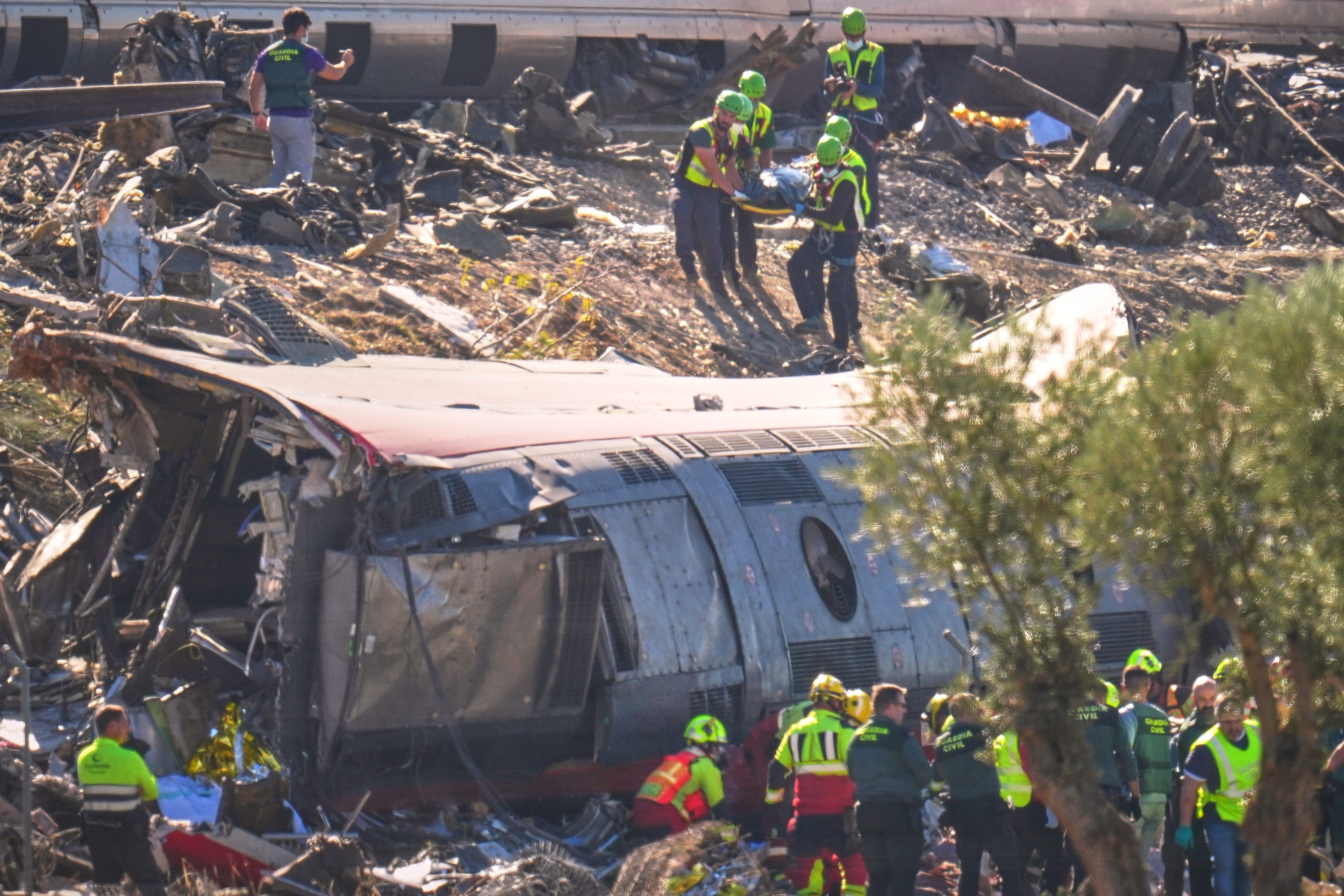
Two high-speed trains collided in central Spain, leaving 64 people dead and 80 others injured in one of the deadliest rail disasters in modern European history. While initial dispatches focus on the immediate emergency response and casualty counts, the core failure points directly to the intersection of extreme velocity, signaling architecture, and human-machine handoffs on Spain's high-speed rail network.
High-speed rail is engineered to make collisions mathematically impossible. When two trains occupy the same block of track at speeds exceeding 250 kilometers per hour, the resulting kinetic energy turns steel carriages into crumpled scrap in milliseconds. The tragedy in central Spain was not a random act of nature or a simple mechanical fluke. It was a systemic breakdown of multiple redundant safety layers designed specifically to keep fast-moving steel apart.
The Physics of a High-Speed Impact
To understand why the casualty count reached 64 dead and 80 injured so rapidly, you have to look at the math of momentum. A standard high-speed trainset weighs roughly 400 metric tons. Moving at 300 kilometers per hour, that mass carries over 1.3 gigajoules of kinetic energy.
Braking distances tell the rest of the story. Unlike a freight truck or a commuter car, steel wheels on steel rails generate minimal friction. Under full emergency braking, a high-speed train traveling at top speed requires between three and four kilometers to come to a complete stop. Sightlines mean nothing. By the time a driver sees an obstruction on the tracks ahead, the crash has already happened in slow motion.
Crashworthiness standards in Europe have evolved dramatically over the past thirty years. Modern trainsets are built with crumple zones at the cab ends and anti-climbing buffers designed to prevent carriages from telescoping into one another. Telescoping—where one carriage rides up and shears through the passenger cabin of the next—is historically the primary killer in rail wrecks. Yet even the most advanced energy-absorption structures have hard physical limits. When two trains meet head-on, or when a full-speed express strikes a stationary or slower-moving train at a switch, the structural tolerances of the passenger compartments are overwhelmed instantly.
How European Rail Signaling Is Supposed to Work
Modern high-speed lines across Spain do not rely on drivers looking out the window at colored trackside lights. At 300 kilometers per hour, human reaction time is far too slow to process visual signals and initiate braking. Instead, the network relies on continuous cab signaling, primarily the European Rail Traffic Management System (ERTMS) and Spain's legacy ASFA (Anuncio de Señales y Frenado Automático) system.
In a properly functioning ERTMS environment, the track is divided into virtual or physical blocks. Balises—electronic transponders mounted between the rails—communicate constantly with onboard computers, feeding the train its exact movement authority. The onboard computer calculates a continuous braking curve. If the train exceeds the safe speed required to stop before the end of its authorized block, the system overrides the human operator and triggers the emergency brakes automatically.
For two trains to collide on a central Spanish corridor, one of three catastrophic breakdowns must occur:
- A signaling logic failure or corrupted trackside data that granted overlapping movement authorities to two separate trains simultaneously.
- An operational transition error, which frequently happens when a train moves from a high-speed ERTMS corridor onto a conventional or mixed-traffic track section governed by older signaling protocols, or during degraded-mode operations when maintenance work forces trains onto a single shared track.
- Manual override protocols, where human dispatchers and drivers bypass automated protections due to a perceived sensor fault, substituting verbal authorization for electronic certainty.
Industry veterans know that the most dangerous moment on any railway is not routine high-speed operation. It is the transition to degraded mode. When a track circuit fails, a switch freezes, or maintenance crews take a line out of service, dispatchers step in to keep traffic moving. Under intense pressure to prevent cascading delays across the national network, human operators issue written or radio orders permitting drivers to pass red signals at restricted speeds. Once automated enforcement is switched off, the entire safety margin rests on radio clarity and human memory.
Spain's Complex Rail Infrastructure Reality
Spain boasts the longest high-speed rail network in Europe and the second longest in the world, trailing only China. Managed by the state infrastructure operator Adif, the network spans thousands of kilometers radiating outward from Madrid into the central plateau and beyond.
That rapid expansion created a patchwork of technical standards. While the flagship corridors utilize Level 1 and Level 2 ERTMS, dozens of secondary connectors, bypasses, and transitional junctions still rely on older versions of ASFA. Unlike continuous ERTMS supervision, older iterations of ASFA operate on intermittent point-to-point communication. A train receives an update when it passes over a beacon, and until it reaches the next beacon, the onboard system assumes the track conditions remain unchanged.
The liberalization of Spain's passenger rail market has also transformed track utilization. Over the last few years, state operator Renfe has been joined on major corridors by private competitors like Iryo and Ouigo. Competition drove ticket prices down and passenger volumes to record highs. More trains now run closer together, leaving narrower recovery windows when minor technical glitches occur.
High density is safe when every sensor, axle counter, and radio link functions as designed. When an axle counter misreads a passing train and falsely reports a block as clear, or when a dispatcher misidentifies a train's location on a centralized traffic control screen during a busy afternoon rush, high track utilization compresses the time available to catch the mistake.
The Ghost of Angrois and Unlearned Lessons
Anyone covering Spanish rail safety recognizes the bitter familiarity of this disaster. In July 2013, an Alvia high-speed train derailed on a sharp curve near Santiago de Compostela in Galicia, killing 80 people and injuring more than 140.
The investigation into the 2013 Angrois crash exposed a glaring vulnerability in Spain's network design. The train had been running on a modern high-speed line protected by ERTMS, which was programmed to slow the train automatically before the sharp curve. However, just kilometers before the bend, the line transitioned to a conventional track section covered only by the older ASFA system. Worse, the onboard ERTMS unit had been switched off because of compatibility glitches between the train's computer and the trackside equipment. When the driver became distracted by an internal phone call from the conductor, there was no automated braking curve to catch the error. The train entered an 80-kilometer-per-hour curve at nearly 180 kilometers per hour.
Following that tragedy, regulators promised exhaustive risk assessments at every single transition zone and junction across central Spain and the wider peninsula. Billions of euros were earmarked for upgrading legacy track sections and eliminating single-point human failures.
Yet structural vulnerabilities persist wherever older infrastructure meets modern rolling stock. Transition zones remain choke points of cognitive load for train drivers. In a matter of seconds, an operator must acknowledge shifting speed limits, confirm signaling mode changes on cab displays, and verify radio channels with regional control centers.
What Investigators Look For First
In the immediate aftermath of a collision killing 64 people, forensic rail investigators secure four primary sources of truth before heavy cranes clear the wreckage.
- The Event Recorders. Commonly referred to as black boxes, every high-speed locomotive carries crash-hardened memory modules. These units record speed, throttle position, brake pipe pressure, horn activation, and every electronic telegram received from trackside balises down to the millisecond.
- Centralized Traffic Control (CTC) Logs. Every command entered by dispatchers in the regional control center is time-stamped and archived. Investigators replay the exact schematic screens the dispatchers saw prior to impact to see whether the system displayed a phantom clear track or an active conflict warning.
- GSM-R Voice Recordings. High-speed trains communicate with control centers over a dedicated railway mobile network called GSM-R. Every conversation between drivers, conductors, and signallers is recorded. If a verbal authorization was given to bypass a signal or enter an occupied block, it will be preserved on those audio files.
- Switch Point and Axle Counter Diagnostics. Mechanical switches at track junctions contain internal locking sensors that report whether the rails are physically aligned and locked for a specific route. Axle counters at the entry and exit of each track block tally the exact number of wheels passing through. If a switch failed to throw completely or an axle counter reset prematurely, the physical hardware at the crash site will bear the evidence.
The Immediate Aftermath and Triage Reality
Emergency response in central Spain faces unique geographical hurdles. Outside the major metropolitan hubs of Madrid, Toledo, Valladolid, and Zaragoza, the central plateau—the Meseta—consists of vast stretches of open agricultural land with limited road access.
When 144 passengers and crew members are suddenly dead or injured miles from the nearest highway interchange, emergency triage becomes a logistical battle against the clock. Firefighters and paramedics must haul hydraulic cutting gear across ballast rock and drainage ditches while stabilized triage zones are established in adjacent fields.
Of the 80 injured survivors, rail trauma patterns typically divide into two distinct groups. Passengers in the middle and rear carriages suffer blunt-force fractures, spinal compressions, and lacerations from flying luggage and dislodged seats during rapid deceleration. Those trapped in the forward carriages face crush injuries and severe internal trauma requiring immediate surgical intervention once extracted from twisted aluminum and steel.
The Myth of Infallible Automation
The rail industry frequently markets high-speed networks as immune to human error. That confidence is misplaced. Automation does not eliminate human fallibility; it shifts it from the driver's cab to the software engineer, the maintenance technician, and the traffic controller.
A hypothetical scenario illustrates how easily redundant systems collapse. Imagine a trackside axle counter suffers a voltage drop during a storm, locking a ten-kilometer section of track in a false "occupied" state on the dispatcher's screen. To clear the backlog of delayed expresses, the controller follows standard contingency rules and issues a manual authorization for the next train to proceed through the block at restricted speed. Meanwhile, a second train—perhaps a maintenance vehicle or a diverted express—is routed onto the same corridor due to a misread track diagram in the control room. Because the automated safety envelope was manually bypassed to clear the initial sensor fault, neither train's onboard computer intervenes until the metal meets.
Every major rail crash in modern history follows a similar chain of minor, seemingly manageable anomalies that align at the worst possible moment.
Families in central Spain are now mourning 64 lives lost on a transport system built to represent the pinnacle of European engineering. Restoring public trust will require far more than condolences from transport ministries or routine pledges of internal reviews. Investigators must publish the raw telemetry, the control room audio, and the exact maintenance logs of the signaling hardware without political filtering, because until every manual bypass and transitional blind spot on the network is permanently engineered out of existence, the next catastrophe is merely waiting for another routine sensor fault to trigger it.


