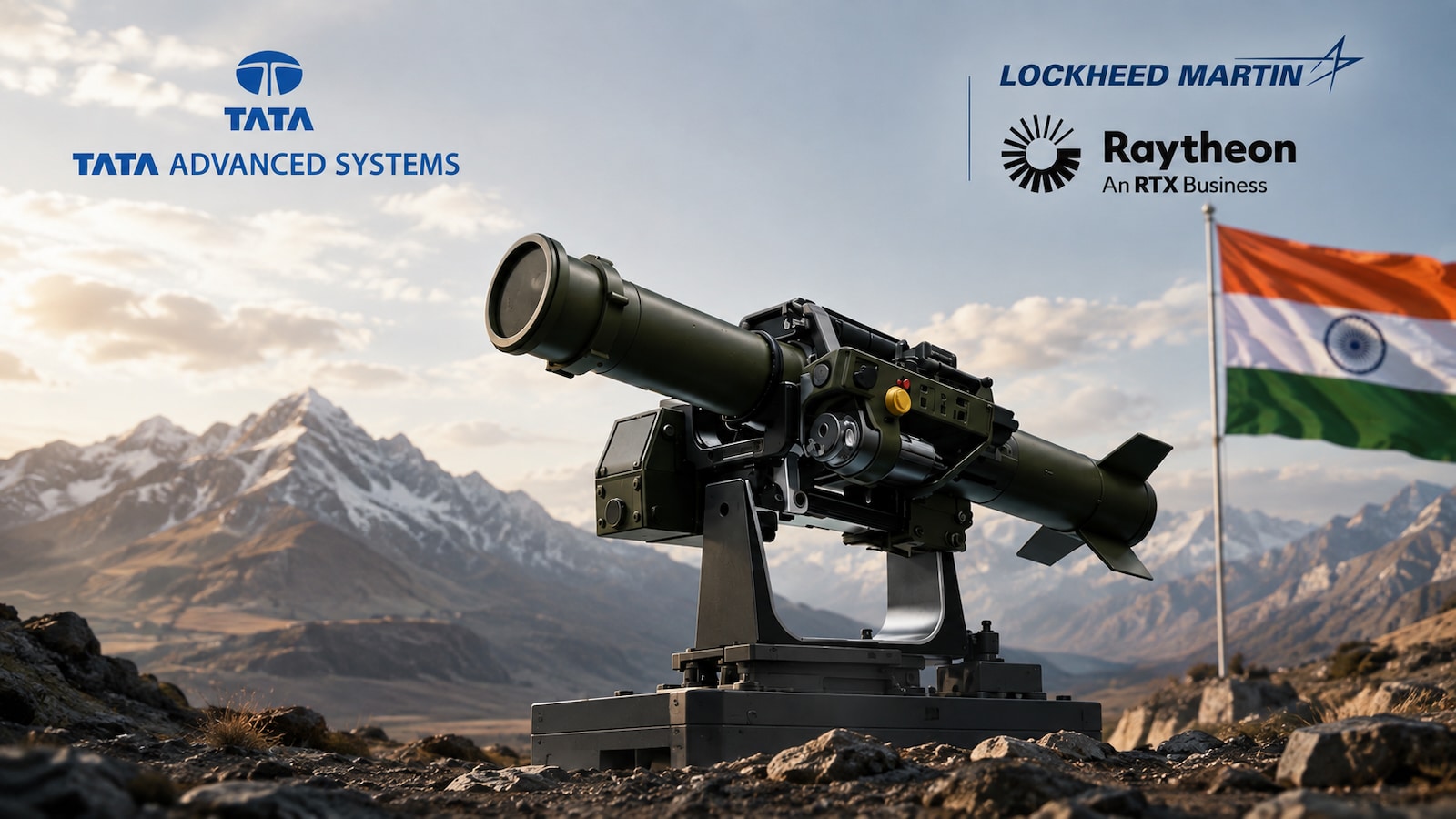
The recent Memorandum of Understanding between Tata Advanced Systems Limited and the Javelin Joint Venture—a corporate partnership between Lockheed Martin and Raytheon—to co-produce the FGM-148 Javelin anti-tank missile system in India represents a structural shift in cross-border defense procurement. Rather than executing a standard Foreign Military Sales transaction or a direct commercial sale of finished All Up Rounds, the agreement establishes an industrial framework designed to split production labor across continents. Understanding the viability and long-term consequences of this arrangement requires moving past corporate press releases to examine the underlying cost functions, supply chain bottlenecks, and technology transfer mechanics governing modern tactical missile manufacturing.
The Three Pillars of the Transnational Defense Model
The industrial architecture of this co-production agreement rests on three distinct operational tiers: sub-assembly manufacturing in the United States, component creation for guidance systems, and final assembly and integration within domestic Indian facilities managed by Tata. If you enjoyed this article, you might want to look at: this related article.
[Lockheed Martin: Troy, AL] ----\
                                 v
[Raytheon: Tucson, AZ] ---------> [Tata Advanced Systems: India] ---> [All Up Round Delivery]
                                 ^
[Domestic Indian Suppliers] ----/
This geographic distribution is not accidental; it maps directly to the core competencies and regulatory constraints of the participating firms.
The first pillar involves the heavy structural and mechanical sub-assembly kits, produced primarily at Lockheed Martin's facility in Troy, Alabama. These components require specialized tooling for composite materials, propulsion housing structures, and mechanical launch mechanisms. By keeping this volume in the United States, the joint venture maintains baseline manufacturing velocity and protects foundational intellectual property. For another look on this story, check out the recent coverage from MarketWatch.
The second pillar centers on the guidance electronics units, engineered and fabricated at Raytheon's facility in Tucson, Arizona. Guidance sections represent the highest-margin and most sensitive technological choke point of the weapon system. Retaining the fabrication of infrared seekers and onboard microprocessors within domestic American factories addresses ITAR compliance and technological security protocols while allowing the parent firms to capture high-value value-add segments.
The third pillar is the establishment of a dedicated final assembly and integration facility by Tata Advanced Systems on Indian soil. Final assembly requires rigorous quality control, environmental testing, and safety compliance, but it is fundamentally less capital-intensive than primary electronics fabrication. For Tata, this tier provides the operational entry point to absorb complex integration methodologies without requiring immediate domestic invention of basic seeker physics.
The Cost Function and Economic Order Quantities
A critical economic driver behind this multi-continent manufacturing split is the pursuit of economic order quantities. Defense manufacturing is characterized by high fixed capital costs offset by low marginal costs once production lines scale. When manufacturing lines operate below capacity, unit costs spike due to the inefficient amortization of overhead.
By integrating Indian final assembly demand into the broader global production schedule, the Javelin Joint Venture increases total component volume flowing through the Alabama and Arizona facilities. This volume expansion allows prime contractors to negotiate better pricing tiers with raw material suppliers, spreading fixed plant overhead across a larger denominator.
However, this cost-reduction mechanism introduces counter-balancing logistical friction. Shipping sensitive guidance electronics and sub-assembly kits across global supply chains incurs transit insurance, regulatory oversight costs, and vulnerability to maritime chokepoint disruptions. The economic efficiency gained through scale must outweigh the transaction costs of international logistics. If the domestic Indian assembly facility operates at low intermittent rates to satisfy modest localized procurement targets, the expected unit cost savings from economic order quantities will degrade rapidly.
Technology Transfer and Industrial Capability Realities
Proponents often frame such agreements as unalloyed technology transfers that instantly elevate a developing nation's defense industrial base. A rigorous examination of the operational parameters reveals a more measured reality.
Technology transfer operates on a spectrum ranging from basic operator training to licensed production, co-development, and fundamental intellectual property creation. The Tata-Javelin agreement is anchored firmly in licensed final assembly and integration, supplemented by localized component production over time. It does not grant Tata the intellectual property rights to modify the internal seeker algorithms, alter the tandem shaped-charge warhead chemistry, or redesign the propulsion chemistry.
Instead, the knowledge transfer focuses on process engineering, quality assurance protocols, factory floor layout optimization, and workforce certification. For the Indian defense ecosystem, this creates tangible value in manufacturing discipline. Precision missile assembly demands zero-defect tolerances where a microscopic particulate contamination in a rocket motor or guidance harness results in complete mission failure. Mastering these quality control feedback loops elevates the tier-one and tier-two domestic supply chains, making them more attractive partners for future global aerospace contracts.
Supply Chain Resiliency Versus Geopolitical Vulnerability
The stated intent of distributing production lines across the United States and India is supply chain resilience. Traditional single-nation defense manufacturing lines are vulnerable to domestic labor strikes, facility accidents, or localized energy crunches. By dual-sourcing or dispersing final assembly capabilities closer to regional end-users, the industrial base theoretically insulates itself against localized shocks.
Yet, this architecture creates a coupled dependency. The Indian facility cannot function without uninterrupted component inputs from Troy and Tucson. Simultaneously, the U.S. parent facilities rely on the overseas plant to absorb scheduled production output that sustains multi-year manufacturing contracts.
If geopolitical friction disrupts maritime transit corridors in the Indo-Pacific or Middle East, the cross-continental supply chain risks severe inventory starvation. True supply chain resilience would require complete redundancy—the ability for either node to manufacture the entire system independently. Because the current agreement partitions the manufacturing process strictly by component sensitivity, it remains a coordinated assembly network rather than an autonomous redundant ecosystem.
Strategic Execution for the Prime Contractor
To ensure operational success without margin erosion, Tata Advanced Systems must avoid the common trap of treating the facility as a symbolic badge of technological capability rather than a high-throughput industrial asset. Management should prioritize immediate workforce certification programs aligned with American aerospace standards, establish rigorous statistical process control metrics on the factory floor from day one, and secure long-term framework agreements with secondary domestic suppliers to insulate against import bottlenecks for non-sensitive structural materials.