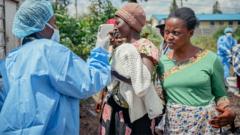
Epidemiological containment in high-conflict zones fails not from a lack of medical efficacy, but from a systemic breakdown in operational logistics, community trust, and security infrastructure. While public health announcements frequently label escalating Ebola outbreaks as "alarming," a rigorous structural analysis reveals that transmission acceleration is a predictable function of specific, compounding bottlenecks. Controlling an outbreak under these conditions requires shifting from reactive medical deployment to a synchronized strategy that treats community dynamics and logistics security as core components of the medical intervention.
Effective containment relies on a fragile operational equilibrium: the rate of contact tracing and isolation must consistently exceed the virus's reproduction number ($R_0$) within a highly mobile population. When security threats or deep-seated community mistrust disrupt this equilibrium, the containment window closes exponentially. To reverse this trajectory, international interventions must pivot from treating Ebola purely as a biological crisis to managing it as a complex operational vulnerability problem.
The Triad of Operational Disruption
The acceleration of an Ebola outbreak in the eastern Democratic Republic of Congo is driven by three interconnected structural vectors: localized security deficits, community resistance mechanisms, and logistical friction in high-density, fluid environments.
Security Deficits and Transmission Blinds
Active conflict zones generate systemic data gaps. When violent non-state actors operating in provinces like North Kivu and Ituri launch attacks, international and local health workers face immediate mobility constraints. This creates a cascade of containment failures:
- Surveillance Suspension: Contact tracing requires a continuous 21-day monitoring cycle for every exposed individual. A single day of suspended operations due to security threats breaks the chain of custody, allowing potentially infected individuals to move undetected.
- Decentralized Vectors: Security threats force civilians to flee, accelerating population displacement. This movement transforms localized outbreaks into regional transmission networks, pushing the virus across porous borders into neighboring countries like Uganda.
Community Resistance and Alternative Health Systems
Public health interventions often collapse when top-down medical protocols collide with local socio-political realities. Community resistance is not a irrational behavioral quirk; it is a predictable response to historical marginalization and sudden external enforcement.
The imposition of militarized or highly clinical containment measures—such as forced isolations and non-traditional burial practices—often alienates the population. When communities view international medical teams with suspicion, they shift from formal healthcare facilities to informal, traditional healers. This creates an epidemiological blind spot. Informal clinics lack the personal protective equipment (PPE) and bio-containment protocols needed for highly infectious pathogens, transforming these alternative care spaces into super-spreading hubs.
Logistical Friction and the Cold Chain Bottleneck
The deployment of advanced biomedical tools, such as the Ervebo (rVSV-ZEBOV) vaccine, introduces severe logistical dependencies. The vaccine requires an uninterrupted ultra-cold chain, maintaining temperatures between $-60^\circ\text{C}$ and $-80^\circ\text{C}$.
In regions with deficient electrical grids, poor road infrastructure, and tropical climates, maintaining this cold chain demands immense operational energy. Every point of transit—from central storage hubs to remote rural clinics—presents a potential point of failure. When the cold chain fails, vaccine efficacy degrades rapidly, wasting scarce resources and eroding community trust when vaccinated individuals subsequently contract the virus.
The Transmission Cost Function
The math behind an escalating outbreak can be understood through a modified transmission cost function, where the effective reproduction number ($R_e$) is determined by biological virulence ($\beta$), contact rates within the population ($c$), the duration of infectiousness ($\tau$), and an operational discount factor ($\omega$) representing systemic failures:
$$R_e = \beta \cdot c \cdot \tau \cdot \omega$$
When $\omega > 1$, operational inefficiencies amplify the biological potential of the virus. In the eastern Democratic Republic of Congo, $\omega$ is driven heavily by the delay between symptom onset and isolation.
The Time-to-Isolation Bottleneck
| Phase of Delay | Root Operational Cause | Epidemiological Impact |
|---|---|---|
| Symptom Onset to Presentation | Community mistrust; fear of stigmatization or forced isolation in treatment centers. | Continued community transmission; high exposure among family caregivers. |
| Presentation to Diagnostic Confirmation | Lack of localized RT-PCR testing capacity; sample transit delays across insecure terrain. | Diagnostic ambiguity; prospective patients remain in general triage areas, risking cross-contamination. |
| Confirmation to Bio-Containment Isolation | Deficient transport infrastructure; lack of dedicated, secure bio-secure ambulances. | Prolonged exposure windows for transport personnel and community members. |
Reducing this cumulative delay is the single most critical variable in lowering $R_e$. If the time from symptom onset to isolation exceeds 48 hours, the probability of secondary community transmission loops increases by over 70%.
Structural Flaws in the Traditional Response Architecture
The persistent resurgence of Ebola in Central Africa exposes deep architectural flaws in how global health bodies and international charities structure their interventions. The dominant model relies on a surge capacity framework—flooding an area with foreign experts and temporary treatment centers once an outbreak crosses an arbitrary threshold of severity.
This model is fundamentally unsustainable. The sudden influx of high-budget international organizations creates a dual-track economic reality, distorting local labor markets and undermining existing public health structures. Local doctors and nurses are frequently integrated into international non-governmental organizations (INGOs) for temporary premiums, hollowed out the state’s foundational healthcare delivery system.
Furthermore, the centralized design of standard Ebola Treatment Centers (ETCs) acts as a geographic barrier. Expecting highly symptomatic, fearful patients to travel long distances through insecure territory to enter a high-security, plastic-walled isolation unit demonstrates a profound misalignment with local risk calculations.
Strategic Reconfiguration of Epidemic Interventions
To transition from a state of permanent crisis management to definitive outbreak suppression, international actors and sovereign health ministries must execute three structural shifts.
Decentralization via Bio-Secure Units
The centralized ETC model must be replaced by a highly distributed network of small-scale, localized isolation capabilities. Deploying modular, easily transportable bio-secure emergency care units—such as the CUBE (Biosecure Emergency Care Unit for Outbreaks)—allows medical teams to deliver high-standard intensive care directly within existing community health centers.
This approach minimizes the need for high-risk patient transport, keeps patients closer to their support networks, and strengthens local clinical infrastructure rather than bypassing it.
Localized Co-Design and Neutral Humanitarian Space
Securing access to conflict-restricted areas requires decoupling medical interventions from state military apparatuses or highly politicized security escorts. Humanitarian actors must leverage strict neutrality to negotiate health corridors with local community leaders and armed factions alike, ensuring access based purely on medical necessity.
Concurrently, containment protocols must be co-designed with local authorities. Traditional burial practices, a major driver of amplification due to post-mortem viral shedding, cannot simply be banned by decree. They must be adapted into "safe and dignified burials" where family members participate via structured, low-risk protocols, balancing epidemiological safety with cultural necessity.
Proactive Surveillance and Ring Vaccination Optimization
Instead of reactive ring vaccination—which attempts to vaccinate contacts and contacts-of-contacts after a case is confirmed—interventions in endemic regions must maintain a baseline tier of geographic prophylaxis. Frontline healthcare workers, local transport operators, and traditional healers in high-risk corridors should be pre-vaccinated during inter-epidemic periods.
This creates an immediate immunological firewall, dampening the initial transmission velocity when a spillover event occurs and buying critical operational time for logistics teams to scale up targeted ring vaccination protocols.
The Geopolitical Risk Horizon
The long-term management of Ebola in Central Africa depends on stabilizing the cross-border health security matrix. The high mobility of traders, miners, and displaced populations across the frontiers of the Democratic Republic of Congo, Uganda, Rwanda, and South Sudan means that a localized containment failure anywhere poses an immediate regional health threat.
Future stability requires a unified regional health surveillance framework, featuring real-time genomic sequencing data sharing and synchronized cross-border contact tracing protocols. Until regional health systems achieve this level of operational integration, the containment of highly infectious pathogens in volatile territories will remain dangerously fragile, vulnerable to sudden, systemic collapses sparked by localized security failures.