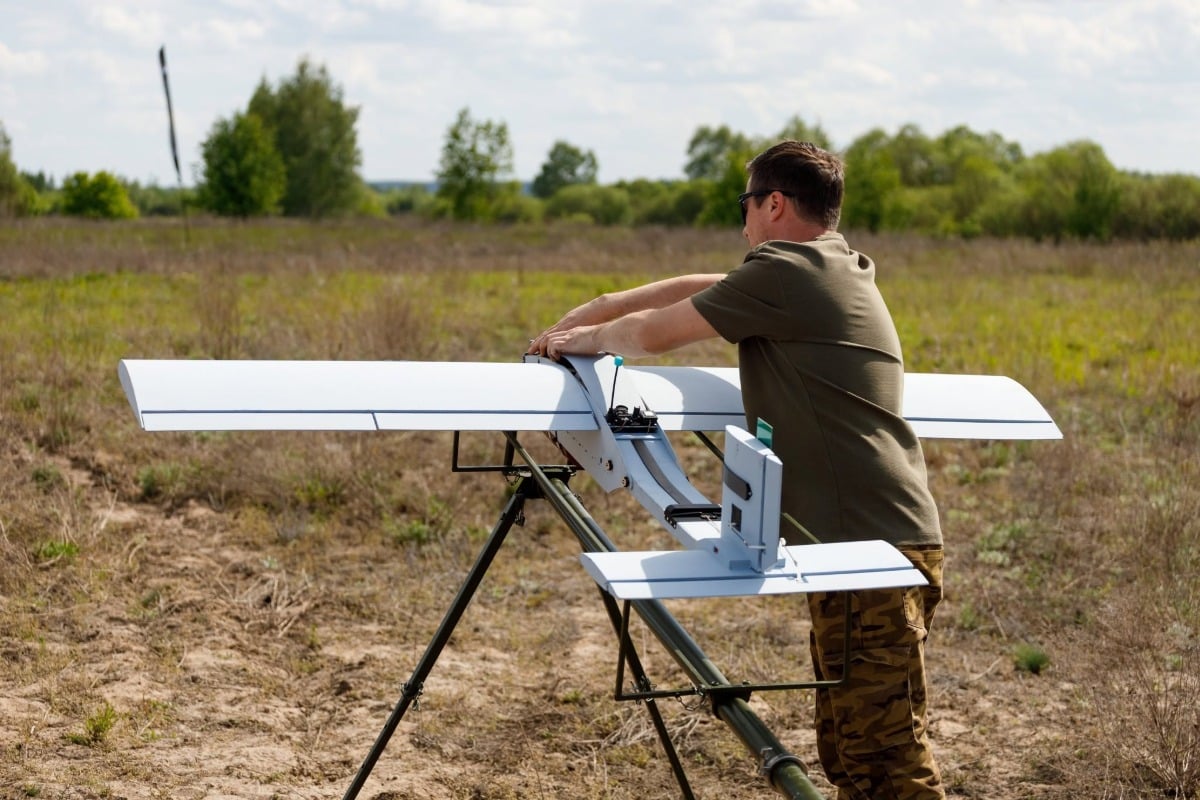
The newly minted EU-Ukraine Defense Industrial Partnership, signed during Ukraine's Statehood Day in Kyiv, represents a profound shift from donor-recipient military aid to structured industrial co-dependence. Historically, Western support functioned via a direct consumption loop: donor countries transferred stockpiled armaments or financed acquisitions, which Ukraine subsequently expended on the battlefield. This model has reached its structural limits.
To survive a war of attrition that has entered its fifth year, Ukraine and the European Union are attempting to integrate their defense-industrial bases. This strategy aims to resolve two structural bottlenecks: Europe’s stagnant defense manufacturing capacity and Ukraine’s vulnerability to Russian strikes targeting its domestic assembly lines. However, translating political intent into physical industrial output requires resolving severe operational misalignments.
The Co-Dependency Matrix: Asymmetric Value Exchange
The partnership is built on an asymmetric but highly complementary exchange of strategic assets.
+-----------------------------------+     +-----------------------------------+
|          EUROPEAN UNION           |     |              UKRAINE              |
+-----------------------------------+     +-----------------------------------+
| - Capital and Financing           |     | - Real-time Battle Testing        |
| - IP and Advanced Electronics     | --> | - Low-cost Manufacturing Base     |
| - Safe Manufacturing Territories  |     | - Rapid iteration cycles (drones) |
+-----------------------------------+     +-----------------------------------+
                                    \     /
                                     v   v
                      +---------------------------------+
                      | JOINT WEAPONS PRODUCTION BUFFER |
                      +---------------------------------+
1. Ukraine’s Contribution: Tactical Iteration and Battle-Testing
Ukraine possesses what no Western defense contractor has: an active, high-tempo laboratory for real-time electronic warfare (EW) and counter-EW iterations. The development cycles for Ukrainian unmanned aerial vehicles (UAVs) and first-person view (FPV) drones are measured in weeks, not years. Ukraine’s domestic defense sector has evolved from a seeker of foreign hardware into an exporter of high-value, battle-proven operational methodology.
2. The EU's Contribution: Capital, Components, and Strategic Depth
While Ukraine excels at rapid tactical iteration, it lacks the industrial depth to scale heavy defense manufacturing. The EU provides:
- Capital Security: Financial frameworks that insulate production from immediate fiscal shocks.
- Component Access: Specialized inputs, such as advanced microcontrollers, high-precision optical sensors, and solid-propellant chemical precursors, which Ukraine cannot produce domestically.
- Geographic Sanctuary: Manufacturing facilities located outside the range of Russian long-range precision strikes, ensuring uninterrupted assembly lines.
The Three Pillars of the Integrated Production Strategy
The signed letter of intent prioritizes three distinct technology vectors, each subject to its own operational timelines, industrial bottlenecks, and scaling constraints.
                     [INDUSTRIAL INTEGRATION]
                                |
       +------------------------+------------------------+
       |                        |                        |
   Pillar 1:                Pillar 2:                Pillar 3:
Tactical Attrition      Strategic Defense        Systemic Air Defense
 (Drones/Counter)      (Patriot Licensing)    (Anti-Ballistic Missiles)
 [Timeline: <1 Year]    [Timeline: <1 Year]      [Timeline: by 2028]
Pillar 1: Unmanned Systems and Electronic Countermeasures (Target: End of Year)
This is the lowest-hanging fruit. The objective is to scale joint drone and anti-drone systems rapidly. Because these platforms rely primarily on commercially available off-the-shelf (COTS) electronics and 3D-printed or carbon-fiber airframes, the capital expenditures (CapEx) required to establish assembly lines are low. The primary constraint is supply-chain reliability for components like brushless motors, speed controllers, and specialized radio transceivers capable of hopping frequencies to evade Russian EW.
Pillar 2: Licensed Patriot Assembly (Target: Technical Capability by End of Year)
A critical development is the U.S. licensing agreement allowing Ukraine to assemble its own Patriot air defense systems. While political leadership projects localized assembly capabilities in the near term, defense manufacturing experts recognize this as a highly ambitious timeline.
The Patriot system is a complex assembly of radar sets, engagement control stations, and launching stations. Achieving domestic assembly requires a rapid transfer of technical data packages (TDPs), precision tooling, and highly specialized labor training. The initial phase will likely involve semi-knocked-down (SKD) assembly, where pre-manufactured sub-assemblies are shipped to secure Western Ukrainian locations for final integration and testing.
Pillar 3: Anti-Ballistic Missile Systems (Target: 2028)
This is the long-term, high-technology pillar. Producing anti-ballistic missile interceptors is one of the most demanding undertakings in aerospace engineering. The development of solid-fuel rocket motors, radar homing seekers, and guidance computers requires deep integration between Ukrainian aerospace bureaus (such as Pivdenne) and European defense majors (like MBDA). The 2028 target reflects the reality of certifying military-grade hardware, securing long-term component supply contracts, and building specialized test ranges.
The Cost and Risk Function of Distributed Defense Manufacturing
Establishing joint production lines in an active theater of war introduces unique structural risks that do not exist in conventional defense joint ventures.
1. The Physical Vulnerability Constraint
Every manufacturing facility on Ukrainian soil is a potential target for Russian cruise and ballistic missile strikes. This risk dictates a highly decentralized, underground, or highly mobile production model. Instead of large, centralized gigafactories, production must be fragmented into dozens of micro-facilities. While this approach mitigates the impact of single-point-of-failure strikes, it drastically increases logistics overhead and complicates quality control.
2. The Intellectual Property and Technology Transfer Bottleneck
European defense firms operate under strict export control regimes (such as ITAR in the U.S. and national security export controls in EU member states). Sharing proprietary source code for radar processing, missile guidance laws, or advanced material compositions requires navigating complex legal frameworks. This bureaucratic process can delay implementation even when political willpower is high.
3. The Energy Grid Dependency
Russia's targeting of Ukraine's energy infrastructure during the colder months directly impacts manufacturing. Heavy machining, precision chemistry, and semiconductor assembly require highly stable, uninterrupted power. The joint partnership must address this physical dependency by deploying dedicated, off-grid micro-generation units (such as industrial battery storage systems and localized natural gas turbines) at every key assembly node.
Strategic Recommendation: The Decentralized Co-Production Playbook
To transform political agreements into a sustainable industrial shield, the EU-Ukraine partnership must bypass conventional procurement bureaucracy and execute a three-part operational strategy.
- Implement the Danish Model for Direct Procurement: Rather than waiting for European factories to produce weapons to donate, the EU must directly fund Ukrainian defense firms to manufacture weapons domestically. This approach capitalizes on Ukraine's significantly lower labor and overhead costs while injecting vital capital directly into the local economy.
- Establish "Borderland" Assembly Corridors: High-value, complex systems (such as Patriot interceptors or advanced cruise missiles) should follow a split-production model. Initial component fabrication and heavy manufacturing should occur in secure facilities in Eastern Poland, Slovakia, or Romania. Final assembly, software integration, and combat calibration should happen in mobile or underground facilities just inside the Ukrainian border. This minimizes transport time while leveraging the physical security of NATO territory for the most capital-intensive parts of the supply chain.
- Standardize on Open-Architecture Interfaces: To speed up joint drone and anti-drone development, the partnership should mandate open-architecture standards. This prevents proprietary locks by individual defense contractors, allowing any Ukrainian software innovation (such as computer-vision terminal guidance) to be instantly flashed onto hardware chassis manufactured anywhere in the EU.