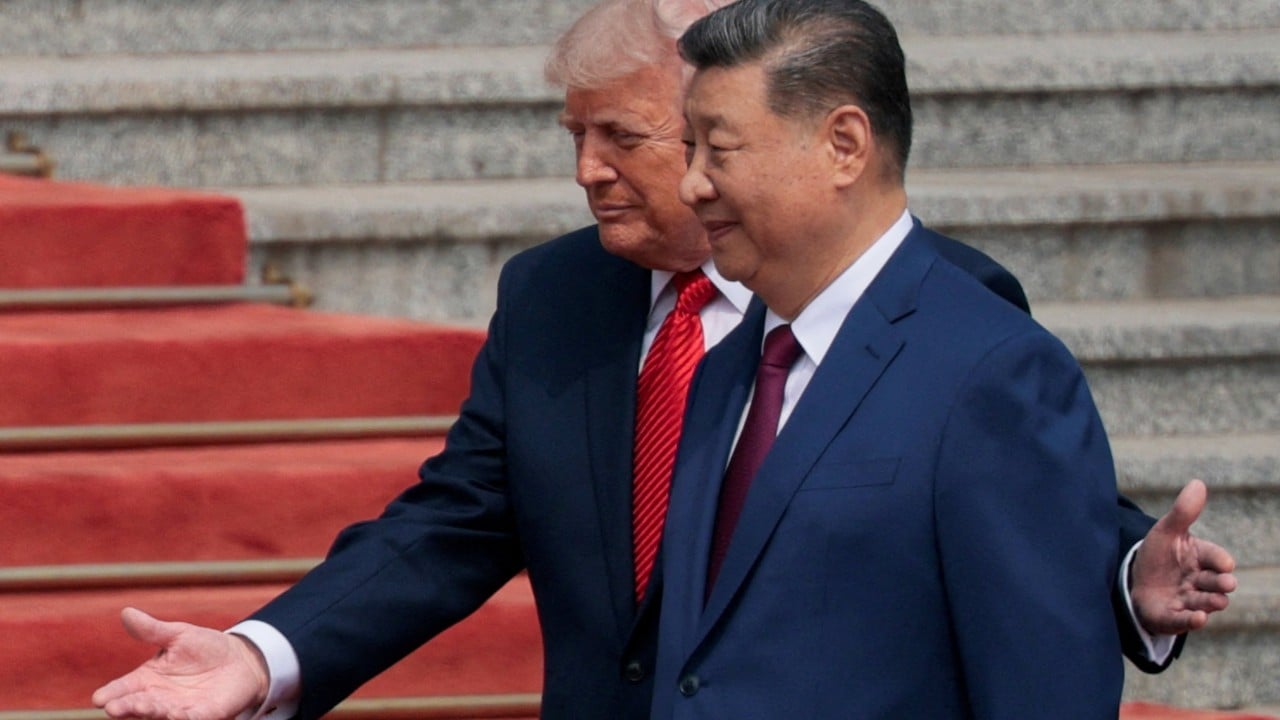
The divergent reactions of North American conservatives to Donald Trump’s bilateral summitry in Beijing compared to Canadian Prime Minister Mark Carney’s trade mission reveal a structural misunderstanding of modern trade economics. While political commentators routinely attribute this double standard to partisan bias, a rigorous assessment of the two events reveals distinct economic realities, asymmetric sovereign risks, and structural variances in trade dependency.
To evaluate why Trump’s unilateral trade maneuvers face minimal resistance from the right while Carney’s diversification strategy draws sharp condemnation, the interactions must be parsed through two core analytical frameworks: the Asymmetric Exposure Function and the Sovereign Enforcement Premium.
The Asymmetric Exposure Function
The primary driver of the divergent political assessments lies in the structural composition of the U.S. and Canadian export portfolios. The critique leveled by domestic conservatives against Carney—most notably articulated by Conservative Party Leader Pierre Poilievre and Ontario Premier Doug Ford—focuses on systemic vulnerability rather than the act of diplomacy itself.
Canada’s economy operates under high trade concentration risk. Approximately 70 to 76 percent of all Canadian exports are bound for a single market: the United States. When the Carney administration pursues a policy framework explicitly titled "reliance to resilience" with the stated goal of doubling non-U.S. trade by 2035, the mathematical reality of this rebalancing requires a rapid pivot toward alternative large-scale consumer markets, primarily China.
The structural risk profile of this substitution is defined by the following variables:
- The Dilution Coefficient: Canada’s economic output relies heavily on natural resources (agricultural products like canola, metals, and energy) and integrated manufacturing (automotive components within the Canada-United States-Mexico Agreement, or CUSMA). Diverting these supply chains away from a contiguous neighbor to a distant, non-market economy introduces structural friction, higher logistics costs, and intense supply chain vulnerabilities.
- The Strategic Foothold Penalty: As seen in the January trade package negotiated in Beijing, Canada agreed to a tariff-quota arrangement allowing up to 49,000 Chinese electric vehicles (EVs) into the domestic market. Conservative critics isolate this specific concession as an existential threat to the highly integrated North American automotive corridor. Permitting Chinese industrial capacity to bypass traditional trade barriers—even under strict volume caps representing roughly 3 percent of domestic auto sales—undermines the unified continental tariff front established under CUSMA.
- The Retaliatory Cost Vector: Historically, Canada’s diplomatic maneuvers with Beijing have carried severe asymmetric economic penalties. The structural memory of the 2018 Huawei executive detention and the subsequent agricultural blocks imposed by China demonstrates that middle powers face deep non-market coercion when negotiating bilaterally with economic superpowers.
By contrast, the United States operates from a position of systemic trade dominance. The U.S. economy does not face trade concentration risk; it is the consumer market of last resort for the global economy. When a U.S. administration engages in bilateral negotiations with Beijing, it is executing an exercise in market access extraction rather than trade diversification born of vulnerability.
The Sovereign Enforcement Premium
The second structural differentiator is the capacity to enforce trade terms, which dictates how conservative factions perceive the sovereignty costs of foreign agreements. Trump’s trade strategy uses unilateral economic coercion—the "Donroe Doctrine"—predicated on the enforcement power of the U.S. domestic market.
When the U.S. executive branch negotiates in Beijing, conservative factions back the initiative because the operational thesis assumes the U.S. maintains the leverage to dictate terms, impose snap-back tariffs, or deploy secondary sanctions to penalize non-compliance. The strategic objective is the managed containment of a systemic rival from a position of relative legislative and economic strength.
Carney’s diplomatic architecture, conversely, operates under the constraints of a middle-power framework. Because Canada lacks the unilateral enforcement mechanisms of a global reserve currency or an expansive apparatus of secondary sanctions, any "strategic partnership" forged with Beijing is structurally dependent on the good faith of the counterparty.
Conservative skepticism isolates this enforcement deficit. Critics argue that a middle-power state, driven by the urgency of a trade dispute with an unpredictable Washington administration, is highly susceptible to predatory terms. In this context, concessions on tech integration, critical minerals, or green energy supply chains carry an unhedged sovereign risk profile that the United States simply does not share.
The CUSMA Renewal Bottleneck
The domestic political backlash to Carney’s China policy is further accelerated by the timeline for the mandatory review of CUSMA. Trade agreements are not static legal texts; they are dynamic regulatory frameworks subject to political re-litigation.
[Canadian Pivot to China] ──> [Tariff-Quota Openings (e.g., 49k Chinese EVs)]
                                          │
                                          ▼
                         [CUSMA Rules-of-Origin Breached]
                                          │
                                          ▼
                      [U.S. Triggers Section 32.1 Non-Market Clause]
                                          │
                                          ▼
                     [Loss of Preferential U.S. Market Access]
The introduction of Chinese industrial goods into Canada creates an immediate friction point for Washington trade negotiators, regardless of partisan affiliation. U.S. Trade Representative Jamieson Greer and Transportation Secretary Sean Duffy both highlighted that the entry of Chinese EVs into North America directly conflicts with Washington's protectionist industrial strategy.
The core mechanism of vulnerability for Canada is Article 32.1 of CUSMA, often referred to as the non-market economy clause. This provision allows any signatory to terminate the agreement and replace it with a bilateral deal if another member enters into a free trade agreement with a non-market country like China.
While Carney’s January arrangement was framed as a limited sectoral tariff-quota deal rather than a comprehensive free trade agreement, it tests the definition of economic integration tolerated by Washington. Conservative critics observe that the potential downside of triggering a U.S. regulatory retaliation during a crucial treaty renewal cycle far outweighs the marginal economic upside of expanding agricultural or EV trade with Beijing.
The Strategic Miscalculation of Divergent Signaling
The final component of this analytical breakdown is the execution of the diplomatic signaling itself. The Trump administration’s engagement with China is explicitly transactional, protectionist, and decoupled from institutionalism. It does not validate Beijing’s preferred geopolitical architecture.
In sharp contrast, Carney’s rhetorical framing during his Beijing visit presented an optimization vulnerability. By stating that Canada must adapt to "new global realities" and position itself for a "divided and fragmented" world order, the Canadian administration adopted terms that align with Beijing’s long-term objective of eroding the U.S.-led international financial and security architecture.
For North American conservatives, this rhetorical alignment is an unnecessary geopolitical concession. It signals a shift away from continental solidarity at a moment when Washington is enforcing strict hemispheric alignment. While Trump himself remarked that it was a "good thing" for Canada to pursue trade opportunities, the broader U.S. national security apparatus views any integration between a G7 partner and Chinese industrial supply chains as a structural vulnerability in the Western defense perimeter.
The policy recommendation for middle powers navigating this friction requires abandoning broad, aspirational strategic partnerships in favor of narrow, defensive economic hedging. Trying to balance a deeply integrated continental relationship with a parallel pivot to a non-market superpower creates a structural instability that modern trade frameworks are explicitly designed to penalize.