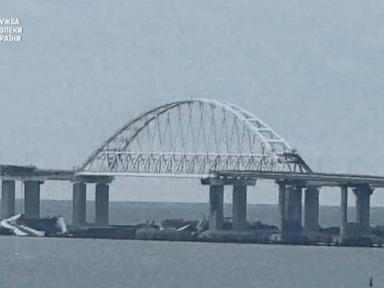
Military infrastructure attacks rarely achieve decisive outcomes through kinetic destruction alone; their primary value lies in forcing an adversary to reallocate scarce air defense assets and absorb compounding logistical friction. When Ukrainian leadership characterizes a strike on the Crimean Bridge as unprecedented, standard news coverage treats the statement as a measure of physical damage or political theater. That framing misses the operational reality. The Kerch Strait crossing functions as the primary arterial bottleneck for the southern theater of operations, and any degradation of its throughput alters the mathematics of force sustainment across the entire occupied peninsula.
The Structural Vulnerability of Single-Point Arteries
In military logistics, network resilience depends on redundancy. When an operational theater relies on a single high-capacity corridor, that corridor ceases to be mere infrastructure and becomes a strategic center of gravity. The Kerch Strait Bridge—spanning approximately 19 kilometers across the Kerch Strait—combines parallel road and rail decks into a singular point of failure connecting the Russian mainland in Krasnodar Krai to the Kerch Peninsula in Crimea.
From a systems engineering perspective, the vulnerability of this structure stems from three intersecting design realities:
- Load-Bearing Concentration: Heavy military equipment, armored vehicles, and bulk ammunition cannot move efficiently over long distances via wheeled transport without incurring massive fuel and maintenance penalties. Rail transport provides orders-of-magnitude higher efficiency per ton-kilometer. Disrupting the rail span forces a shift to road haulage or maritime ferry operations, immediately slashing daily tonnage capacity.
- Environmental Exposure: Long-span marine bridges sit exposed to multi-domain threats across a wide arc. Defending a 19-kilometer linear target requires continuous overlapping coverage against aerial drones, cruise missiles, ballistic trajectories, and uncrewed surface vessels. Unlike a hardened bunker or a dispersed depot, a bridge cannot be concealed, moved, or easily armored against high-explosive warheads detonating near critical support piers or expansion joints.
- Repair Complexity: Marine pilings driven deep into unstable seabed sediment require specialized heavy lift vessels and calm sea states to repair. Even when a strike fails to collapse a span into the water, thermal damage from burning fuel or structural warping from blast overpressure degrades the load-bearing rating of steel girders and prestressed concrete, forcing speed restrictions and weight limits that throttle throughput just as effectively as a physical gap.
Standard reporting focuses on whether the bridge is open or closed. Operational analysts measure tonnage velocity—the net volume of materiel moving from rear depots to forward firing positions per 24-hour cycle. A bridge operating at 40 percent structural capacity due to single-lane restrictions or axle-weight limits creates a cascading backlog at railheads hundreds of kilometers away.
Deconstructing the Unprecedented Metric
When Ukrainian President Volodymyr Zelenskyy describes a strike as unprecedented, the term demands strict analytical boundaries rather than emotional interpretation. In the context of previous operations against the Kerch crossing—specifically the October 2022 truck bombing and the July 2023 naval drone attack—an unprecedented strike indicates a shift in one or more operational variables: delivery vector, warhead saturation, target precision, or defensive penetration.
To evaluate the claim without relying on unverified battlefield damage assessments, we separate confirmed mechanics from educated hypotheses.
Confirmed Mechanics:
- Multi-Vector Saturation: Modern integrated air defense systems (IADS) operate on engagement channels. Every radar and launcher unit can track and engage a finite number of targets simultaneously. Overcoming a layered defense network—comprising long-range surface-to-air missiles, medium-range point defense, electronic warfare jammers, and physical boom barriers—requires saturating those channels across different altitude and speed profiles.
- Sub-Surface and Surface Geometry: Bridge piers represent the most structurally vital components of any marine viaduct. Unlike the road deck, which can be bridged temporarily with modular steel trusses, a compromised pier compromises two adjacent spans simultaneously. Targeting the waterline or the pile cap requires precision guidance capable of operating in GPS-denied environments, relying instead on inertial navigation paired with terminal optical or infrared scene matching.
Educated Hypotheses:
- Integrated Strike Packages: An operation earning the label of unprecedented likely combined decoy profiles with primary strike munitions, forcing local air defense batteries to expend interceptor missiles on low-cost targets seconds before high-value warheads entered the terminal engagement zone.
- Sub-Surface Delivery: Given the deployment of extensive floating barrier systems around the bridge pilings following the 2023 surface drone strikes, bypassing perimeter defenses suggests either an underwater delivery mechanism or a coordinated aerial strike designed specifically to breach the surface barriers moments before marine drones arrived.
What separates a tactical nuisance from a strategic blow is not the size of the explosion captured on surveillance cameras, but whether the strike forces a permanent change in the defender's force posture.
The Cost Function of Theater Sustainment
To understand why Ukraine allocates scarce precision-guided munitions to a heavily defended structure rather than directly targeting frontline infantry positions, one must examine the cost function of logistics. Every artillery shell, liter of diesel, and replacement barrel consumed on the southern front must travel through a finite set of supply lines.
Prior to the construction of the Kerch Bridge, supplying Crimea required either maritime transport through Black Sea ports or transit through mainland Ukraine. Since 2022, Russian forces have relied on two primary corridors to sustain their southern grouping: the Kerch Strait Bridge and the overland corridor running along the Sea of Azov coast through Mariupol, Berdyansk, and Melitopol.
When the Kerch Bridge suffers degradation, the entire logistical burden shifts onto the Azov coastal route. This creates an immediate operational dilemma for Russian planners:
- Distance to Contact Line: The Kerch Bridge sits roughly 250 kilometers from the nearest Ukrainian-held territory, placing it outside the range of standard tube artillery and conventional rocket systems. By contrast, the overland rail and road network along the Sea of Azov runs within 80 to 120 kilometers of the front line. Shifting heavy rail traffic onto this coastal route brings high-value supply trains inside the engagement envelope of medium-range precision strike systems.
- Maritime Vulnerability: Replacing rail capacity with roll-on/roll-off ferries or naval landing ships exposes slow-moving vessels to anti-ship cruise missiles and uncrewed surface vessels while docked at loading terminals in Port Kavkaz or Kerch. Port infrastructure is static, flammable, and easily mapped by commercial satellite imagery.
- Fuel Consumption Penalty: Routing heavy transport trucks around the Sea of Azov adds hundreds of kilometers to each round trip. Trucks burn fuel to haul fuel. Over thousands of sorties, the net efficiency of the logistics tail drops sharply, meaning a higher percentage of delivered diesel is consumed simply by the transport fleet itself rather than by frontline armored units.
This dynamic illustrates a fundamental rule of operational art: you do not need to destroy an army's weapons if you can starve its logistics network of the bandwidth required to feed them.
Air Defense Cannibalization and Resource Asymmetry
The second-order effect of striking the Kerch Bridge manifests in the allocation of air defense assets. High-end surface-to-air missile batteries—such as the S-300 and S-400 systems—are finite, expensive, and slow to manufacture. They cannot be everywhere at once.
The Kerch Strait Bridge carries immense symbolic and political weight alongside its military utility. Because the structure serves as a tangible monument to the 2014 annexation of Crimea, Russian political leadership cannot afford the domestic perception of vulnerability that accompanies a catastrophic collapse of the span. This political imperative overrides pure military optimization.
Whenever Ukrainian forces demonstrate the ability to penetrate the air defense umbrella over the Kerch Strait, Russian commanders face a binary choice:
- Accept the risk of future strikes collapsing the bridge entirely.
- Strip air defense batteries, radar units, and electronic warfare systems from other sectors—including frontline airfields, command posts, or domestic energy infrastructure—and redeploy them to reinforce the Kerch perimeter.
Choosing the second option creates localized air defense gaps elsewhere in the theater. By keeping the Kerch Bridge under persistent threat, Ukrainian planners force the adversary to maintain a dense, static defensive bubble around a fixed piece of concrete and steel. Those deployed batteries sit idle during periods without strikes, unable to support offensive ground operations or protect mobile logistics hubs further north. The strike acts as a force-multiplying magnet, pinning down high-tier defensive hardware that cannot be easily replaced.
Operational Limitations of Infrastructure Interdiction
Rigorous analysis requires acknowledging the boundaries of any strategy. Infrastructure interdiction is rarely a silver bullet, and relying exclusively on high-profile bridge strikes carries distinct operational risks and diminishing returns.
First, redundancy engineering mitigates shock. Over the past two years, Russian military engineers have actively worked to reduce their single-point dependency on the Kerch Bridge by constructing new rail spurs along the northern coast of the Sea of Azov, connecting Rostov-on-Don directly to Crimea via occupied Donetsk and Zaporizhzhia oblasts. While these overland routes remain closer to the front lines and vulnerable to interdiction, their existence means a temporary closure of the Kerch Bridge no longer causes immediate starvation of frontline units. The shock is absorbed by rerouting, turning a potential collapse into a manageable delay.
Second, munitions expenditure carries opportunity cost. Penetrating one of the most heavily defended airspace zones in the world requires expending top-tier, long-range precision weapons or large numbers of specialized drones. Every missile fired at a bridge pier is a missile not fired at an ammunition depot, an electronic warfare station, or an aviation base housing strike aircraft. If a strike inflicts superficial damage to an asphalt road deck that can be paved over in 72 hours, the exchange ratio favors the defender.
Third, structural resilience of heavy civil engineering. Modern suspension and arch bridges are built with substantial safety factors to withstand extreme weather, seismic activity, and heavy dynamic loads. Bringing down a reinforced concrete and steel marine bridge requires precise placement of large warheads directly against critical load-bearing nodes—such as the main arch ribs or submerged support columns. Surface blasts on the roadway often look dramatic on video while leaving the underlying structural skeleton intact.
Tactical Integration Over Isolated Spectacle
For an attack on the Kerch Strait crossing to yield decisive military value rather than fleeting media attention, it cannot exist as an isolated event. Operational art demands synchronization across time and space.
A strike on the primary logistics artery only achieves maximum leverage when paired simultaneously with interdiction operations against the secondary bypass routes. If the Kerch Bridge is closed or restricted for 14 days, Ukrainian strike assets must immediately target the rail junctions, fuel storage depots, and marshaling yards along the overland Azov corridor during that exact window. This prevents the adversary from smoothly shifting volume from one pipe to the other.
Furthermore, persistent pressure requires a shift from sporadic, high-cost spectacle strikes to continuous, low-cost harassment. Deploying autonomous surface and sub-surface platforms to constantly probe perimeter defenses forces round-the-clock alert states, accelerates radar maintenance cycles, and drains interceptor missile inventories through attrition.
The Strategic Imperative for Interdiction Operations
Evaluating the Kerch Bridge strike strictly through the lens of immediate physical destruction misses the broader campaign design. The optimal strategic play is not to treat the bridge as a standalone target to be destroyed in a single blow, but to manage it as a persistent systemic tax on Russian military capacity.
By maintaining a credible, recurring threat against the Kerch Strait while simultaneously holding the overland Azov rail line at risk, Ukrainian forces lock the adversary into a permanent state of logistical inefficiency. Planners should prioritize strike packages that target specialized port loading infrastructure, rail switching yards, and bridge support caissons—elements with long repair lead times—while synchronizing those strikes with ground pressure in the southern sector to spike Russian ammunition consumption at the exact moment supply bandwidth contracts.


