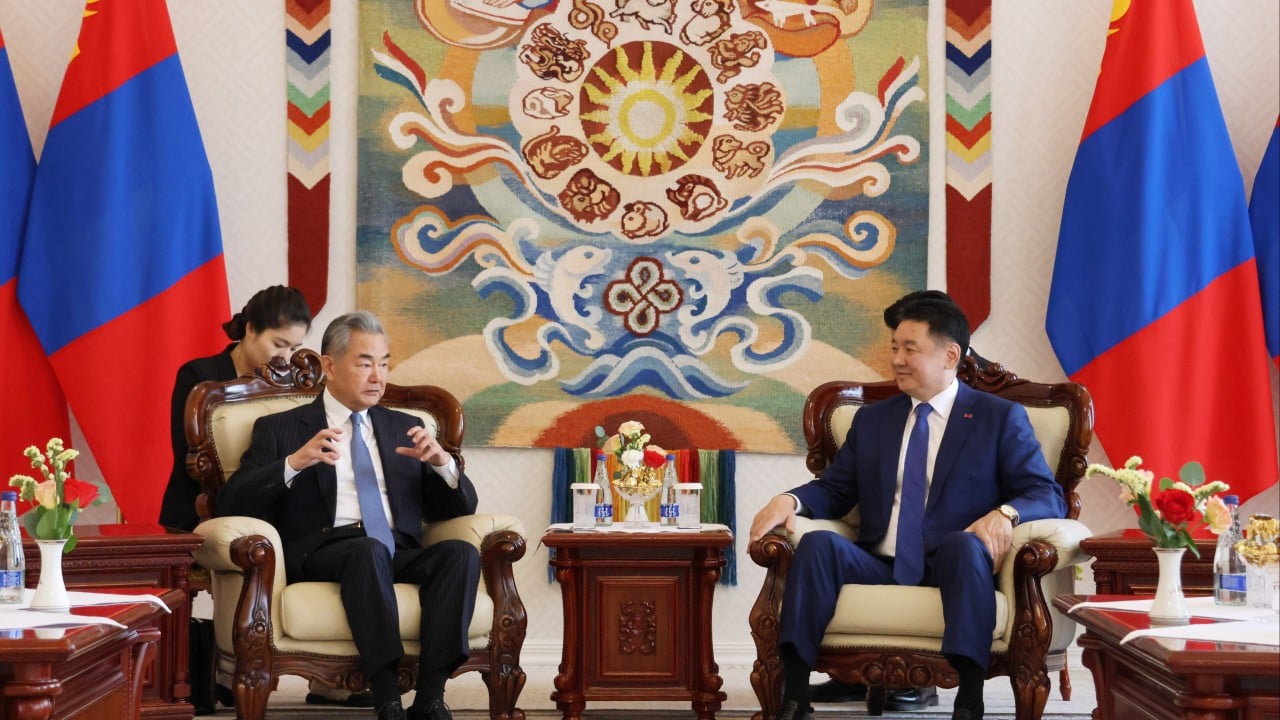
Mongolia’s newly formed government faces an immutable structural reality: its geographic position between two nuclear-armed powers dictates its economic limitations and capabilities. While diplomatic rhetoric emphasizes mutual trust and neighborhood solidarity, Beijing’s strategic focus during Foreign Minister Wang Yi’s recent delegation to Ulaanbaatar reveals a deliberate, data-driven blueprint for systemic economic anchoring. This statecraft relies on structural leverage, infrastructure alignment, and supply chain integration designed to lock Mongolia into China's industrial orbit, aiming for a bilateral trade volume of $20 billion.
To evaluate this dynamic requires moving past diplomatic platitudes and assessing the explicit mechanics of the relationship. This relationship operates across three distinct vectors: asymmetric trade dependence, infrastructure gauge alignment, and the extraction of critical mineral inputs.
The Asymmetric Monopsony Framework
The fundamental economic vulnerability of Mongolia is its extreme trade concentration. Mongolia operates as a primary commodity exporter, with a gross domestic product highly sensitive to Chinese industrial demand. This concentration creates a classic monopsony framework, where a single buyer dictates terms to a structurally dependent seller.
The Trade Concentration Index
- The Monopsony Reality: Over 90% of Mongolia’s exports—predominantly coking coal, copper concentrate, iron ore, and crude oil—are directed to Chinese markets. This lack of diversified off-take agreements leaves the Mongolian state budget vulnerable to shifts in China’s domestic industrial output and macroeconomic policy.
- The Capital Inflow Vector: Foreign direct investment into Mongolia is skewed heavily toward the extractive sector. Because Western and regional alternatives (the "Third Neighbor" policy) face prohibitive logistics costs when moving bulk commodities across land borders, alternative capital inputs struggle to match the return on investment seen by Chinese state-backed infrastructure projects.
This asymmetry shapes the balance of leverage. When diplomatic friction occurs, border processing speeds or customs clearance protocols can be altered at short notice, introducing structural volatility into Mongolia's fiscal planning. Consequently, the Mongolian leadership’s pledge that the nation will not harm Chinese national interests through its relationships with third parties is a logical acknowledgement of this asymmetry.
The Infrastructure Cost Function
Geographic isolation acts as a structural tax on Mongolian competitiveness. To bypass this, Beijing’s "Belt and Road Initiative" seeks direct integration with Mongolia’s "Steppe Road" program. This convergence is not merely about laying asphalt; it centers on technical standard alignment designed to optimize transit velocities and lock in long-term supply chains.
[Mongolian Extractive Hubs]
       │ (Broad Gauge: 1520mm)
       ▼
[Border Transshipment Bottleneck] -> High capital/time costs
       │ (Standard Gauge: 1435mm)
       ▼
[Chinese Industrial Ports]
The Gauge Discrepancy Bottleneck
A primary structural friction point in Eurasian logistics is the railway track gauge. Mongolia uses the Russian broad-gauge standard ($1520\text{ mm}$), whereas China relies on the international standard gauge ($1435\text{ mm}$).
Every ton of bulk cargo crossing the border must undergo mechanical transshipment or bogie exchange. This adds specific frictional costs:
- Capital Expenditure: Maintaining specialized cross-docking facilities at key border points like Erenhot and Zamyn-Uud requires constant capital deployment.
- Temporal Frictions: Transshipment adds between 24 to 72 hours to total transit times, depressing the velocity of capital for Mongolian exporters.
By funding and constructing specific standard-gauge mineral lines directly from southern Mongolian mining deposits (such as Tavan Tolgoi) across the Chinese border, Beijing changes this cost function. Eliminating transshipment fees reduces the marginal cost of Mongolian minerals at Chinese smelters, pricing out international competitors. However, this optimization carries a long-term strategic trade-off: it physically tethers Mongolian extraction assets to the Chinese rail ecosystem, reducing the viability of alternative transit routes through Russian Pacific ports.
Critical Mineral Securitization and the Green Transition
China's domestic industrial strategy is transitioning toward high-value manufacturing, electric vehicles, and clean energy storage infrastructure. This shift drives its interest in Mongolia's untapped geological reserves.
The Resource-for-Infrastructure Swap
The mechanical execution of this strategy relies on resource-for-infrastructure agreements. Mongolia possesses significant reserves of copper, fluorspar, and rare earth elements necessary for advanced battery chemistries and semiconductor manufacturing.
The operational loop functions as follows:
[Chinese Infrastructure Loans] ──> [Mongolian Rail & Grid Upgrades]
               ▲                                    │
               │                                    ▼
[Refined Industrial Goods]      <── [Raw Mineral Extraction & Export]
This dynamic creates a specific developmental loop. Mongolia secures the capital needed to upgrade its energy grid and transport links, but the debt service is paid via long-term, fixed-price commodity off-take contracts. This shields Chinese industrial buyers from global spot-market price spikes while capturing the refining margin, as the raw ore is processed inside Chinese territory rather than in Mongolia.
Strategic Constraints of the "Third Neighbor" Policy
Mongolia’s core foreign policy directive seeks to balance its two geographical neighbors by building deep diplomatic and economic ties with "Third Neighbors"—including the United States, Japan, the European Union, and South Korea. However, an objective analysis reveals severe structural limits on this strategy.
- The Transit Monopoly: Any non-bulk or high-tech item traded with a Third Neighbor must still pass through either Chinese or Russian airspace and land corridors. Consequently, physical access remains subject to the regulatory approval of Beijing or Moscow.
- The Valuation Disconnect: Western capital is primarily drawn to high-margin, low-volume assets, or requires stringent environmental, social, and governance (ESG) compliance metrics that Mongolian infrastructure projects often struggle to meet quickly. Conversely, Chinese state-directed capital evaluates projects based on long-term resource security rather than immediate quarterly returns, allowing it to move faster and absorb higher geopolitical risks.
Definitive Forecast
The integration of Mongolia into China's economic framework will accelerate over the next twenty-four months, driven by the alignment of cross-border transport projects. As bilateral trade approaches the targeted $20 billion threshold, the relationship will shift from a standard import-export dynamic to a highly integrated, specialized regional supply chain.
Mongolia will achieve stable fiscal inflows and modernized domestic logistics infrastructure. The trade-off is an institutionalized reliance on Chinese industrial demand, rendering Ulaanbaatar’s macroeconomic stability entirely dependent on the structural health of the Chinese economy.
The upcoming launch of direct standard-gauge mineral rail lines will mark the point of no return for this economic alignment. Once operational, the reduced transport costs will make it economically irrational for Mongolia to divert its resource wealth elsewhere, cementing its role as a core upstream node in China’s industrial ecosystem.