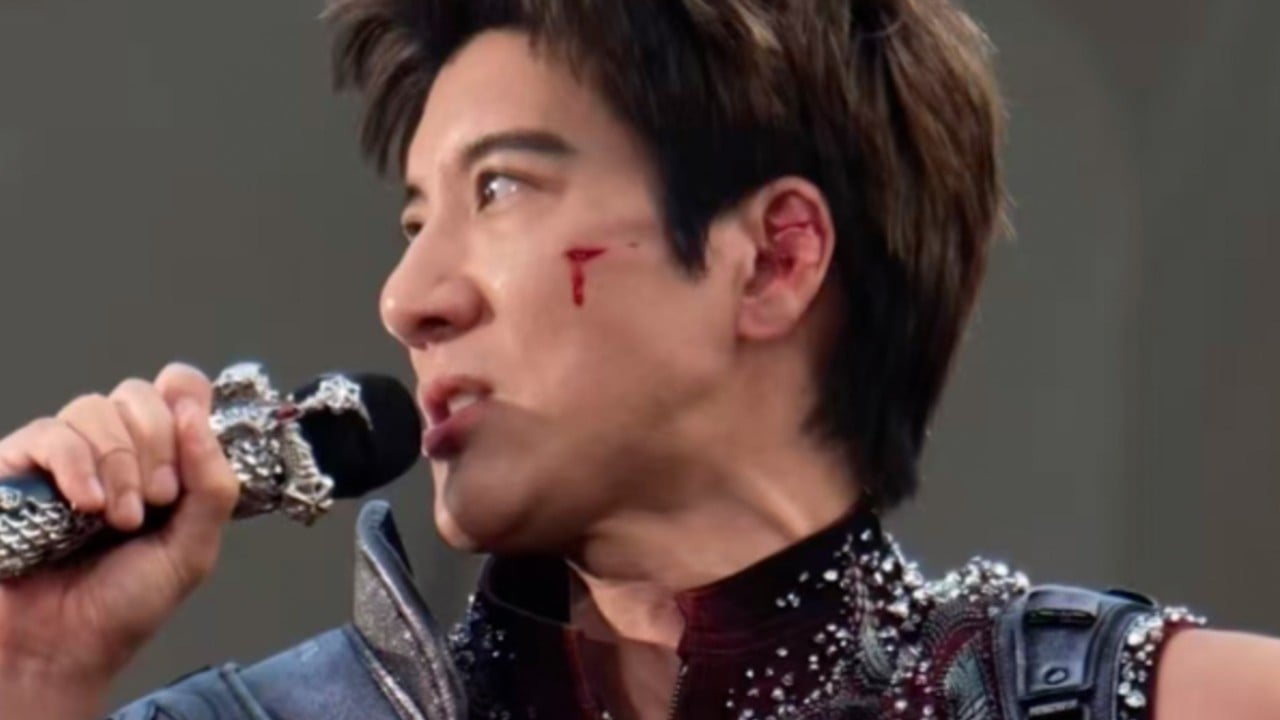
The financial recovery of the live entertainment sector has vastly outpaced the calibration of its technical safety systems. On July 4, 2026, during an arena performance in Chengdu, China, Mandopop artist Leehom Wang tripped over a decoupled aerial rigging wire, falling onto a metal staircase frame. The mechanical energy transfer from the fall, amplified by a rigid in-ear monitor casing, fractured the singer’s auricular cartilage and inflicted facial lacerations, requiring 27 ear stitches and 12 facial stitches. While public discourse focuses on the performer's operational continuation despite severe injury, the incident exposes a systematic failure configuration common to hyper-scaled live productions. When live event markets experience rapid growth, operational margin pressure directly degrades specialized labor quality and runtime check protocols.
To understand how a routine scenic transition converts into severe physical trauma, production safety must be analyzed not as a series of isolated human errors, but as an interdependent operational system. The mechanisms of this system reveal why standard entertainment risk mitigations are structurally insufficient.
The Kinematic Vulnerability Function of Aerial Rigging
The operational failure in Chengdu originated within the aerial rigging and automated descent framework. The primary function of an aerial rigging system is the controlled vertical displacement of a performer between an elevated point and the main deck. A structural vulnerability is introduced during the transition phase, where the kinetic mechanism switches from automated mechanics to manual choreography.
The system's failure mechanics follow a specific causal sequence:
[System Deselects Automation]
         │
         ▼
[Manual Harness Decoupling]
         │
         ▼
[Incomplete Line Retrieval (Slack Wire)]
         │
         ▼
[Performer Foot Snag via Blind Backward Step]
         │
         ▼
[Uncontrolled Center-of-Mass Displacement]
This sequence identifies the precise failure points missed by standard safety checklists:
- The Decoupling Latency: The interval between the performer's feet establishing contact with the stage deck and the complete extraction of the safety harness from the active performance zone.
- The Line Retention Failure: Preliminary investigations indicate an operational error where the wire harness was not cleared from the performance zone after decoupling. This left a high-tensile steel core or synthetic line slack across a high-traffic pedestrian plane.
- The Blind Backstep Vector: Performers rely on muscle memory and spatial orientation vectors mapped during technical rehearsals. When a line is left uncleared, it introduces an unmapped physical obstruction into a zone where the performer is moving backwards while maintaining audience eye contact.
The resulting fall was not a simple misstep. It was a mechanical trip where the foot became anchored to the stage deck by a high-tensile wire while the upper body’s momentum continued forward. This creates an uncorrectable shift in the performer's center of mass, preventing defensive landing maneuvers.
Secondary Impact Aggravation: Hardware as a Hazard Vector
The severity of the trauma—specifically the fracturing of the outer ear cartilage—reveals a significant flaw in consumer and professional stage gear integration. The primary injury driver was not direct contact with the metal stage edge, but rather the structural failure of an acoustic isolation tool: the hard-molded in-ear monitor (IEM).
Professional IEMs are manufactured using high-durability acrylic polymers or cold-cure plastics designed to maximize acoustic isolation and withstand sweat and friction. These materials possess high structural rigidity. When the left side of the performer's face struck the metal step, the hard acrylic shell of the IEM acted as an unyielding wedge driven directly into the soft tissue and cartilage of the pinna.
Instead of distributing the impact force across the temporal bone, the rigid shell concentrated the kinetic energy directly onto the auricular cartilage, causing it to shatter under compression. This highlights a critical design oversight in live performance hardware. Equipment optimized for acoustic isolation and durability frequently lacks impact-absorption or breakaway capabilities, turning necessary technical tools into direct injury hazards during a fall.
The Post-Pandemic Scaling Trap: Structural Root Causes
The operational errors seen in the Chengdu incident, alongside recent live event mishaps across the regional market—such as stage lift drops and unmapped trapdoor exposures—point to systemic macroeconomic pressures rather than isolated instances of worker negligence. The post-pandemic live entertainment sector is operating within a severe capacity constraint model.
       [Market Revenue Demand Spikes]
                     │
                     ▼
       [Show Volumes Scale Exponentially]
                     │
                     ▼
[Labor Supply Deficit & Accelerated Load-In Compressed Timelines]
                     │
                     ▼
       [Safety Protocol Execution Declines]
This market dynamic creates three structural systemic vulnerabilities:
1. The Specialized Labor Deficit
The rapid expansion of the live performance market has caused show volumes to outpace the supply of certified automation engineers, structural riggers, and stage managers. To staff expanding tour schedules, production companies are forced to compress onboarding cycles or hire sub-contracted technicians lacking specific experience with complex automated set pieces.
2. Time-Compressed Load-In Cycles
Stadium and arena rentals carry high fixed costs. To maximize profitability, operators compress the load-in, rigging, testing, and strike windows into tight schedules. When technicians work consecutive 18-hour shifts to meet hard launch deadlines, cognitive fatigue increases. This directly degrades the precision required to operate complex safety lines and automated platforms safely.
3. Redundancy Deficits in Automation Scripts
In standard industrial settings, any automated movement near human workers requires integrated physical barriers or light-curtain sensors that cut system power upon boundary breaches. In live entertainment, these industrial protections are frequently omitted to preserve stage aesthetics and sightlines. Safety relies entirely on human spotters and the precise execution of manual cues, leaving the system with a single point of failure.
Risk Mitigation Framework for High-Velocity Productions
To prevent failure cascades in complex stage environments, production management must move away from relying on performer vigilance. Instead, operations should implement rigid engineering controls and structured risk frameworks.
The Live Stage Fail-Safe Matrix
| Risk Zone | Failure Mode | Primary Engineering Control | Secondary Operational Control |
|---|---|---|---|
| Aerial Flight Systems | Unretracted line / Slack wire entanglement | Tension-sensing auto-retraction winches with zero-velocity cutoffs. | Dual-operator confirmation cues (automation desk + stage deck spotter). |
| Scenic Transitions | Level changes / Open lift pockets | Pressure-sensitive edge mats or localized infrared perimeter sweeps. | High-visibility photoluminescent markings on all moving edges. |
| Performer Hardware | IEM-induced compressive cartilage trauma | Low-durometer silicone-molded IEM outer shells or breakaway faceplate designs. | Mandatory trauma-response training for on-site medical staff. |
Implementing Kinetic Zone Segregation
Productions must establish strict physical and temporal boundaries during transitions. A performer should never occupy a moving platform or changing surface without a dedicated safety handler maintaining direct physical or visual control.
Following the Chengdu incident, the production team added anti-collision padding to the staircase edges and deployed three dedicated stage hands to manage the transition area. While these reactive measures address the immediate hazard, a proactive strategy requires integrating these protocols directly into the technical design phase, rather than treating them as post-accident corrections.
The ultimate responsibility for performance safety cannot rest on the artist's resilience. The concept that "the show must go on" must be replaced by a strict operational standard: a production only proceeds if its safety systems possess the structural redundancy to successfully absorb human errors.