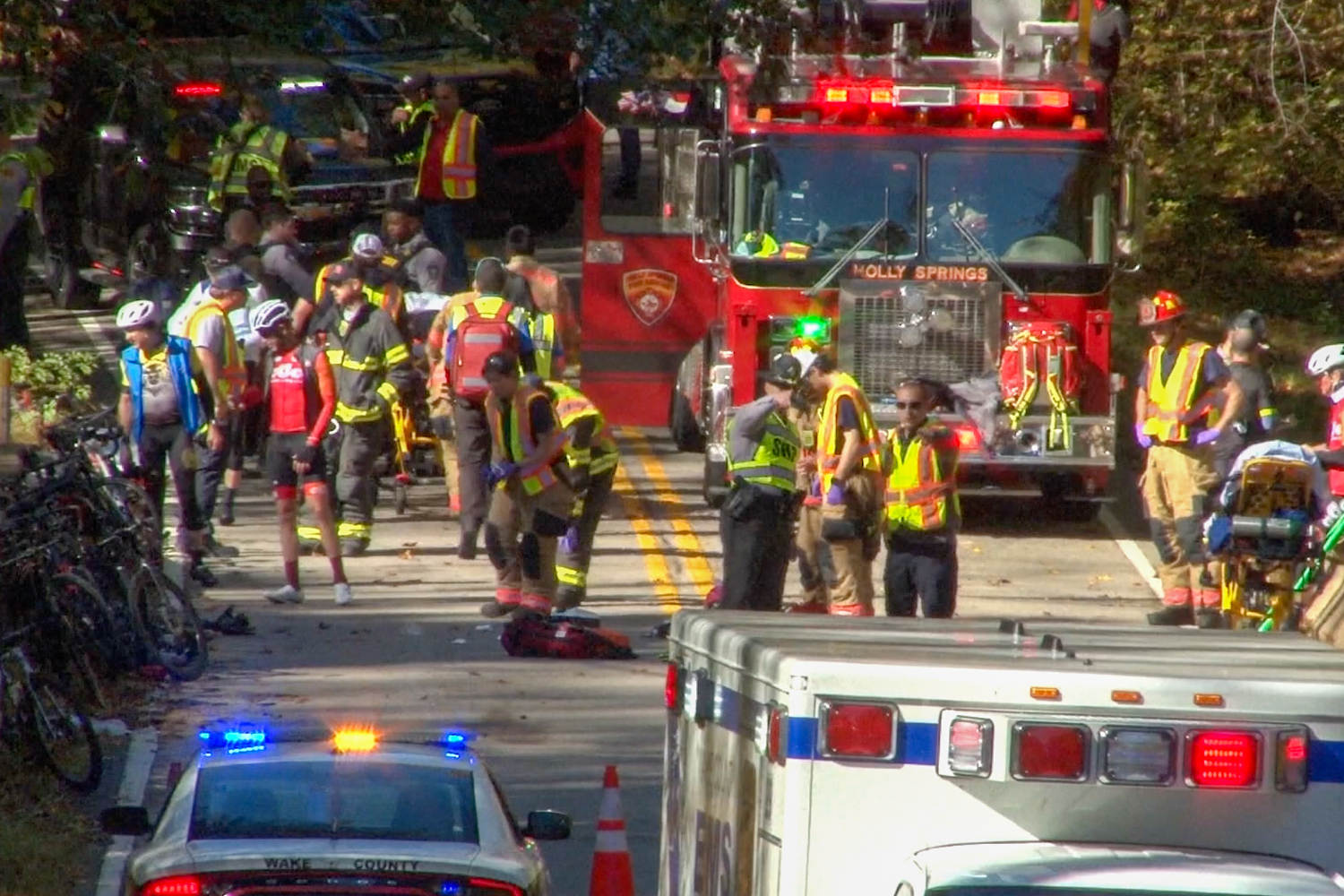
Mass-casualty collisions between motor vehicles and group cyclists are rarely isolated anomalies; they represent the predictable intersection of human physiological decline, peloton aerodynamics, and static roadway infrastructure. When an older motorist strikes a large group of riders—such as the fatal incident in North Carolina that killed one cyclist and injured at least twelve others—standard news reporting reduces the event to a sequence of tragic outcomes. To prevent recurrence, safety engineers and policymakers must examine the underlying mechanics of driver cognitive load, group cycling kinematics, and systemic licensing failures.
The Kinematics of Peloton Vulnerability
A group of cyclists riding in formation operates under distinct physical dynamics that differ fundamentally from those of a single rider or a passenger vehicle. Understanding these mechanics clarifies why a single vehicle intrusion produces high casualty counts rather than a localized impact. Meanwhile, you can explore similar events here: What We Actually Know After the Krakow Gun Attack.
Spatial Compression and Reaction Windows
Cyclists ride in tight pacelines to reduce aerodynamic drag, which drops by up to 30% to 40% for riders drafting behind a leader. This efficiency requires minimal longitudinal spacing—often less than one meter between wheels—and tight lateral grouping.
- Zero Lateral Escape: Riders in the interior or rear of a paceline have no peripheral visibility of approaching rear traffic and no physical space to swerve without colliding with adjacent riders.
- Cascading Mechanical Failure: When a vehicle impacts the rear of a peloton, the kinetic energy transfers forward through the formation. A single impact triggers a chain-reaction crash, multiplying injury counts even among riders the vehicle never directly touches.
- Mass Disparity: A standard passenger sedan weighs between 1,500 and 2,000 kilograms. A cyclist and bicycle combined weigh roughly 80 to 100 kilograms. At highway or rural arterial speeds of 70 to 90 kilometers per hour, the kinetic energy differential leaves the human body with zero structural protection against blunt-force trauma.
Closing Speed Misjudgment
Drivers approaching a peloton from behind frequently miscalculate closing speed—the rate at which the distance between two moving objects shrinks. Human visual perception relies on the rate of expansion of an object's image on the retina, known as optical looming, to judge time-to-collision. Because bicycles have narrow vertical profiles compared to cars or trucks, they generate a weaker looming signal. A motorist traveling at 85 kilometers per hour approaching cyclists moving at 30 kilometers per hour closes the gap at 15.3 meters per second. If the driver mistakes the group for stationary roadside clutter or underestimates their slow forward velocity, the braking window collapses before cognitive recognition occurs. To explore the bigger picture, we recommend the recent analysis by Reuters.
Physiological Mechanics of Late-Life Driving
Age alone does not disqualify an individual from operating a motor vehicle, as chronological age correlates imperfectly with functional driving ability. However, specific age-related neurological and sensory changes directly impair a driver's capacity to manage complex, high-speed traffic environments.
Visual Processing and Contrast Sensitivity
Standard state licensing exams almost exclusively measure static visual acuity—the ability to read high-contrast letters on a stationary chart. Static acuity fails to capture the visual functions required to detect cyclists on rural or suburban roads:
- Useful Field of View (UFOV): Aging narrows the peripheral area from which a driver can extract visual information without moving their eyes or head. A contracted UFOV causes drivers to miss hazards entering from the shoulder or lane edge.
- Contrast Sensitivity: The ability to distinguish an object from its background degrades faster with age than static acuity. Dappled sunlight under tree canopies, dusk glare, or overcast skies can render cyclists visually indistinguishable from asphalt until the vehicle is within critical braking distance.
- Saccadic Eye Movement Delay: Older adults exhibit slower visual scanning speeds, increasing the time required to shift gaze from the roadway ahead to dashboard instruments, mirrors, and back to the lane.
Executive Function and Pedal Error
Operating a vehicle requires continuous executive function: filtering irrelevant stimuli, sustaining attention, and executing rapid motor responses. Cognitive decline slows information processing speed, creating a bottleneck when unexpected obstacles appear.
In high-stress emergencies, cognitive overload frequently triggers unintended acceleration—commonly termed pedal error. Instead of depressed braking, the driver presses the accelerator while believing their foot is on the brake. Under panic, the somatosensory feedback of sudden acceleration causes the driver to push harder on the pedal, propelling the vehicle through a group of cyclists rather than bringing it to a halt.
Infrastructure Deficits on Rural and Suburban Arterials
High-casualty cycling crashes cluster disproportionately on two-lane rural and exurban roads. These corridors attract recreational cyclists seeking low traffic volume and long uninterrupted distances, yet their physical geometry maximizes collision severity.
The Shoulder-to-Lane Conflict
Many secondary roads in states like North Carolina feature narrow lanes, zero paved shoulders, and immediate drop-offs into drainage ditches or soft gravel. This geometry forces cyclists into the primary travel lane to avoid edge hazards.
- Sightline Obstructions: Rolling hills and horizontal curves restrict forward visibility. A motorist cresting a hill at the posted speed limit may encounter a slow-moving peloton occupying the lane with insufficient stopping sight distance.
- Passing Friction: Double-yellow centerlines legally prohibit passing in no-passing zones, yet impatient motorists frequently attempt high-speed passes around wide cycling groups, increasing the risk of head-on collisions with oncoming traffic or sideswipes into the peloton.
- Speed Limit Mismatch: Rural arterials routinely carry statutory speed limits of 45 to 55 miles per hour (72 to 88 kilometers per hour) despite lacking the clear zones, lighting, or lane widths required to safely mix high-speed motor vehicles with vulnerable road users.
Limitations of Current Regulatory Frameworks
Public debate following fatal crashes involving older drivers typically centers on mandatory age-based license revocation. Operational data from transportation safety agencies demonstrates that blanket age cutoffs are both blunt and counterproductive.
Revoking driving privileges strictly by birth year removes safe, competent older drivers from the road, accelerating social isolation, cognitive decline, and mortality rates among seniors who lose mobility independence. In suburban and rural regions lacking public transit, driving cessation imposes severe economic and health penalties on older adults.
Conversely, relying solely on self-reporting or infrequent vision screenings fails to identify drivers experiencing gradual cognitive impairment. Drivers with early-stage dementia or severe UFOV contraction often lack insight into their own deficits—a clinical condition known as anosognosia—making voluntary self-regulation unreliable.
Liability and Forensic Attribution
Following a multi-victim crash, law enforcement and accident reconstructionists must separate medical emergencies from negligent operation. Investigators analyze event data recorders (black boxes) within modern vehicles to establish pre-impact speed, throttle position, steering angle, and brake application in the five seconds prior to collision. Toxicology screenings, medical records, and eyewitness accounts determine whether the driver suffered an acute incapacitating event, such as a stroke or syncope, or failed to maintain lane discipline due to distraction or cognitive impairment. While criminal charges address post-incident accountability, legal penalties do not alter the physical risk factors present on the roadway prior to impact.
Systemic Risk Mitigation Protocols
Reducing the frequency and lethality of vehicle-peloton collisions requires coordinated interventions across licensing standards, vehicle engineering, and road design rather than reliance on individual behavioral perfection.
Functional Licensing Assessments
State departments of motor vehicles must replace arbitrary age rules with objective, functional screening triggered at specific renewal intervals:
- UFOV and Contrast Testing: Integrate computerized Useful Field of View and contrast sensitivity assessments into license renewals starting at age 70. Drivers failing these thresholds should undergo mandatory on-road driving evaluations rather than immediate revocation.
- Restricted Licensing Tiers: Expand conditional licensing that permits older drivers with mild functional declines to operate vehicles only during daylight hours, within local geographic boundaries, or on roads below specific speed thresholds.
- Medical Reporting Protections: Establish clear legal safe harbors and streamlined reporting protocols enabling physicians, optometrists, and family members to flag medically unfit drivers for state evaluation without fear of civil liability.
Mandatory Active Safety Systems
Human reaction time cannot compete with millisecond electronic sensors. Regulatory mandates accelerating the adoption of crash-avoidance technology represent the most reliable near-term defense against human error:
- Cyclist-Capable Automatic Emergency Braking (AEB): Standardize AEB systems calibrated specifically to detect narrow vertical silhouettes and low-speed movement profiles in both daylight and low-light conditions.
- Pedal Misapplication Mitigation: Deploy onboard software that suppresses sudden, full-throttle acceleration when forward-facing radar or cameras detect an immediate obstacle, neutralizing pedal error events before high-speed impact occurs.
Corridor-Level Infrastructure Segregation
Where recreational cycling volume intersects with high-speed rural traffic, paint lines offer zero physical protection. State departments of transportation must prioritize capital allocation toward physical separation:
- Buffered Paved Shoulders: Widen shoulders to a minimum of 1.5 to 2 meters on designated cycling routes, separated from the travel lane by milled rumble strips placed at the lane edge rather than inside the shoulder space.
- Speed Harmonization: Lower posted speed limits on high-use cycling corridors with constrained sightlines, pairing reduced limits with automated speed enforcement to align actual vehicle speeds with roadway geometry.
State transportation agencies and motor vehicle regulators must decouple driver licensing from chronological age while aggressively mandating cyclist-detection AEB and physical shoulder separation on high-speed rural corridors.