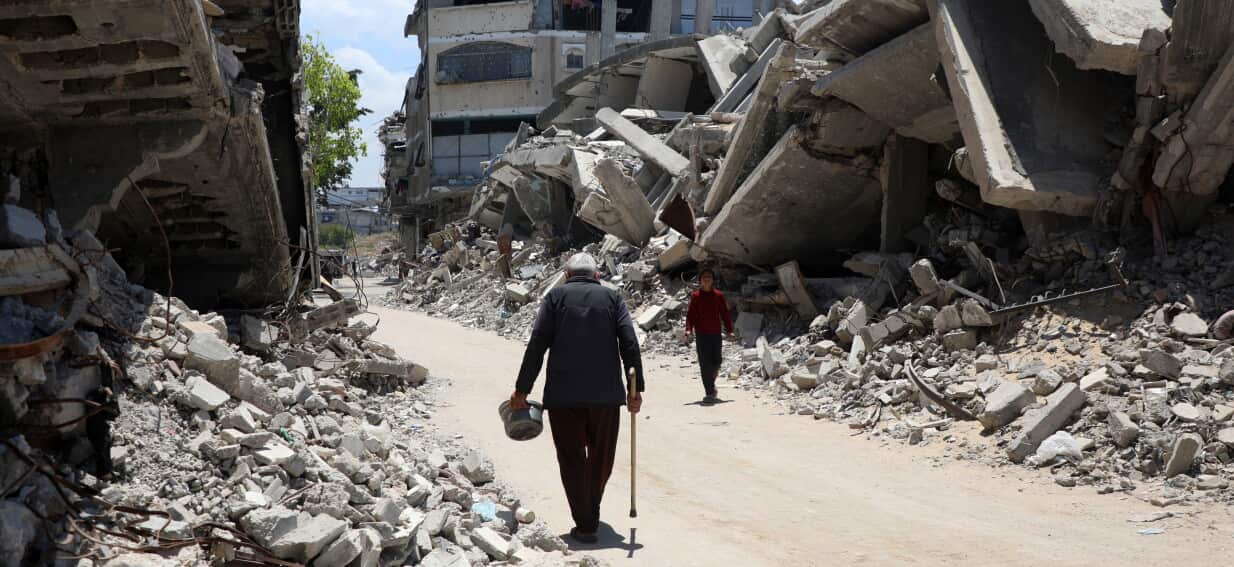
The sky above Khan Younis does not clear after an airstrike. It lingers. A thick, chalky mix of pulverized concrete and sulfur hangs in the summer heat, settling into the throats of everyone left standing. For decades, the people living in this narrow strip of land have learned to read the sky like a grim weather report. They know the difference between the sharp crack of tank fire and the deep, concussive thud of a bunker-buster bomb dropped from an F-16.
But on a blistering morning in mid-July, the sound was different. It was a roar that seemed to tear the air itself apart, targeted at Al-Mawasi, a designated humanitarian zone crowded with makeshift tents.
When the smoke finally drifted toward the Mediterranean, the geopolitical landscape of the Middle East had shifted on its axis. Israel announced it had targeted Mohammed Deif, the elusive, near-mythical chief of Hamas’s military wing, the Al-Qassam Brigades. For weeks, confirmation hung in a tense, agonizing limbo. Then came the official declaration from the Israeli military: Deif was dead.
To understand the weight of that announcement, you have to understand the ghost who wore the name.
The Man Who Wasn't There
For nine thousand days, Mohammed Deif was less a man and more an omnipresent whisper. He was the architect of the tunnels, the mastermind of the October 7 attacks, and the top of Israel’s most-wanted list for over a generation.
Consider the sheer psychological weight of surviving nine assassination attempts. Most people break after one near-death experience. Deif grew more cautious, more deeply embedded in the subterranean labyrinth beneath Gaza. He didn't use smartphones. He didn't look at computer screens connected to the internet. He communicated through a web of trusted couriers, a human chain of secrets passed mouth-to-ear in the dark.
Imagine a life spent entirely in the negative space of reality. He lived in the shadows thrown by the concrete walls of Gaza's underground network. He became known as The Cat with Nine Lives. To the Israeli intelligence apparatus, Shin Bet, he was the ultimate obsession—a puzzle piece that refused to fit. To young militants in Gaza, his anonymity was his power. You cannot kill a man you cannot see.
His real name was Mohammed Diab Ibrahim al-Masri, but he took the nom de guerre "Deif," which translates to "The Guest." It was a bitterly brilliant piece of dark poetry. He was a guest in every house he visited, never staying in one place for more than a few hours, never leaving a footprint.
But everyone leaves a trace eventually.
The strike that took him out was not a sudden stroke of luck. It was the culmination of an intelligence operation that read like a slow-motion chess game played over years. Every piece of trash discarded from a tunnel exit, every brief moment a courier stepped too close to a window, every thermal signature picked up by a high-altitude drone flying miles above the clouds—it all fed into a massive, algorithmic mosaic.
The trap sprung in Al-Mawasi. The Israeli military stated they targeted a fenced compound belonging to Rafa’a Salameh, Hamas's Khan Younis brigade commander. Salameh died in the strike. For Deif, the verification took longer. How do you prove the death of a man who barely existed in the physical world?
The Cost of the Target
The math of modern warfare is brutal, cold, and devastatingly unequal.
To kill a ghost, you have to destroy the house he is hiding under. Local health officials reported that the strikes killed at least 90 Palestinians and injured hundreds more in the surrounding displacement camp. This is where the dry facts of a news ticker fail us. They cannot capture the sound of a mother screaming through the dust, digging through rubble with bleeding fingernails, looking for a child who was eating breakfast moments before.
This is the central, agonizing paradox of the conflict. The pursuit of security often breeds the very despair that fuels the next generation of resistance.
Let us look closely at what happened in that dirt compound. Israel asserted that the strike was a precise surgical operation based on pinpoint intelligence, hitting an active military outpost hidden within a civilian zone. Hamas countered, calling the claim a justification for a massacre of displaced people. The truth, as it always does in war, lay buried beneath layers of grief and propaganda.
The physical destruction was absolute. Craters filled with water from broken mains. Scorched frames of cars twisted like discarded toys. The sheer force of the munitions used indicates that the goal was not just to kill, but to ensure that nothing—and no one—could survive within the blast radius.
But what happens when the target is gone?
History shows us that decapitation strategies—the military term for killing an organization's leadership—rarely yield the clean victories promised on strategic whiteboards. When Israel assassinated Abbas al-Musawi, the leader of Hezbollah, in 1992, they believed they had dealt a crippling blow to the group. Instead, he was replaced by Hassan Nasrallah, a leader who proved far more strategically capable and politically astute.
Hamas is not a corporate hierarchy where removing the CEO halts production. It is an idea bound by a violent, deeply entrenched historical narrative.
The Echoes in the Dark
The death of Deif leaves an immense vacuum, but a vacuum in a war zone is quickly filled by rushing wind.
Inside the tunnels, the reaction is likely one of frantic realignment. Deif was the operational spine of the military wing. He was the one who unified the disparate factions, who standardized the manufacturing of homemade Qassam rockets, and who convinced a generation that the underground kingdom was impenetrable. His absence shakes the foundational myth of invulnerability that Hamas cultivated.
But look at the geopolitical chessboard. For Israeli Prime Minister Benjamin Netanyahu, the elimination of Deif represents a massive, tangible victory—a "scalp" to show a domestic public deeply traumatized by the failures of October 7 and increasingly weary of an open-ended war. It provides a moment of political leverage.
Yet, the strategic dilemma remains unchanged. The hostages held in the darkness beneath Gaza are still there. The borders are still hostile. The structural realities of millions of people living under blockade and occupation have not dissolved with the smoke over Khan Younis.
The real question we must ask is not who wins the tactical battle, but what happens to the human soul when the dust settles.
A young boy stands on the edge of the crater in Al-Mawasi. His shoes are covered in grey ash. He does not know the intricate history of Mohammed Deif. He does not understand the geopolitical calculations of Washington, Jerusalem, or Doha. He only knows that his home is gone, his cousin is injured, and the sky above him is a source of terror.
We often view these events through the lens of political analysis, counting the dead, assessing the strategic implications, and debating the legality of proportional force. We treat it like a game of risk. But the pieces on this board are made of flesh and bone.
The death of Mohammed Deif is an undeniable milestone in a conflict that has defined the twenty-first century. It proves that no one is beyond the reach of modern military might, that even the most deeply buried secrets eventually come to light under the relentless gaze of technology.
But as night falls over Gaza, the drones continue their steady, rhythmic buzz overhead. It is a sound that never stops, a mechanical heartbeat in the dark. The ghost may be gone, but the haunting continues.