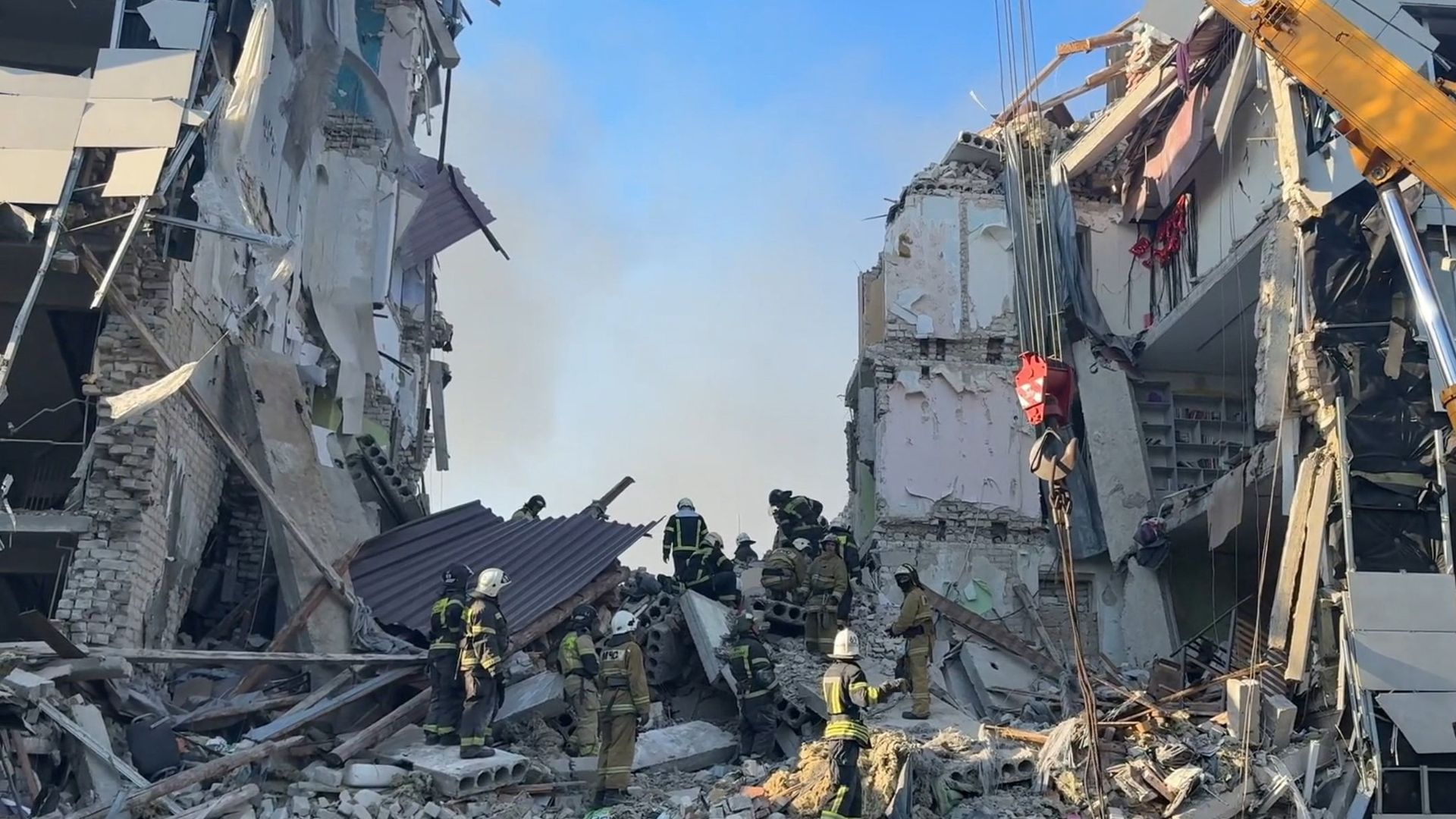
The windows in specialized school number four did not just break. They dissolved. One moment, the morning light was filtering through cheap, yellowed cellophane tape—the kind teachers stick across the glass in X-shapes, a fragile geometry meant to hold back the pressure of the sky. The next moment, the tape was gone, the glass was dust, and the silence that usually follows a bell was replaced by a sound that resembles a long, metallic tear.
We talk about geopolitical flashpoints in the abstract. We discuss strategic boundaries, defensive perimeters, and retaliatory measures. But war at its core is not a map. It is the smell of pulverized plaster, the cold dampness of a basement floor, and the sudden, violent termination of a history lesson.
When six people died inside that building, the official machinery of the state began to turn almost instantly. Within hours, the narrative was framed, polished, and broadcast across the continent. A line was drawn from the wreckage straight to the office of a rival president. The rhetoric was sharp, calculated, and heavy with the promise of more thunder. Yet, if you sit with the reality of what happened on that Tuesday morning, the grand pronouncements from Moscow begin to feel remarkably distant. They feel like a script written for an audience that has never had to scrub gray soot from a child’s desk.
To understand the weight of this event, you have to look past the official press releases. You have to look at the geometry of the drone itself.
The Weight of Wood and Wire
A modern loitering munition is not an elegant piece of machinery. It is a crude marriage of lawnmower engines, fiberglass, and off-the-shelf electronics. It hums with a flat, irritating drone that sounds precisely like a weed-whacker operating two blocks away. That is the detail that catches most people off guard. The sound does not terrify you because it sounds like an engine of doom; it terrifies you because it sounds entirely ordinary until it is directly overhead.
Consider what happens inside a classroom when that hum begins to grow louder.
The teacher, a woman who has spent thirty years explaining the difference between active and passive verbs, does not look at a tactical map. She looks at thirty faces. She knows that the basement is three flights of stairs down. She knows that three flights of stairs take exactly forty-five seconds to navigate if everyone moves without panic. She also knows, through a terrible kind of mathematical intuition developed over the last few years, that the hum has been growing for forty seconds already.
The decision is not strategic. It is instinctive. You get under the wood.
Standard-issue school desks are made of particleboard and tubular steel. They are designed to withstand spilled ink and the scratches of bored teenagers. They are not designed to stop fragments of pre-formed shrapnel moving at eight hundred meters per second. When the impact occurred, the building did not collapse like a house of cards. It buckled. The roof remained largely intact, but the pressure wave—the invisible hammer that moves ahead of the flame—cleared out the interior with a terrifying efficiency.
The official reports list the casualties with a cold, numerical finality. Six dead. Twelve wounded. A statistic suitable for a morning briefing. What the briefing leaves out is the condition of the notebook pages scattered across the courtyard, fluttering in the breeze like dead leaves, some of them still carrying the red marks of a teacher’s pen.
The Rhetoric of the Rebound
Before the smoke had even cleared from the perimeter, the political machinery was in motion. The language used in the aftermath was predictable, functioning like a well-oiled piston. The blame was assigned with absolute certainty. It was an act of terror, the state media declared. It was proof of an enemy that had lost all semblance of humanity, an enemy that targeted the innocent out of pure malice.
But there is a strange, hollow echo in these declarations.
For months, the sky over the neighboring country has been filled with the exact same hum. The same lawnmower engines have descended upon apartment blocks in Kyiv, power stations in Kharkiv, and hospitals in Kherson. The arguments used to justify those strikes are always framed in the language of military necessity. They are called "precision strikes on critical infrastructure." They are described as legitimate operations to demilitarize a hostile neighbor.
When the same steel falls on a school within Russia’s recognized borders, the vocabulary changes instantly. The precision strike becomes an atrocity. The strategic operation becomes a war crime.
This is the fundamental distortion of modern conflict. The moral quality of an explosion is determined entirely by where it lands and who held the remote control. The civilian beneath the ceiling is irrelevant to the equation. They are merely the canvas upon which the two sides write their bloody arguments.
The Kremlin’s rapid assignment of guilt is not just about assigning blame; it is about maintaining a specific internal equilibrium. It is an assurance to the population that the state is still in control, even when the sky itself has become hostile. It is an attempt to turn a moment of profound vulnerability into a rallying cry for further escalation. The message is simple: Look what they are doing to us. Look why we must destroy them.
The Ghost of the Safety Drill
In the middle of the last century, schools across the world taught children to hide under their desks to survive an atomic blast. It was a lie, of course. A wooden desk offers no protection against the sun falling to earth. But the drill was never truly about survival. It was about management. It gave the children something to do with their hands while the adults figured out how to avoid total annihilation.
Today, the drills have returned, but the illusion of safety has evaporated.
A friend of mine who teaches in a border region once told me about the evolution of her classroom. It started with heavy curtains to block the light from night flares. Then came the sandbags against the lower panes of glass. Finally, the move to the hallway, away from the exterior walls entirely. The classroom, a space once defined by maps of the world and colorful alphabets, had slowly contracted into a gray, windowless corridor where the children sat on gym mats, their knees pulled tight to their chests.
"You can teach them history in the hall," she said. "But you cannot teach them to forget the sound of the sky."
The tragedy of the six who died is not just that their lives were cut short in a flash of heat and steel. It is that their deaths were entirely predictable. When you unleash thousands of autonomous and semi-autonomous weapons into the air over a period of years, the weapons eventually stop respecting the lines drawn on map tables. They drift. They lose their guidance locks. They are brought down by air defenses, falling randomly into whatever happens to be below them.
Sometimes what is below them is an ammunition dump. Sometimes it is a coal yard. And sometimes, by the cruel logic of probability, it is a room where children are learning how to divide fractions.
The Invisible Stakes
The true cost of this strike will not be measured in the rubles required to rebuild the brickwork. It will be measured in the permanent alteration of the local geography. Every school within three hundred kilometers of the frontier is now a potential front line. The boundary between the home front and the combat zone, a line that the state has spent immense energy trying to maintain, has been permanently blurred.
Parents who once watched the news with a sense of distant solidarity now look at the morning drop-off with a knot in their stomachs. They scan the treeline. They listen to the noise of passing delivery trucks with a new, sharp attention.
The state promises vengeance. It promises new air defense batteries, heavier bombardments of the enemy’s logistics hubs, and an unyielding commitment to victory. But these promises contain a dark truth that no one in power wishes to acknowledge: every action invites a reaction, and every escalation ensures that more drones will find their way through the net.
The cycle is self-sustaining. The grief of the families in this school will be used to fuel the fury of the next missile barrage. That barrage will create a corresponding grief across the border, which will in turn be used to justify the next drone launch. The individuals who died become fuel for the engine that killed them.
The sun sets early in the borderlands during the late spring, casting long, stark shadows across the asphalt of the schoolyard. The emergency vehicles have gone, leaving only the smell of burnt rubber and wet soot. A single piece of yellow tape, torn from a shattered window frame, catches the wind and whips against the rusted metal of a playground swing.
It makes a sharp, rhythmic snapping sound.
In the quiet of the evening, if you stand close enough to the perimeter fence, that snap is the only thing you can hear. It sounds remarkably like a clock ticking down, marking the seconds until the next hum begins on the horizon.