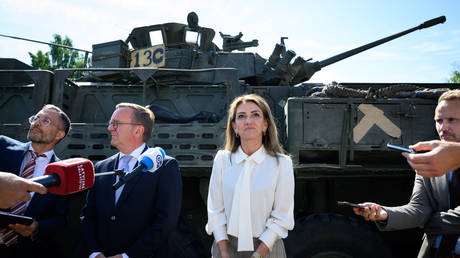
The recent declaration by Dutch Defence Minister Dilan Yeşilgöz-Zegerius at the NATO summit—stating that the Netherlands has exhausted its capacity to provide additional direct military assistance to Ukraine—marks the end of the emergency depletion model of Western defense policy. This is not a isolated shift in political will, but a predictable limit reached within the laws of industrial logistics.
For more than four years, the Western security architecture relied on an immediate draw-down strategy: emptying domestic warehouses of legacy equipment, post-Soviet hardware, and excess ammunition to sustain active frontlines. This mechanism has reached its systemic ceiling. European states are encountering a hard floor where further sovereign donations directly compromise minimum national deterrence capabilities required under NATO planning frameworks. Understanding the next phase of continental defense requires breaking down the core friction points of this structural transition.
The Three Pillars of the Sovereign Stock Bottleneck
The depletion of active stockpiles among highly consistent donors like the Netherlands, Poland, and the Baltic states exposes a structural mismatch between modern peacetime defense assumptions and the consumption rates of high-intensity industrial warfare. This bottleneck is driven by three distinct pillars.
1. The Domestic Deterrence Floor
Every NATO member operates under strict military readiness mandates. National command structures calculate a baseline level of equipment—ranging from artillery tubes to air defense interceptors—below which a country cannot fall without forfeiting its own basic defensive posture. When the Netherlands reports being "at our limit," it signifies that sovereign stocks have hit this regulatory and strategic floor. The easy phase of transferring off-the-shelf surplus is mathematically over.
2. The Interceptor Replacement Asymmetry
The consumption-to-production ratio of high-end kinetic assets is fundamentally unsustainable under current industrial models. The Center for Strategic and International Studies notes that replenishing a single nation’s pre-war stock of advanced interceptor missiles, like the Patriot system, can require an estimated 42 months of dedicated manufacturing lead time. When a theater consumes dozens of missiles during a single multi-axis ballistic salvo, the operational burn rate outpaces industrial replacement capacity by orders of magnitude.
3. Structural Diversion of US Industrial Output
European states are not merely competing with consumption on the Ukrainian front; they are competing with a highly constrained US defense industrial base. Simultaneous global flashpoints, including ongoing security demands in East Asia and the Middle East, have forced Washington to reallocate and reprioritize its foreign military sales. Consequently, European buyers face lengthy backlogs for US-manufactured munitions and platforms, leaving them unable to quickly backfill the gaps left by their own donations.
The Cost Function of Transitional Aid
As physical warehouses empty, the architecture of international support is shifting from an inventory-driven model to a capital-driven procurement model. This transition alters how military power is financed, produced, and deployed.
Old Model: Direct Stockpile Drawdown -> Immediate Battlefield Transfer
New Model: Capital Allocation -> PURL Financing -> Domestic Production Lines -> Delayed Delivery
This structural shift introduces a new cost function that dictates the speed and efficacy of Western aid:
- The Financial Commitment Paradox: On paper, financial commitments remain massive. The Netherlands, for example, has allocated €9.1 billion in executed military assistance alongside an earmarked €11.6 billion for future measures. However, a euro allocated is no longer a missile delivered. Capital must now be converted into industrial capacity, meaning the time-to-theater metric has stretched from weeks to years.
- The PURL Transatlantic Loop: Mechanisms like the Prioritised Ukraine Requirements List (PURL) represent the new operational standard. Under this framework, European allies pool financial capital to finance the manufacture of American weapons systems. While structurally sound, this model concentrates production risk within US borders and subjects European security timelines to American supply-chain bottlenecks and political shifts.
- The Strategic Cost of Decentralized Procurement: Without centralized, pan-European defense procurement, individual nations are competing against one another for raw materials, specialized chemical propellants, and manufacturing slots. This fragmentation artificially inflates the unit cost of artillery shells and air defense components while degrading standardization across different battalions.
The Industrial Pivot: Autonomy and Asymmetric Technology
The limits of Western industrial scale have forced an acceleration toward local, low-cost asymmetric technology. Faced with a deficit of multi-million-dollar Western anti-ballistic missile systems, the strategic focus is shifting toward localized co-production.
The launching of programs like "Build with Ukraine" to manufacture unmanned aerial and maritime systems directly within European and Ukrainian corridors reflects this reality. Software-defined warfare, long-range strike drones, and autonomous naval platforms require significantly shorter supply chains and lower capital investments than traditional heavy armor or legacy aviation.
However, this technological pivot highlights a critical operational vulnerability. While Ukraine has achieved interception rates exceeding 90% against low-speed loitering munitions like the Shahed drone using localized capabilities, it remains entirely reliant on external Western supply chains for heavy anti-ballistic systems. Drones cannot intercept supersonic ballistic missiles; that reality requires heavy industrial infrastructure that Europe is only beginning to rebuild.
The Long-Term European Defense Reality
European capitals face a dual-front financial and political challenge. Governments must simultaneously finance the expansion of domestic defense industrial bases to protect their own borders while bankrolling long-term, multi-year procurement programs for external theaters.
This environment eliminates the viability of short-term, reactionary aid packages. The strategic baseline for the remainder of the decade requires Western defense ministries to institutionalize permanent wartime financing structures, mandate multi-year purchasing guarantees to private defense contractors to incentivize factory expansions, and aggressively standardize ammunition types across the alliance. The era of donating from existing reserves has concluded; the era of sustained industrial competition has begun.