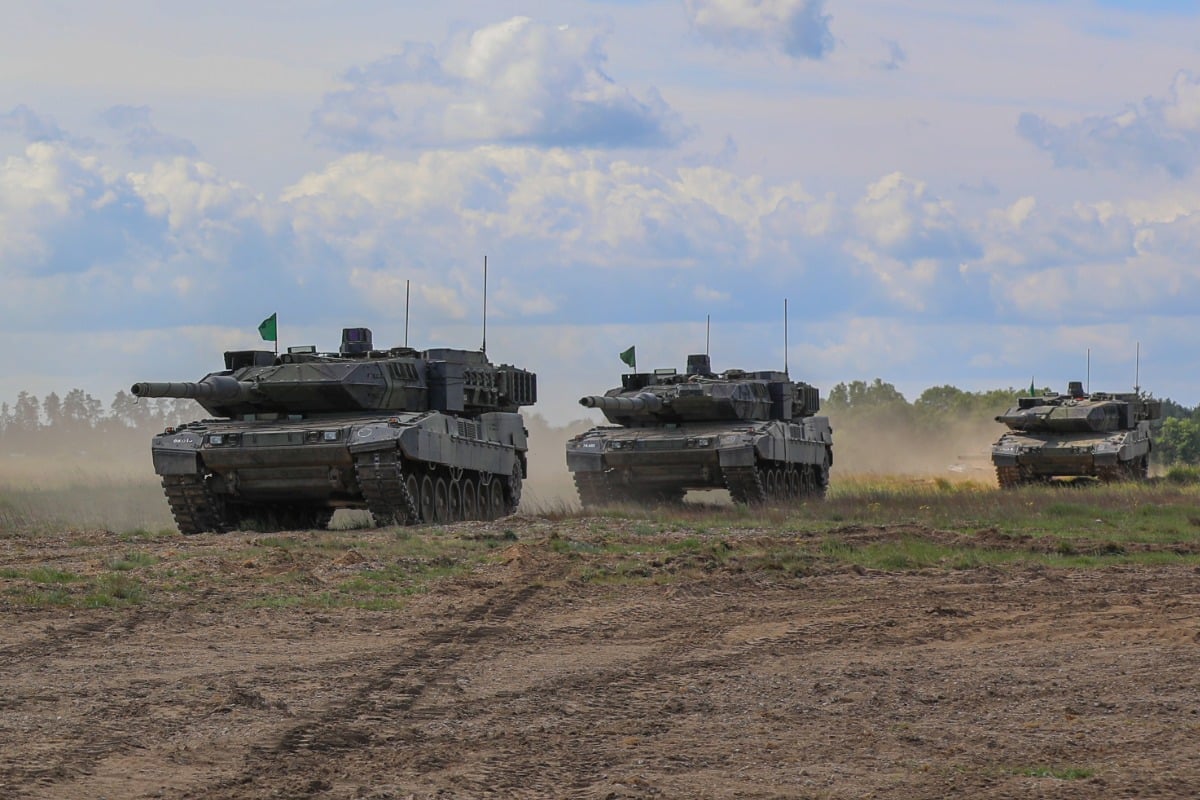
Industrial milestones in military procurement are rarely about the celebration itself; they are indicators of long-term platform viability and supply chain stabilization. The initiation of production on the 4,000th RENK HSWL 354 transmission at the Augsburg facility marks a critical data point for the Leopard 2 main battle tank (MBT) ecosystem. In heavy tracked armor design, the transmission is not merely a component; it is the definitive bottleneck or enabler of tactical movement. Weighing 2,250 kilograms without oil, this hydromechanical, reversing, and steering system serves as the mechanical nexus between raw engine output and combat weight distribution across 50-to-70-ton platforms.
To understand the strategic significance of this production volume, one must move past generic descriptions of reliability and look closely at the mechanical principles, operational economics, and industrial constraints governing heavy armor propulsion systems.
The Mechanics of Kinetic Conversion
The HSWL 354 operates within a highly demanding power envelop, managing engine outputs ranging from 900 to 1,300 kilowatts ($1,200 \text{ to } 1,800 \text{ hp}$). The system solves a fundamental engineering paradox: moving a 60-plus-ton vehicle from a dead stop to maximum velocity while maintaining the ability to pivot on its own axis instantly.
The system uses three core subsystems inside a single housing:
- The Power Shift Mechanism: Operating via a planetary gear design with four forward and four reverse speeds, it relies on a hydrodynamic torque converter with an automatic lock-up clutch. The stall torque ratio of 2.5 acts as a mechanical multiplier during the high-inertia startup phase, transitioning to direct mechanical drive via the lock-up clutch once operational velocity is reached to maximize thermal and fuel efficiency.
- The Superimposed Steering System: Unlike wheeled vehicles or light armor that rely on differential braking, the HSWL 354 uses a hydrostatic-hydrodynamic superimposed steering loop. This design allows infinitely variable turning radii. Power is diverted from the main drive shaft to accelerate the outer track while decelerating the inner track, preserving total kinetic energy rather than converting it into wasted heat through brake friction.
- The Integrated Braking Loop: The service brake integrates a non-wearing hydrodynamic retarder with mechanical service and parking brakes. The retarder absorbs the vast majority of kinetic energy during high-speed deceleration, protecting the mechanical brake discs from thermal fade and wear.
[Engine Power Output: 900–1,300 kW]
                │
                ▼
   [Torque Converter / Lock-Up]
                │
                ▼
   [Planetary Powershift Stage] ───► [Superimposed Steering Unit]
                │                                │
                ▼                                ▼
   [Hydrodynamic Retarder]         [Track Velocity Differential]
                │                                │
                └───────────────┬────────────────┘
                                │
                                ▼
                   [Final Drives & Sprockets]
This integrated design directly dictates the platform's combat weight limit. When an MBT receives upgraded armor packages, the transmission bears the burden of increased rotational inertia. The mechanical ratio of 4.5 across the gears provides the required torque density, but running near the upper limit of a 70-ton threshold increases internal hydraulic pressures and alters the wear cycle of the multi-disc clutches.
The Logistics Blueprint: Interchangeability and Fleet Economics
The industrial lifecycle of a military transmission relies heavily on commonality. The 4,000 units produced do not map one-to-one with the number of Leopard 2 hulls in existence. Instead, they reflect a wider ecosystem across variants and derivative platforms.
Variant Allocation and Derivative Vehicles
The HSWL 354 is not exclusive to the Leopard 2 MBT. It is integrated across a family of combat engineering and support vehicles, including the Büffel Armoured Recovery Vehicle (ARV) and specialized driver training platforms. This multi-role deployment stabilizes logistics pipelines. A maintenance detachment in a NATO armored brigade handles identical core powerpack interfaces whether servicing a frontline combat asset or a recovery vehicle.
The Powerpack Replacement Cycle
The operational availability of heavy armor depends on a rapid modular maintenance strategy known as the "powerpack" concept. The engine—typically an MTU multi-fuel diesel—and the RENK transmission are coupled structurally with the cooling system into a single unit.
The maintenance cycle relies on precise time metrics:
- Field Extraction: A specialized recovery crew can lift and extract the complete powerpack from a Leopard 2 hull in under 30 minutes under field conditions.
- Decoupling: The transmission can be unbolted from the engine block, inspected, and replaced with a depot-level spare unit without requiring structural modifications to the hull.
- Rotational Logistics: This modularity isolates hull availability from component repair times. If a transmission suffers a hydraulic pump failure, the vehicle returns to combat readiness using a spare powerpack, while the damaged transmission enters a secondary repair loop at a deeper maintenance depot.
This approach introduces specific economic constraints. Operating a fleet requires a structural surplus of transmissions relative to hulls—a float ratio typically maintained between 1.15 and 1.30 depending on expected operational tempos. This surplus ensures that when units are pulled for depot-level overhaul after their designated operating hour intervals, combat units face zero reduction in immediate readiness.
Industrial Scaling and Next-Generation Upgrades
The announcement of the 4,000th unit coincides with an active development cycle for the upcoming evolution of Western MBT platforms, specifically the Leopard 2 A8 and modern international configurations. The increase in defense spending across NATO member states creates an industrial bottleneck that requires moving away from boutique, slow-rate artisan manufacturing toward repeatable, high-density industrial assembly.
The manufacturing challenges of a hydromechanical system like the HSWL 354 are found primarily in the tight tolerances required for its hydraulic control blocks and planetary gear carriers. Minor variations in material composition or surface finish can cause localized cavitation, fluid breakdown, and eventual gear tooth pitting under high loads.
The strategic plan for this propulsion architecture must address two clear operational issues:
- Thermal Management Boundaries: As vehicle weight pushes past 65 tons due to active protection systems (APS) and increased floor armor, the heat rejected by both the torque converter and the hydrodynamic retarder grows exponentially. The existing cooling loop, driven by power take-offs from the transmission itself, faces hard thermodynamic limits within the fixed geometry of the engine compartment.
- The NextGen Mobility Agenda: The development contracts currently underway focus on digitizing the hydraulic control interfaces. Transitioning from analog hydraulic actuation to digital drive-by-wire controls is necessary to integrate autonomous or semi-autonomous driving modes. It also enables predictive maintenance arrays that monitor fluid pressure variances and temperature spikes in real time to flag internal seal degradation before catastrophic mechanical failure occurs.
The future of heavy armor mobility depends on managing these thermal and mechanical stresses. The industrial infrastructure at the Augsburg site must pivot from sustaining legacy fleets to scaling these NextGen architectures. The baseline established by these 4,000 units provides the data needed to accurately model wear, fatigue, and fluid dynamics under heavy loads. This operational history will guide the engineering decisions for the next generation of armored combat vehicles.