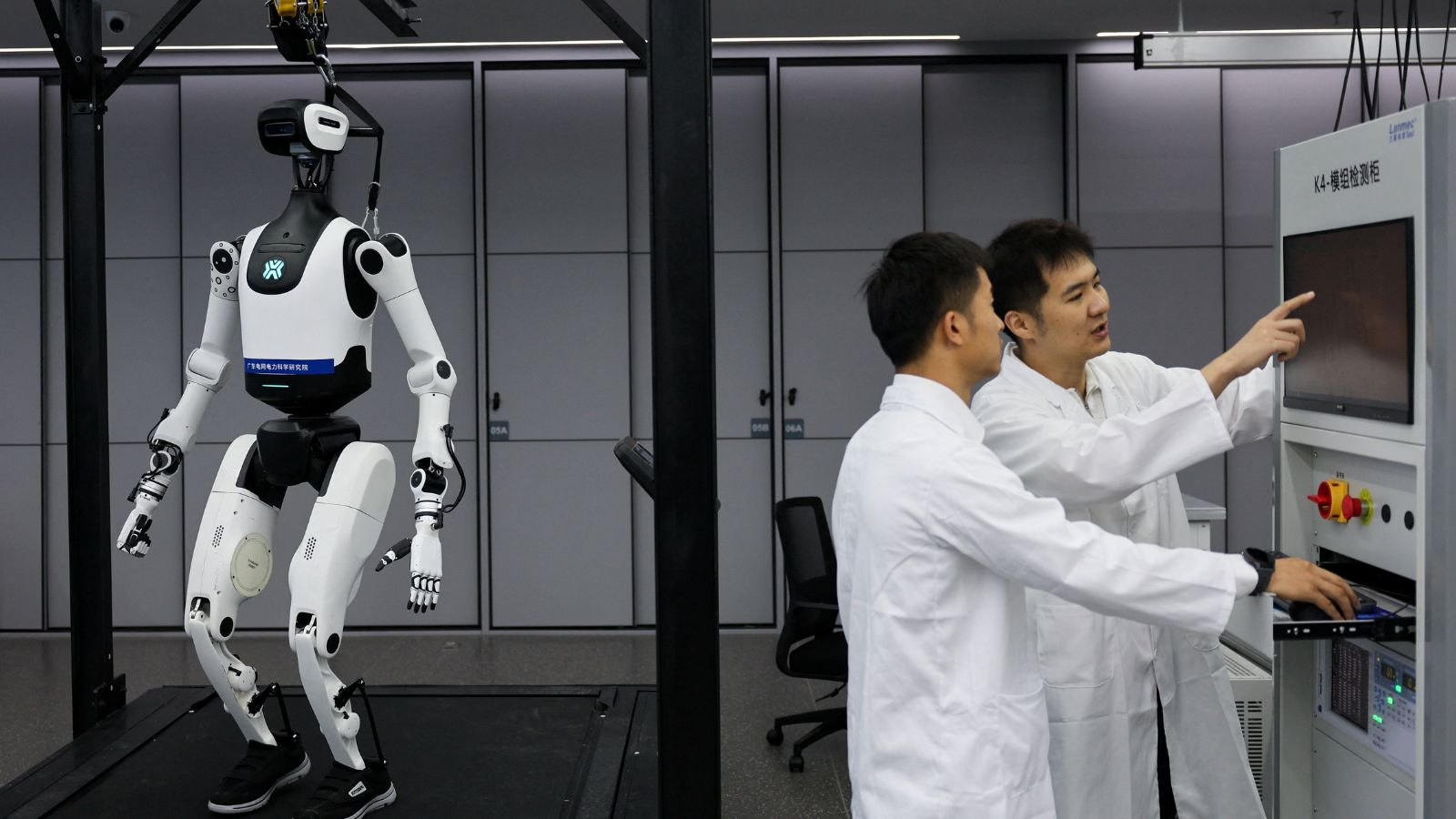
Geopolitical competition is increasingly waged through the structural architecture of supply chains rather than traditional tariffs. The Federal Communications Commission decision to expand its Covered List to prohibit imports of foreign-produced advanced robotic devices and connected power inverters marks a definitive shift in state-directed industrial policy. By targeting humanoid and quadruped robots alongside grid-tied inverters, regulatory authorities are preemptively closing vectors of systemic risk at the intersection of energy infrastructure and artificial intelligence deployment.
Understanding this maneuver requires dismantling the policy into its underlying risk vectors, economic incentives, and operational consequences. The intervention is not merely a punitive trade action; it is a systemic effort to decouple critical domestic growth sectors from adversarial manufacturing dependencies.
The Dual Threat Matrix of Hardware Dependencies
The rationale underpinning the regulatory expansion rests on two distinct technological vulnerabilities: the physics of energy distribution grids and the data-collection surface area of autonomous physical systems. Regulatory authorities have categorized these risks into structural supply chain dependencies and active cyber-physical attack surfaces.
Power inverters serve as the vital electronic translation layer between variable renewable energy sources, battery storage systems, and the high-voltage transmission grid. As the energy transition accelerates, the volume of inverter-based resources connected to transmission and distribution networks expands exponentially.
Modern commercial inverters require continuous remote connectivity for firmware updates, telemetry reporting, and performance optimization. This remote accessibility creates an inherent architectural vulnerability.
If manufacturing origins are concentrated within a geopolitical competitor's jurisdiction, the firmware and hardware components contain potential remote-control pathways. An adversary with deep access could theoretically manipulate phase synchronization, trigger simultaneous trips across decentralized installations, or execute localized blackouts.
Advanced robotic systems—specifically humanoid and quadruped form factors—represent an entirely separate risk vector centered on spatial intelligence and data harvesting. These units operate with advanced sensor suites, including high-resolution LiDAR, stereoscopic optical cameras, and spatial mapping algorithms.
When deployed within logistics hubs, manufacturing plants, or research facilities, these machines ingest proprietary environmental layouts and operational telemetry. The regulatory determination emphasizes that network-enabled hardware can quietly aggregate spatial data, map critical infrastructure internals, and transmit intelligence directly to foreign entities. Furthermore, the dual-use nature of mobility hardware means remote override capabilities could transform automated commercial assets into vectors for physical disruption.
Market Asymmetry and the Production Deficit
The urgency behind the import prohibition stems from a severe structural imbalance in global hardware manufacturing capacity. In the advanced robotics sector, market concentration heavily favors producers originating from outside Western industrial bases.
Empirical market tracking indicates that Chinese manufacturers account for a dominant share of global shipments for humanoid and quadruped platforms, driven by mature domestic supply chains for low-cost actuators, high-density batteries, and localized artificial intelligence integration. Conversely, domestic alternatives remain constrained by higher capital expenditure requirements, longer iteration cycles, and nascent manufacturing scale.
This production deficit creates a dangerous economic trap for Western artificial intelligence firms. If domestic developers build their deployment pipelines around cheaper, highly capable foreign hardware to accelerate deployment, the entire automation ecosystem becomes structurally dependent on external components.
The regulatory ban acts as a hard stop to this dependency loop. By choking off the influx of new foreign models before domestic production capacity reaches scale, policymakers are forcing a painful, immediate transition toward localized supply chains.
The Mechanism of Regulatory Enforcement and Exemption Pathways
The execution of the ban leverages the framework of the Secure and Trusted Communications Networks Act, utilizing the FCC Covered List mechanism. Unlike traditional customs tariffs that use pricing levers to discourage imports, the Covered List approach imposes an absolute prohibition on authorization for new equipment models.
The mechanics of the directive operate on precise legal and temporal boundaries:
- Immediate Effect: The restrictions apply instantly to new models of foreign-produced power inverters and advanced robotic devices that have not yet received prior authorization for commercial sale within the United States.
- Existing Inventory Discretion: Previously authorized devices and deployed hardware are largely untouched by the initial text, though regulatory agencies retain residual authority to revoke past authorizations if specific threat thresholds are breached.
- Conditional Exemption Pathways: The framework incorporates an interagency review process through the Department of War and the Department of Homeland Security. Manufacturers or system operators can petition for conditional approvals if they can cryptographically and structurally prove that specific hardware deployments are isolated from foreign intelligence exploitation or supply chain tampering.
This exemption architecture is designed to prevent immediate grid paralysis or logistics stalls. For instance, large-scale utility operators dependent on specific inverter topologies can seek waivers while domestic or allied manufacturing capacity ramps up to fill the void.
Downstream Economic Friction and Strategic Realignment
Artificially severing supply chains introduces immediate friction into the capital expenditure plans of clean energy developers and automation adopters. In the short term, the cost of deploying utility-scale solar and storage projects will face upward pressure as developers scramble to source compliant, non-foreign inverters. Non-Chinese tier-one suppliers will experience surging demand, giving them pricing power that will temporarily inflate project budgets.
In the robotics sector, the restriction acts as a brutal forcing function for venture capital and engineering talent within the United States and allied nations. Capital that might have previously flowed into software optimization running on foreign-built chassis must now pivot toward hardware engineering, specialized semiconductor design for edge robotics, and domestic electromechanical manufacturing.
The strategy accepts short-term operational inefficiency and higher capital costs as an acceptable premium for long-term technological sovereignty. By legally mandating the elimination of adversarial hardware from energy grids and autonomous logistics, the state has fundamentally altered the calculus of technology procurement. Procurement officers can no longer optimize purely for unit economics; they must now treat supply chain provenance as a primary variable of national security compliance.