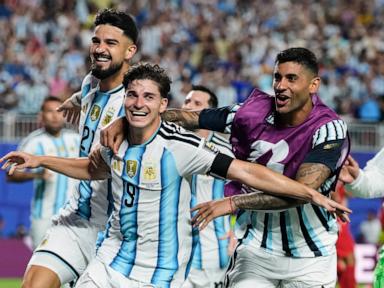
You don't win back-to-back World Cups by playing beautiful soccer for seven straight games. You do it by dragging yourself through the mud, surviving bizarre refereeing decisions, and letting individual brilliance bail you out when your structural blueprint falls apart.
That is exactly what Lionel Scaloni’s team just did at Kansas City Stadium.
Argentina beat Switzerland 3-1 in extra time to book a spot in the semifinals against England. If you just look at the final score, it looks like a comfortable, textbook victory for the defending champions. It wasn't. It was an absolute mess. It was an grueling, nerve-shredding 120 minutes where Lionel Messi's historic World Cup scoring streak came to a grinding halt, a Swiss player left the pitch in tears over a rare protocol rule, and a substitute forward saved an entire nation from the lottery of a penalty shootout.
The night tactical structure went out the window
The game started with typical Argentine efficiency. In the 10th minute, Lionel Messi swung a corner into the box. Alexis Mac Allister, standing at just 1.76 meters, somehow out-jumped a cluster of towering Swiss defenders to power a header past Gregor Kobel.
With that single cross, Messi broke the all-time World Cup record with his 10th career assist, moving past Germany’s Fritz Walter. It looked like the rout was on.
But Murat Yakin’s Switzerland side is incredibly stubborn. They had only conceded three goals in the entire tournament leading up to this match. They didn't panic. Instead, they pushed higher up the pitch, disrupted Argentina's midfield rhythm, and began testing Emiliano Martínez.
The equalizer felt inevitable when it arrived in the 67th minute. Dan Ndoye capsized the Argentine defense with a slick, one-touch buildup involving Ricardo Rodríguez, eventually sliding the ball straight through the legs of Martínez.
Suddenly, the world champions looked completely rattled.
The mistaken identity drama that changed everything
Five minutes after the Swiss equalizer, the entire match turned on its head because of a rule book technicality.
Argentine midfielder Leandro Paredes went into a challenge on Breel Embolo. The Swiss forward went down, and Portuguese referee João Pinheiro initially pulled out a yellow card for Paredes. But then the Video Assistant Referee intervened.
The VAR officials didn't review a red card; they asked Pinheiro to look at a case of "mistaken identity" under the tournament's new protocols. The replays revealed there was absolutely no contact. Embolo had completely simulated the fall to win a free kick.
Because the yellow card was originally meant for the incident, the booking was transferred away from Paredes and given directly to Embolo for simulation. The problem? Embolo had already been booked in the 44th minute.
Pinheiro flashed the second yellow, followed by the red. Embolo was reduced to tears, and Switzerland had to play the remaining 50 minutes of the match down to 10 men. It was only the second time in World Cup history that the mistaken identity rule has been used to flip a card onto the attacking player for diving.
Grinding down a ten-man wall
Even with the numerical advantage, Argentina looked completely devoid of ideas in the final minutes of normal time. Messi had a one-on-one chip saved by Kobel, and Lisandro Martínez attempted a wild, desperate scissor-kick in the box that lacked the power to beat the keeper.
The Swiss simply sat deep, packed the penalty area, and played for a penalty shootout, replicating the exact defensive strategy they used to get past Colombia in the previous round.
It took an instant of pure individual quality to shatter the Swiss wall. In the 112th minute, Julián Álvarez picked up a pass from late substitute José Manuel López on the left edge of the box. With the Swiss defenders backing off to protect the penalty spot, Álvarez found a pocket of vacant space.
He didn't hesitate. The 26-year-old forward unleashed a ferocious, right-footed curling strike that zoomed into the top right corner of Kobel’s net. It was his first goal of this World Cup, and honestly, it couldn't have come at a bigger moment.
With Switzerland pushing everyone forward for a desperate, last-minute equalizer, Argentina struck on the counterattack in the 120th minute. Lautaro Martínez ran onto a loose rebound after a saved Thiago Almada shot, tapping it into the empty net to seal the 3-1 victory.
How the final four shape up
This victory keeps Argentina’s incredible unbeaten run alive. They are now unbeaten in 12 consecutive World Cup matches dating back to the opening game of Qatar 2022.
It also ensures that the top four teams in the official FIFA rankings—Argentina, England, France, and Spain—have all successfully navigated the expanded 48-team bracket to reach the semifinals.
Argentina now travels to Atlanta to face England on Wednesday. It will be the first time these two fierce rivals have crossed paths in a World Cup since 2002. Scaloni's team has shown they know how to suffer; they needed extra time against Cape Verde, a massive multi-goal comeback against Egypt, and another 120-minute war against Switzerland just to get here. They aren't playing pristine soccer, but they are surviving, and right now, that's all that matters.