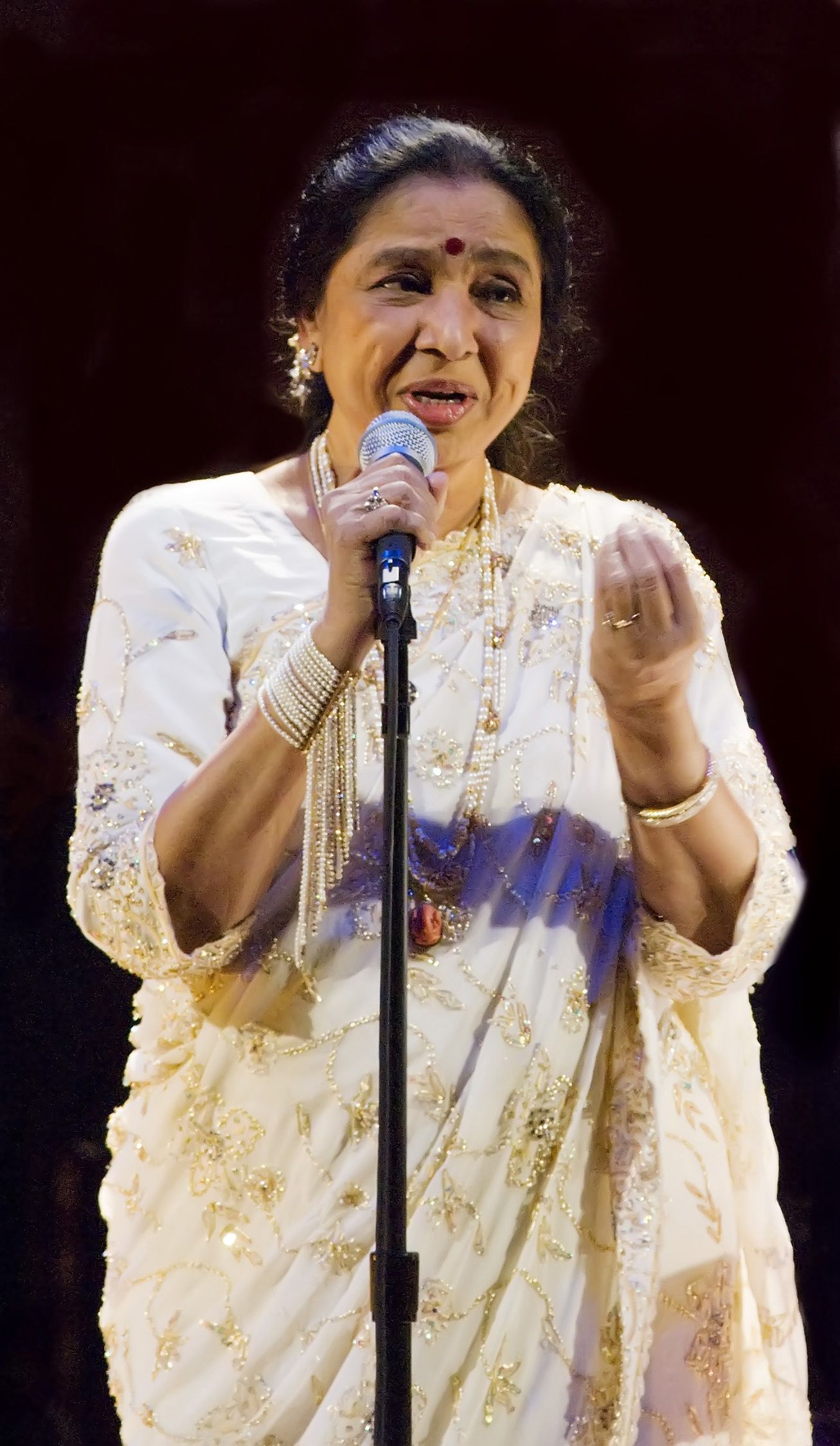
The obituaries are already rolling off the press like factory-stamped sheet metal. They all say the same thing. They call her the "Queen of Versatility." They'll mention the 12,000 recorded songs, the Guinness World Record, and the inevitable, tired comparison to her sister, Lata Mangeshkar. They treat her 92-year life as a triumph of range.
They are wrong. For a closer look into this area, we suggest: this related article.
Calling Asha Bhosle "versatile" is a polite way of saying the industry didn't know what to do with her for twenty years. It’s a lazy label used by critics who mistake survival for strategy. Bhosle wasn't a jack-of-all-trades; she was the ultimate disruptor of a rigid, puritanical vocal monopoly that nearly choked the life out of Hindi cinema’s golden age. If you think her legacy is about singing "everything," you’ve missed the point entirely. Her legacy is about the violent reclamation of the female voice from the "virginal" archetype.
The Monopoly of the Monotone
To understand why Bhosle matters, you have to stop worshipping the 1950s playback system. For decades, the Indian film industry suffered from a collective obsession with the "Sati-Savitri" vocal profile. It was thin, high-pitched, and surgically devoid of any physical texture. Lata Mangeshkar didn't just lead this movement; she was its architect. For further context on this topic, in-depth reporting can also be found at Rolling Stone.
Music directors of that era—C. Ramchandra, Shankar-Jaikishan, Naushad—were terrified of a voice that sounded like it belonged to a woman who had actually lived. They wanted ethereal ghosts.
Asha Bhosle was relegated to the "vamp" songs, the club dances, and the second-lead scraps because her voice had a flaw the industry couldn't handle: grain. There was a huskiness, a dip in the frequency, and a rhythmic elasticity that felt dangerous to the status quo.
The "lazy consensus" says she eventually "found her range." The truth? She outlasted the gatekeepers. She didn't broaden her style to fit the industry; she waited for the world to get bored of perfection.
The O.P. Nayyar Experiment: Engineering the Rebellion
If you want to see where the "versatility" myth falls apart, look at her work with O.P. Nayyar. He was the only composer with the stones to banish the Lata-style flute and violin orchestrations in favor of the Punjabi dhol and the Hawaiian guitar.
Nayyar didn't ask Bhosle to be versatile. He asked her to be rhythmic. In songs like Aao Huzoor Tumko, Bhosle isn't just singing a melody. She is playing an instrument. Most singers of her era were obsessed with the "sur" (the note). Bhosle was obsessed with the "laya" (the beat). She pioneered the use of the glottal stroke—that sharp, breathy intake of air—which most classical purists at the time considered a technical failure.
I’ve sat in rooms with sound engineers who try to "clean up" modern vocals to the point of sterility. They are trying to recreate the 1950s ghost-voice. When you listen to Bhosle’s 1960s tracks, you hear the "imperfections"—the breath, the slight rasp, the smirk behind the lyric. That wasn't a lack of training. It was a middle finger to the establishment.
The RD Burman Pivot: Not Evolution, But Survival
The most over-analyzed period of her career is the 1970s collaboration with RD Burman. This is where the "Queen of Pop" narrative took hold. People point to Dum Maro Dum as the moment she became a legend.
Let’s be honest: Dum Maro Dum was a desperate act of sonic warfare.
The industry was shifting. The hippie movement was leaking into Bollywood. The "pious heroine" was losing ground to the "rebellious youth." Bhosle didn't "evolve" into this; she was the only one who had the technical foundation to execute it.
While other singers were struggling to hit the high notes of a bhajan, Bhosle was studying Western jazz and cabaret. She understood that a microphone is a confidant, not just a recording device. She pioneered "crooning" in an industry that only understood "shouting."
The "People Also Ask" Fallacy: Was She Better Than Lata?
This is the most common, and most useless, question in the history of Indian music. It’s built on a false binary.
- Lata Mangeshkar represented the Ideal.
- Asha Bhosle represented the Real.
One was a goddess; the other was a woman. The tragedy of the "versatility" argument is that it tries to make Asha a goddess too. By claiming she could do everything her sister did, fans inadvertently strip away her most potent weapon: her humanity.
Bhosle’s best work isn't when she’s mimicking the classical purity of Umrao Jaan. It’s when she’s singing Piya Tu Ab To Aaja. In that song, the "he-man" panting isn't a gimmick. It’s a rhythmic bridge. It’s a singer treating her lungs like a percussion section. No one else would have dared to do it because they were too busy protecting their "reputation."
The Technical Reality: The Micro-Shift in Phrasing
The "battle scars" of a career spanning eight decades aren't found in the trophies. They are found in the murkis (the fast melodic ornamentations).
If you analyze the waveform of a Bhosle track versus her contemporaries, you’ll see a higher density of micro-tonal shifts. She didn't just slide from 'Sa' to 'Re'. She took the scenic route. She added a swing that didn't exist in the sheet music.
This is what modern producers get wrong. They think "Asha-style" means singing a fast song with a bit of sass. It’s not. It’s about the attack. It’s hitting the consonant with enough force to create a percussive pop before the vowel takes over. It’s a technique borrowed from the thumri tradition but applied to disco.
The Downside of Being the "Everything" Singer
There is a cost to this supposed versatility. Because Bhosle could—and would—sing anything, she was often given garbage.
For every Mera Kuch Saamaan, there are a hundred forgettable tracks from the 1980s that she saved with sheer willpower. Her willingness to experiment meant she often became the laboratory for bad ideas. The industry exploited her range to cover up lazy songwriting.
If she had been "less versatile," if she had been more precious about her brand, she might have a "cleaner" discography. But she chose the grind. She chose to be the workhorse of the studio system. That’s not a romantic "artistic journey." That’s a gritty, commercial survivalist winning a war of attrition.
The Wrong Lesson for Today’s Artists
Today’s singers are told to "find their niche." They are told to build a "brand identity."
The industry looks at Asha Bhosle and says, "See? You can do everything!"
This is the wrong takeaway. Bhosle didn't succeed because she could do everything. She succeeded because she brought the same specific soul to everything. Whether she was singing a ghazal or a raunchy item number, the "Asha-ness"—the grit, the playfulness, the rhythmic precision—never changed.
Don't strive for versatility. Strive for an unbreakable core.
The Final Disruption: Why 2026 Marks the End of an Era
With her passing in 2026, the last bridge to the pre-digital era of Indian music has collapsed. But don't mourn the "voice." The voice is archived. The voice is being fed into AI models as we speak.
Mourn the nerve. We live in an age of pitch-correction and quantized beats. We live in an age where singers are afraid to sound like they have bodies. Asha Bhosle’s entire career was an argument for the flesh. It was an argument for the breathy, the messy, and the syncopated.
She wasn't the "Queen of Versatility." She was the Queen of the Rebellion. She spent seventy years proving that the "perfect" voice is a lie told by people who are afraid of the dark.
Stop looking for the next Asha Bhosle. She was a product of a specific type of friction—the tension between a conservative society and a changing world. That friction doesn't exist anymore. We have all the "versatility" in the world now, and yet, we have never sounded more the same.
The record is over. Stop trying to flip it.