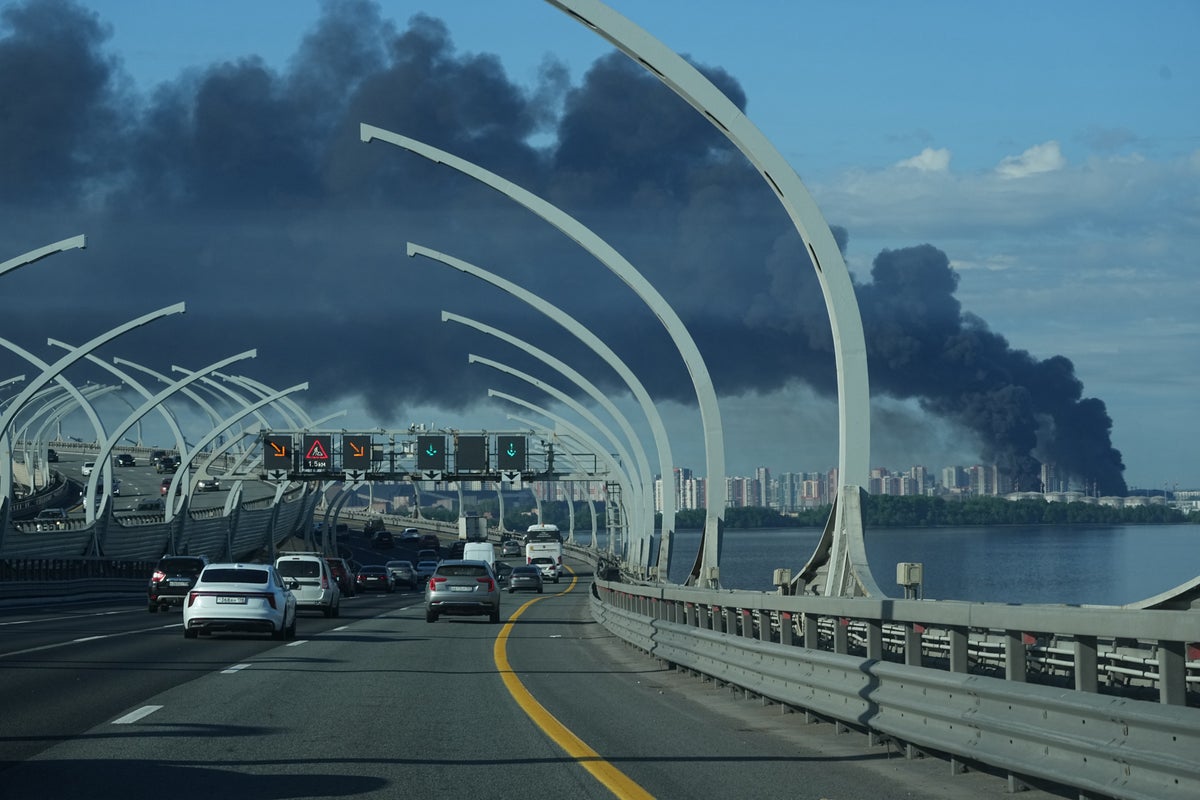
The convergence of kinetic asymmetric warfare and macroeconomic theater was made visible at the opening of the St. Petersburg International Economic Forum (SPIEF). A Ukrainian long-range unmanned aerial vehicle (UAV) strike ignited the Petersburg Oil Terminal and targeted the Kronstadt naval base, casting literal and structural shadows over Russia's premier investment showcase. This operational intersection reveals a deeper structural reality: Russia’s defense architecture is confronting an compounding cost curve where cheap, attritional systems force expensive, destabilizing domestic reallocations of capital and military assets.
While political commentary frames these events around optics and prestige, an analytical evaluation must focus on the quantifiable friction imposed on Russia’s internal economy, logistics, and resource distribution frameworks. The strategic calculus of these strikes extends far beyond the immediate localized damage of an oil terminal; it functions as an economic tax designed to drain Russia's state capacity.
The Economics of Asymmetric Air Defense
The structural imbalance of the current long-range attrition campaign can be mapped through a fundamental cost-exchange ratio. Ukraine’s deep-strike capabilities rely on low-cost, long-range attack UAVs manufactured domestically. These platforms feature simple internal combustion engines, composite or wooden hulls with low radar cross-sections, and commercial-grade GPS or cellular guidance systems optimized for low-altitude flight paths.
$$C_{\text{UAV}} \ll C_{\text{AD}}$$
Where $C_{\text{UAV}}$ represents the marginal cost of production for the offensive drone (typically between $20,000 and $50,000), and $C_{\text{AD}}$ represents the cost of the intercepting air defense missile system (such as the S-400, Pantsir-S1, or Tor-M2 networks, where a single interceptor missile ranges from $100,000 to over $1 million).
This mathematical imbalance yields three distinct structural pressures on the Russian defense economy:
- The Depletion Curve of Surface-to-Air Missiles (SAMs): Because Russia must defend an expansive geographical landmass containing thousands of high-value industrial targets, it faces a structural optimization bottleneck. It cannot simultaneously deploy dense, multi-layered air defense umbrellas over active frontline forces, the capital city of Moscow, and secondary industrial hubs like St. Petersburg. Every interceptor expended 1,200 kilometers away from the front lines reduces the available stock for theater-level operations.
- The Opportunity Cost of Electronic Warfare Deployment: To counter the influx of low-altitude drones during the SPIEF event, regional authorities took the drastic step of shutting down or throttling civilian mobile internet and commercial GPS networks across parts of the Leningrad oblast. This action exposes the functional limits of Russian electronic warfare (EW). Active GPS jamming and spoofing degrade local cellular infrastructure, disrupting digital commerce, port logistics, financial transactions, and automated supply-chain operations in Russia's second-largest metropolitan economy.
- Frontline Dilution: The Kremlin’s stated objective—as articulated by official channels noting that forces must press deeper into Ukraine to prevent these incursions—reveals a forced strategic choice. Russia is compelled to allocate maneuver units and air defense batteries away from high-priority offensive axes in the Donbas to establish border buffer zones and interior security perimeters.
Logistical Friction and the Hydrocarbon Export Vulnerability
The targeting of the Petersburg Oil Terminal underscores a calculated attempt to introduce friction into Russia's primary revenue generation mechanism. Located on the Gulf of Finland, the terminal is a vital node for Baltic maritime trade, possessing a fuel transit capacity of roughly 12.5 million metric tons annually.
The economic fallout of strikes on such critical energy nodes is governed by a distinct supply-chain cascade:
[Kinetic Strike on Terminal]
       │
       ▼
[Destruction of Refining/Storage Capacity]
       │
       ▼
[Forced Storage Accumulation or Wellhead Shut-Ins]
       │
       ▼
[Regional Distribution Bottlenecks & Rail Grid Strain]
When a transshipment hub or refinery is damaged, the impact is rarely limited to lost product. The true vulnerability lies in the inflexibility of midstream infrastructure. Oil production is a continuous chemical and mechanical process; if terminal storage tanks or pumping stations are rendered inoperable, upstream producers must either divert crude via rail or pipeline networks to alternative ports, or face wellhead shut-ins.
Because Russia’s western pipeline networks are rigid and highly centralized, any sustained disruption at Baltic ports forces excess volume onto the internal rail network. This creates an immediate logistical bottleneck. The Russian rail system, managed by RZD, is already operating at near-maximum capacity due to the reorientation of trade toward East Asia and the heavy military requirements of moving heavy armor, ammunition, and personnel. Forcing millions of barrels of displaced petroleum products onto specialized rail tank cars starves other industrial sectors—such as agriculture, metallurgy, and manufacturing—of essential transport capacity.
Furthermore, the operational disruptions extend directly into civil aviation. The drone activity forced immediate airspace closures and delayed or diverted dozens of commercial flights at St. Petersburg’s Pulkovo Airport, alongside secondary restrictions across major Moscow hubs. In a highly centralized, continent-sized economy, civil aviation delays introduce a measurable drag on labor productivity, executive mobility, and high-value domestic supply chains.
The Structural Limits of War-Led Growth
The timing of the strikes directly challenges the narrative of sustainable economic performance projected at SPIEF. While Russia's headline GDP growth figures have shown resilience over the past few years, a rigorous macroeconomic decomposition reveals that this expansion is driven primarily by military Keynesianism—a massive expansion of state spending funded through liquidating national reserves and imposing structural taxes.
The sustainability of this model is constrained by severe structural limits:
The Inflation-Interest Rate Spiral
To fund a prolonged conflict, the state has injected trillions of rubles directly into the military-industrial complex. This injection has triggered severe structural overheating. The influx of liquidity, combined with a profound labor deficit caused by military mobilization and the emigration of high-skilled professionals, has driven inflation far above the central bank's target. In response, the Bank of Russia has been forced to maintain a restrictive monetary policy, holding the benchmark interest rate at highly elevated levels. This dynamic raises the cost of capital for any domestic enterprise operating outside the subsidized defense perimeter, stifling non-defense capital expenditure and private-sector innovation.
The Fiscal Rebalancing Paradox
The initial fiscal cushion provided by high energy prices and the rapid redirection of crude oil to non-aligned markets has begun to narrow. The state budget deficit has widened, prompting the Kremlin to implement sweeping changes to the tax code, including progressive income tax tiers and increased corporate tax rates. Simultaneously, domestic borrowing has increased dramatically. These mechanisms shift capital from the productive private sector directly into non-productive, asset-destroying military output. While a tank or an artillery shell counts positively toward GDP figures during its manufacture, it yields zero long-term economic utility once deployed and destroyed on the battlefield.
The Limits of Alternative Capital Inflows
SPIEF was originally conceived as Russia’s direct analog to the World Economic Forum, designed to court Western institutional capital and Fortune 500 corporations. The current iteration relies on a fundamentally altered composition of attendees, drawing delegations from Saudi Arabia, Central Asia, and Africa. While these engagements serve important diplomatic purposes, they do not replace the deep technology transfers, joint ventures, and direct investment mechanisms that historically anchored Russia's high-tech and energy-extraction sectors. The presence of symbolic Western figures cannot mask the hard data: foreign direct investment (FDI) from capital-exporting economies into non-defense Russian industries has experienced a structural collapse.
Strategic Playbook for Infrastructure Resilience
For corporate entities, state planners, and infrastructure operators navigating this highly volatile operating environment, relying on conventional risk-mitigation frameworks is insufficient. Managing deep-theater asymmetric threats requires a fundamental shift from passive defense to active operational redundancy.
- Distributed Midstream Architecture: Energy and logistics firms must intentionally decentralize their storage and refining profiles. Relying on massive, highly centralized transshipment hubs like the Petersburg Oil Terminal creates high-reward kinetic targets. Operations should be disaggregated into smaller, modular satellite storage arrays that can be rapidly isolated via automated manifold systems when a breach occurs, keeping the broader distribution network functional.
- Hardened Passive Defense and Kinetic Point Protections: Because state-level air defense systems are structurally overextended, critical infrastructure operators must invest directly in localized, private point-defense solutions. This includes the widespread installation of physical anti-drone netting arrays over sensitive components such as distillation towers, electrical substations, and storage tank valves. Additionally, companies must deploy non-kinetic, localized electronic jamming systems optimized specifically to disrupt commercial drone telemetry bands without interfering with regional civilian communication grids.
- Algorithmic Logistics Rerouting: Logistics networks must move away from static scheduling models toward dynamic, algorithmically driven rerouting protocols. In the event of localized airspace closures, port suspensions, or rail corridor blockages, supply chains must automatically recalibrate to utilize secondary and tertiary transit paths. This requires building excess structural capacity and pre-negotiating emergency access agreements across competing transit lines, treating operational redundancy not as an inefficient cost center, but as a core requirement for business continuity.


