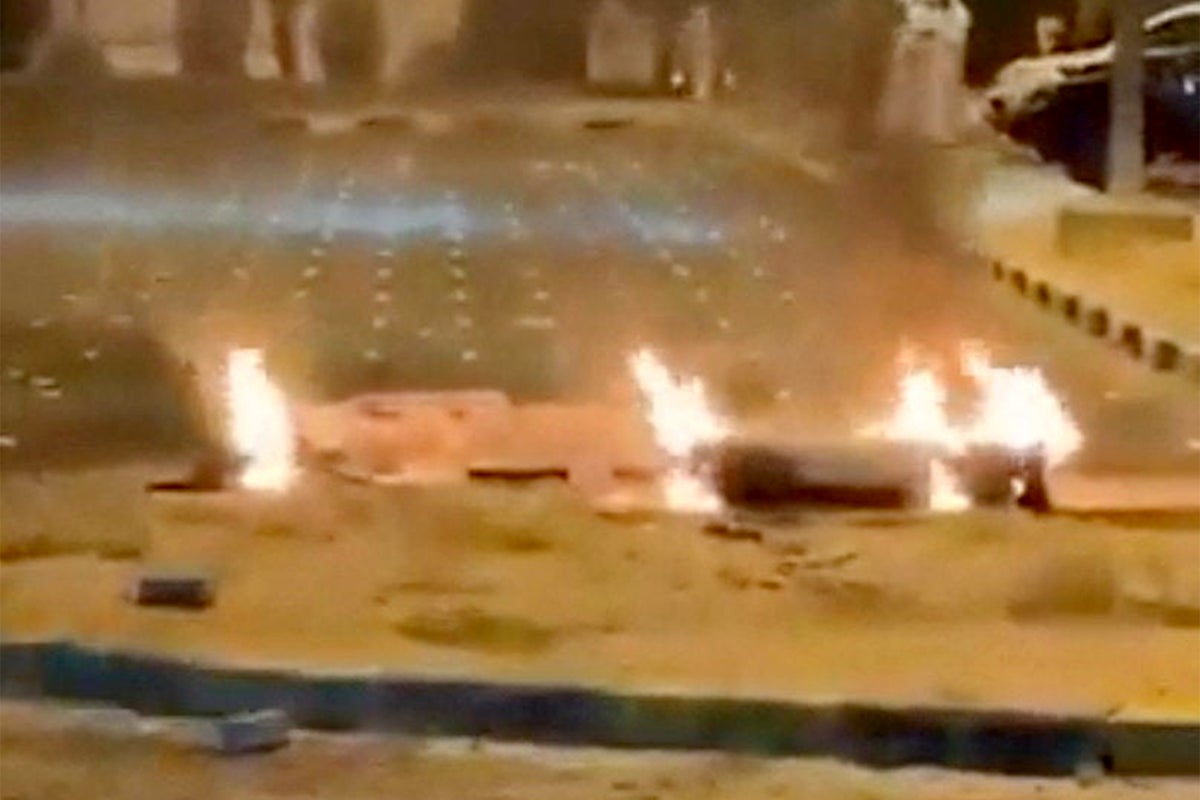
The physical manifestation of a fire on Kuwaiti soil following an Iranian uncrewed aerial vehicle (UAV) and missile strike is not an isolated tactical incident; it is a systemic demonstration of asymmetric warfare designed to exploit vulnerabilities in global energy supply chains. When precision-guided munitions or low-cost loitering munitions penetrate highly defended airspace to strike critical infrastructure, they alter the risk premium of the entire region. The true metric of success for such an operation is not the immediate blast radius, but the compounding economic, logistical, and geopolitical ripples that follow the kinetic event.
Evaluating these disruptions requires moving away from sensationalized reporting and toward a rigid structural analysis of how modern energy nodes operate under fire. By dissecting the event through the lens of air defense saturation, infrastructure vulnerability, and global energy market mechanics, we can quantify the real-time friction introduced into the global economy.
The Saturation Mechanics of Asymmetric Air Defense
The deployment of low-cost loitering munitions alongside ballistic or cruise missiles represents a calculated exercise in air defense degradation. This doctrine relies on a stark economic and operational asymmetry: the cost function of the attacker is orders of magnitude lower than the cost function of the defender.
Attacker Cost (UAV + Missile Salvo) << Defender Cost (Interceptor Batteries + Radar Wear)
To understand how an attack successfully breaches an airspace as heavily monitored as the Persian Gulf, we must analyze the three core variables of the saturation equation:
- Target Volatility and Radar Cross-Section (RCS): Modern loitering munitions utilize composite materials and small internal combustion engines, yielding a minimal radar cross-section. When these platforms fly at low altitudes, they blend into terrain clutter, severely compressing the detection envelope of ground-based radar systems.
- Kinetic Saturation Volumetrics: Air defense batteries possess a finite number of engagement channels. If a missile battery can track and engage twelve targets simultaneously, an attack composition of fifteen vectors guarantees that three assets will penetrate the kinetic envelope, regardless of the interceptor success rate.
- Velocity Vector Mixing: By launching slow-moving, low-altitude UAVs simultaneously with high-altitude, high-velocity ballistic missiles, the attacker forces integrated air and missile defense (IAMD) systems to calculate radically different intercept trajectories. This splits the focus of automated fire-control systems and increases the probability of human or algorithmic targeting friction.
When these three variables optimize in favor of the attacker, a breach occurs. The resulting impact on an energy facility is rarely a product of total structural destruction; instead, it is an exercise in surgical economic immobilization.
Infrastructure Vulnerability and the Refinement Bottleneck
Sensational media reports often focus on dramatic images of burning storage tanks. From an engineering perspective, striking a crude oil storage tank is highly visible but strategically inefficient. Storage tanks are redundant, isolated by earthen berms, and easily bypassed via crude switching manifolds. The true structural vulnerabilities within an oil-and-gas downstream asset lie in highly complex, long-lead-time processing nodes.
The Fractionation and Distillation Vulnerability
The core of any refining asset is the atmospheric and vacuum distillation units. These towering structures operate under extreme thermal and pressure gradients to separate crude oil into intermediate feedstocks. Because these columns are tightly integrated with complex piping networks, a kinetic strike causes immediate thermal shock, catastrophic decompression, and secondary unconfined vapor cloud explosions (UVCE). Replacing a specialized fractionating column requires custom metallurgical fabrication, leading to procurement lead times that frequently exceed twelve to eighteen months.
Hydrocracking and Desulfurization Units
Kuwait’s environmental and economic strategy relies heavily on producing clean-burning, low-sulfur fuels via advanced hydrocracking units. These units utilize high-pressure hydrogen environments to strip sulfur from hydrocarbons. A breach in this sector does not merely start a localized fire; it releases highly toxic hydrogen sulfide gas and creates a high-energy chemical fire that burns at temperatures sufficient to compromise the structural integrity of surrounding steel supports.
The compounding effect of a successful strike on these specific nodes is an immediate reduction in refining capacity, forcing an energy-exporting nation to shift its export mix from high-margin refined products (such as ultra-low sulfur diesel and aviation turbine fuel) back to low-margin, unrefined sour crude. This structurally degrades the nation's fiscal balance sheet.
The Global Energy Market Cost Function
The immediate consequence of physical damage to an energy node is a recalibration of risk models across commodity trading desks. The market response to a kinetic event in the Middle East functions via three distinct transmission channels.
Total Market Friction = Physical Supply Deficit + Maritime Insurance Risk Premium + Strategic Stockpile Depletion Velocity
The first channel is the immediate physical supply deficit. If a strike removes 500,000 barrels per day of refining capacity from the global ledger, a structural deficit emerges in specific product markets. Because global supply chains operate on just-in-time logistics, even a marginal 1% shift in the global supply-demand equilibrium can trigger a non-linear, double-digit percentage spike in spot prices.
The second channel operates through the maritime shipping sector. The waters surrounding the Arabian Peninsula represent the primary chokepoints of global energy transit. When land-based infrastructure is hit, maritime insurance underwriters immediately reclassify the adjacent shipping lanes—such as the Strait of Hormuz or the Bab al-Mandab—as war-risk zones.
| Cost Element | Pre-Strike Baseline | Post-Strike Friction Level |
|---|---|---|
| Hull War Risk Premium | 0.05% of vessel value | 0.5% to 1.0% of vessel value per transit |
| Freight Demurrage Rates | Standard contract rates | Elevated due to rerouting delays |
| Crew Hazard Pay | Standard wages | Double-time requirements within active zones |
This surge in insurance premiums functions as an invisible tariff on every barrel of oil moving through the region, paid ultimately by the global consumer.
The third channel is the acceleration of strategic stockpile depletion. When physical flows are interrupted, sovereign nations draw down their strategic petroleum reserves (SPR) to stabilize domestic markets. While this mechanism dampens short-term price volatility, it reduces the long-term macroeconomic resilience of those consuming nations, leaving them increasingly exposed to subsequent supply shocks.
Structural Geopolitical Realignments
Beyond the immediate financial architecture, a kinetic confrontation involving Iran and GCC states like Kuwait forces a structural realignment of regional security frameworks. The historical security paradigm in the Gulf—predicated on western security guarantees in exchange for uninterrupted energy flows—faces a severe stress test when low-cost asymmetric weapons successfully bypass multi-billion-dollar defense networks.
This operational reality forces regional powers to pursue a dual-track strategy. On one hand, it accelerates investment in deep-tier defense tech, specifically directed-energy weapons (DEW) and high-capacity kinetic counter-UAV systems capable of altering the cost-per-interception ratio. On the other hand, it drives a pragmatic, defensive diplomatic posture. Smaller states bordering intense regional rivalries must balance their strategic partnerships, seeking to deter aggression while simultaneously maintaining diplomatic backchannels to prevent their industrial infrastructure from becoming a kinetic theater for broader proxy conflicts.
The Strategic Playbook for Infrastructure Resilience
To mitigate the systemic vulnerabilities exposed by this strike profile, energy operators and sovereign states must abandon passive defense concepts and implement an active, hardened operational framework.
Hardening physical assets against kinetic intrusion requires constructing reinforced concrete blast walls around critical fractionation nodes and deploying automated, independent deluging systems capable of suppressing high-temperature hydrocarbon fires without relying on centralized control networks. Redundancy must be engineered into the system at the digital and physical level, ensuring that manifold switching systems can immediately re-route feedstocks away from damaged modules to preserve partial operational capacity.
Concurrently, the integration of counter-uncrewed aerial systems (C-UAS) must be shifted directly to the enterprise level. Industrial facilities can no longer rely solely on state-level air defense umbrellas. Deploying localized electronic warfare arrays capable of GPS spoofing, radio-frequency jamming, and kinetic net-capture systems at the perimeter of the facility creates a localized, multi-layered denial envelope. This tactical layer serves as the final, critical barrier against low-altitude asymmetric threats, decoupling the physical security of vital energy nodes from the broader, unpredictable fluctuations of regional geopolitical stability.