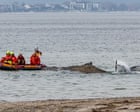
A solitary humpback whale is currently suffocating in the brackish, shallow waters of the Baltic Sea, and the window for a successful intervention is slamming shut. While local headlines focus on the spectacle of a rare sighting, the biological reality is far more grim. This animal is not just lost. It is trapped in an ecological cul-de-sac that was never designed to support its massive caloric or physiological needs.
The Baltic Sea is effectively a giant bathtub with a narrow, treacherous drain. For a deep-water specialist like a whale, entering through the Danish Straits is easy; getting back out against the prevailing currents and through congested shipping lanes is a death sentence. Marine biologists on the ground warn that without an immediate, coordinated international effort to herd or transport the animal back to the North Sea, we are merely watching a slow-motion necropsy.
The Biological Toll of Low Salinity
Humpback whales are built for the high seas. Their bodies are calibrated for the high-density, high-salinity environment of the Atlantic. The Baltic Sea, by contrast, is one of the largest bodies of brackish water on Earth. This creates an immediate problem of buoyancy and skin integrity.
When a whale enters a low-salinity environment, its skin begins to break down. The osmotic pressure changes, causing the epidermal layers to swell and slough off. This leaves the animal vulnerable to opportunistic fungal infections and lesions that would never take hold in the open ocean. Moreover, the lower density of the water means the whale must expend more energy just to stay afloat and swim. It is working twice as hard for half the reward.
Dietary collapse follows quickly. The Baltic lacks the massive concentrations of krill and calorie-dense schooling fish required to sustain a creature of this magnitude. A humpback needs to consume roughly 1.5 tons of food per day during its feeding season. In these waters, it is essentially fasting while its metabolic rate skyrockets due to the stress of the environment. Every hour it remains east of the Oresund Bridge, it is burning through its blubber reserves at an unsustainable pace.
A Gauntlet of Industrial Noise and Steel
If the biology doesn't kill it, the infrastructure might. The Baltic Sea is among the most heavily trafficked maritime regions in the world. At any given moment, more than 2,000 large commercial vessels are underway. For a whale that relies on echolocation and acoustic communication, this environment is a deafening, disorienting nightmare.
The sound of container ships, tankers, and high-speed ferries creates a constant wall of "acoustic fog." This prevents the whale from navigating effectively. It cannot hear the subtle cues of the coastline or the movement of deep-water currents. Instead, it becomes panicked, often diving deeper into bays or lagoons where the water is even shallower and the risk of stranding becomes absolute.
Furthermore, the Baltic is littered with "ghost nets"—discarded fishing gear that never degrades. A weakened whale, struggling with buoyancy and blinded by noise, is a prime candidate for entanglement. Once a humpback is tethered to the seafloor by a derelict net, its death is certain, usually by drowning as it loses the ability to reach the surface for air.
The Myth of Passive Observation
There is a pervasive school of thought among certain wildlife agencies that "nature should take its course." This is a convenient excuse for bureaucratic inertia. The presence of a humpback in the central Baltic is not a natural event; it is an anomaly often driven by shifting prey patterns caused by rising sea temperatures or seismic activity from offshore construction.
Waiting for the whale to find its own way out is a fantasy. Historical data on large cetaceans entering the Baltic shows a near-total mortality rate for those that do not exit within the first week. The Swedish and German authorities often find themselves caught in a jurisdictional vacuum, debating who pays for the fuel and the specialized personnel required for a "harassment" maneuver—using small boats and acoustic pingers to drive the whale toward the exit.
Passive observation is simply a polite term for a vigil. If the objective is conservation, then the current strategy of "monitoring" is a failure of duty. We have the technology to track these animals in real-time using satellite tags and the maritime expertise to guide them. The bottleneck is not capability, but political will and the fear of a botched rescue attempt appearing on the evening news.
Why Rescue Operations Often Stall
Executing a successful herding operation is fraught with logistical nightmares. It requires a fleet of specialized vessels, divers on standby, and a cleared corridor free of commercial traffic. Shutting down a section of a major shipping lane for twelve hours to save a single animal carries a price tag in the millions of euros.
The Cost of Intervention
- Vessel Chartering: High-end research and rescue ships cost upwards of $20,000 per day.
- Specialized Logistics: Acoustic deterrent devices and hydrophone arrays require expert operators.
- Opportunity Cost: Halting commercial shipping creates a ripple effect through European supply chains.
Critics argue that spending such vast sums on a single, likely doomed individual is poor resource management. They suggest the funds would be better spent on habitat protection. However, this ignores the symbolic and scientific value of these interventions. Each failed rescue is a lost opportunity to refine the techniques we will inevitably need as climate change pushes more marine giants into hostile, human-dominated waters.
The Psychological Impact of the Stranding
The public reaction to a stranded whale follows a predictable pattern: initial wonder, followed by concern, and ending in collective trauma when the carcass inevitably washes up on a beach. This cycle is preventable. The emotional weight of watching a magnificent creature die over the course of weeks has a tangible impact on local communities and undermines public trust in environmental agencies.
When a whale dies in the Baltic, it doesn't just disappear. The carcass becomes a massive biological hazard. Gases build up during decomposition, leading to the risk of explosion, and the sheer volume of rotting tissue can contaminate local shorelines for months. The cost of disposing of a 30-ton humpback carcass—often involving heavy machinery, specialized transport, and incineration—frequently exceeds the cost of the initial rescue attempt.
Lessons from Past Encounters
We have seen this play out before. In the mid-2000s, a similar situation occurred in the Thames, and more recently, various "lost" whales have appeared in the Mediterranean. The successful interventions shared one common trait: speed. The moment the animal was identified as being in a high-risk zone, the decision to intervene was made within 48 hours.
In the Baltic, we are already past that window. The humpback is reportedly showing signs of lethargy, a clear indicator that its fat stores are depleted and its internal organs are struggling against the lack of salt. Every day spent in committee meetings is a day the whale loses the strength required to make the 150-mile swim back to the Skagerrak.
The Responsibility of Maritime Nations
The Baltic Sea is a shared resource, and the responsibility for its wildlife falls on every nation that borders it. We cannot treat the arrival of a whale as a freak accident or a tourist attraction. It is a biological emergency.
If we are to prevent the Baltic from becoming a permanent graveyard for North Atlantic giants, we need a standing, well-funded task force capable of rapid deployment. This group must have the legal authority to override local maritime traffic regulations and the budget to act without waiting for private donations or sluggish government grants.
The current situation is a test of our commitment to the marine life we claim to protect. If we allow this humpback to perish because the paperwork was too complex or the cost of a few days of boat fuel was deemed too high, we have ceded our role as stewards of the ocean.
The whale is still breathing. For now.
Call the emergency response teams in Kiel and Stockholm. Clear the shipping lanes. Move the animal now, or prepare the excavators for the beach.