The air in the basement of the Bibliothèque Nationale de France feels heavy, thick with the scent of decaying leather and old dust. If you ask to see the personal papers of Marie Skłodowska Curie, you will not be led to a sunlit reading room. Instead, you will be asked to sign a liability waiver. You will be handed protective clothing.
For more than a century, these ordinary household objects—recipe books, personal letters, scrawled laboratory notes, and even pieces of furniture—have lived locked away in lead-lined boxes.
They are warm to the touch. They glow with a faint, ghostly luminescence if the room is dark enough. They are also entirely capable of killing you.
We tend to look at the history of science through a sterile lens. We see black-and-white photographs of solemn faces, textbooks filled with equations, and brass plaques in museum hallways. We forget the dirt. We forget the blood, the sweat, and the sheer, blinding obsession that drives a human being to dismantle the known universe with their bare hands. Marie Curie did not just discover radium. She breathed it. She carried it in her pockets. She slept with it on her nightstand, watching its green-blue light flicker against the bedroom walls like a tiny, captured star.
She thought it was beautiful. It was, in reality, a patient executioner.
The Weight of a Glowing Paperweight
Step back to the turn of the twentieth century. Imagine a drafty, abandoned wooden shed on the Rue Lhomond in Paris. It had no floorboards, the roof leaked when it rained, and the summer heat turned the interior into a suffocating greenhouse. Inside this makeshift laboratory, a woman is hunched over a boiling vat of pitchblende. She handles twenty kilograms of the brown, earth-crusted ore at a time, stirring it with an iron rod nearly as large as herself.
Her hands are covered in raw, peeling burns. She chalks it up to the harsh chemicals, the friction of the iron, or perhaps just the dry winter air.
Marie and her husband, Pierre, were working in total darkness—both literally and metaphorically. They were chasing a ghost. They knew that pitchblende contained something far more active than uranium, but they had no idea what that activity actually meant for the human body. To them, the glowing vials of isolated radium were a triumph over the mundane world. Marie would later write about the joy she and Pierre felt when they returned to the dark shed at night, seeing the luminous silhouettes of their test tubes shining like faint fairy lights on the wooden tables.
But radioactivity is not a magic trick. It is the literal tearing apart of atomic nuclei, a microscopic barrage of high-energy particles slicing through anything in their path.
When you look at Marie Curie’s notebook today, you are not just looking at historical syntax. You are looking at a battlefield. Every time she reached for a pen, her fingers left behind a microscopic trail of radium-226. That specific isotope has a half-life of roughly 1,600 years.
Think about that timeline. A millennium and a half. The Roman Empire collapsed roughly 1,500 years ago. If Julius Caesar had possessed a vial of radium, it would still be spitting out lethal alpha particles today at nearly the same intensity as the day he died. The words Marie wrote about her daily life, her shopping lists, and her revolutionary discoveries will remain actively toxic long after the cities we live in today have crumbled into unrecognizable dust.
The Illusion of Safety
It is easy to look back from our modern, safety-regulated vantage point and judge the past. We have yellow hazard signs, Geiger counters, and strict government protocols. We know the invisible dangers of the electromagnetic spectrum.
But consider the sheer confusion of that era. Radium was a miracle. It was the ultimate marketing buzzword. Because it could destroy cancerous tumors, the public—and many scientists—assumed it was a universal source of vitality.
Entrepreneurs quickly capitalized on the craze. Companies sold radium-infused drinking water to cure arthritis. There were radium cosmetics promising a luminous complexion, radium toothpastes to whiten smiles, and even radioactive blankets designed to revitalize the elderly. The world was utterly intoxicated by the light.
Pierre Curie, perhaps sensing the erratic nature of their discovery, once tested the element on his own flesh. He strapped a sample of radium to his arm for ten hours. The resulting burn took months to heal, leaving a permanent gray scar. Yet, the couple remained undeterred. The obsession was too deep. The pursuit of pure knowledge had eclipsed the basic human instinct for self-preservation.
Then came the reckoning.
It started quietly. Chronic fatigue. Persistent aches. The skin on their fingertips became permanently scarred and numb from handling raw isotopes. Pierre met a sudden end in 1906, not from radiation, but from a rain-slicked Paris street where he slipped and fell beneath the wheels of a heavy horse-drawn wagon. His body, however, was already deeply compromised. Had the carriage not claimed him, the air he breathed surely would have.
Marie carried on alone, driven by a stubborn, almost terrifying resolve. She drove X-ray vans to the front lines of World War I, exposing herself to unimaginable doses of radiation to save wounded soldiers. She won a second Nobel Prize. She became a global icon. And all the while, her bone marrow was slowly, systematically being dismantled by the very element she had named and given to the world.
The Silent Inheritance
She died in 1934 from aplastic anemia. The medical report stated explicitly that her bone marrow had failed to function, its regenerative capabilities destroyed by a long accumulation of radiations.
When her house in Sceaux was finally cleared out years later, authorities realized the entire structure was a hot zone. The wallpaper, the carpets, the utensils, and the books were all humming with an invisible energy. The French government had to decontaminate the property, and her personal effects were transferred to the national library, sealed away like ancient, cursed artifacts.
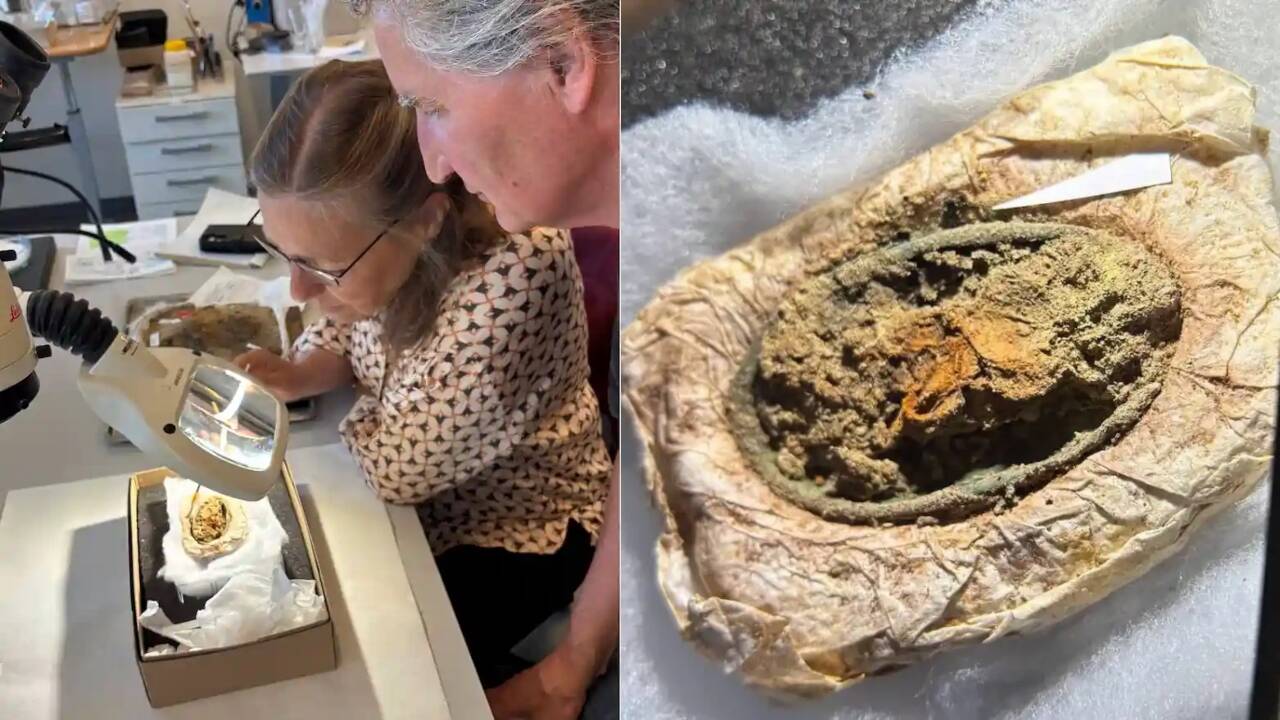
Today, if a researcher wishes to handle these papers, the experience is less like an academic pursuit and more like an archaeological dig in a exclusion zone. The lead box opens with a heavy, metallic thud. Inside lies the physical manifestation of an obsession.
There is a profound irony in the way we preserve history. We build monuments out of marble and bronze to ensure our heroes are never forgotten. But Marie Curie created her own immortal monument, woven directly into the atomic structure of her belongings. Her legacy is not merely intellectual; it is physical, atomic, and terrifyingly persistent.
When you see a photograph of her standing by her laboratory bench, looking tired, thin, and entirely consumed by her work, you realize she wasn't just studying science. She was consumed by it. The furniture she sat on, the ledgers she signed, the letters she sent to her daughters—they are all physical extensions of her life's work, still vibrating with the energy she unlocked from the earth.
The lead boxes in Paris will remain shut for centuries to come. They serve as a stark, quiet reminder of the price of discovery. True genius often requires a vulnerability so total that it burns away the self, leaving behind a light that refuses to go out.