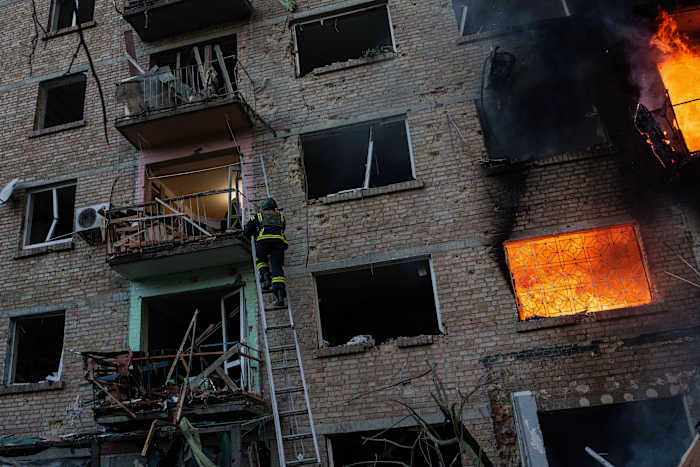
The operational stalemate on the 1,250-kilometer front line in southern and eastern Ukraine has forced a shift in Russian military doctrine toward high-leverage asymmetric options. While tactical focus remains fixed on the grinding attrition in the Donbas, the primary strategic vulnerability for Ukraine sits on its unengaged northern border. The joint tactical nuclear drills conducted by Minsk and Moscow, followed immediately by Russia's largest coordinated missile assault on Kyiv using hypersonic Oreshnik systems, are not isolated escalations. They represent a calculated optimization of the "Belarus Option"—a highly efficient strategic lever that imposes severe defensive costs on Ukraine without requiring the immediate kinetic commitment of the Belarusian Armed Forces.
To understand the mechanics of this northern threat, analysts must look past the diplomatic posturing of regional leaders and focus on the structural dependence and geometric constraints governing the Minsk-Moscow axis.
The Strategic Cost-Imposition Framework
The utility of Belarus to the Russian General Staff can be expressed as a function of strategic distraction. By maintaining a credible threat of a secondary invasion axis from the north, Moscow forces Ukraine into a permanent misallocation of defensive resources.
The Northern Front Dilemma
Ukraine cannot afford to leave its 1,000-kilometer northern border undefended. The memory of February 24, 2022, when Russian forces utilized Belarusian infrastructure to launch a rapid armored advance toward Kyiv, dictates that a baseline defensive posture must be sustained. This creates a structural bottleneck for the Armed Forces of Ukraine:
- Force Dilution: High-readiness brigades, engineering units, and western-supplied air defense assets that are urgently required to stabilize the eastern front must instead remain garrisoned in the north.
- Fortification Sunk Costs: Vast capital and logistical resources are continuously diverted to construct deep defensive lines, minefields, and anti-tank obstacles along the Belarusian border, reducing the resources available for counter-offensive operations elsewhere.
- Air Defense Overextension: The geographic proximity of Minsk to Kyiv compresses the early-warning window for missile and drone strikes. Air defense batteries must be positioned to cover a 360-degree vector, significantly lowering the defense density over critical industrial and energy infrastructure in the east.
This dynamic allows Russia to achieve a multiplier effect. A minimal deployment of Russian personnel and regional joint forces inside Belarus ties down a disproportionately large percentage of Ukrainian combat power. The Kremlin effectively achieves defensive denial along the northern border at a near-zero operational casualty rate.
The Asymmetrical Dependence Matrix
Alexander Lukashenko's current geopolitical posture is governed by a strict matrix of economic survival and domestic security constraints. The regime's survival functions entirely through its relationship with the Russian state, leaving Minsk with minimal strategic autonomy.
+--------------------------------------------------------------------------+
|                      Kremlin Subsidies & Loans                           |
|                                  |                                       |
|                                  v                                       |
|                    +---------------------------+                         |
|                    | Lukashenko Regime Survival|                         |
|                    +---------------------------+                         |
|                                  ^                                       |
|                                  |                                       |
|                        Military Integration                              |
+--------------------------------------------------------------------------+
The underlying mechanism of this relationship relies on three distinct dependencies.
First, the economic baseline of Belarus is fully subsidized by Moscow. The regime relies on sub-market-rate Russian crude oil and natural gas imports, direct financial loans to roll over sovereign debt, and access to Russian maritime ports to bypass comprehensive Western sanctions.
Second, the structural integration of the Belarusian and Russian militaries is now effectively complete. The establishment of joint training centers, the permanent stationing of Russian air defense units within Belarus, and the recent joint execution of tactical nuclear deployment drills mean that the Belarusian General Staff operates as a functional subsidiary of the Western Military District of the Russian Federation.
The third variable is the internal security imperative. The 2020 domestic political crisis demonstrated that the Lukashenko regime lacks independent domestic legitimacy. Its survival depends on the explicit guarantee of Russian security intervention in the event of renewed internal unrest.
Consequently, any attempt by Minsk to diversify its foreign policy or pursue diplomatic resets with the West is structurally constrained. Recent moves by Lukashenko to release political prisoners to secure marginal relief from U.S. sanctions reflect an attempt to gain leverage. However, these tactical maneuvers cannot decouple Belarus from its underlying structural dependence on Russia.
The Escalation Vector Checklist
To evaluate whether Belarus will transition from a passive staging ground to an active participant or a launchpad for a renewed ground offensive, intelligence analysts must monitor three specific operational indicators. A qualitative shift on the northern border will not occur overnight; it requires measurable logistical and command infrastructure adjustments.
1. Integration of Joint Command Structures
The primary indicator of an imminent offensive is the formal transition of command and control from independent national structures to a unified theater command. Analysts must look for the establishment of forward operational headquarters staffed by senior Russian officers within the Belarusian Ministry of Defense, alongside the synchronization of tactical communication networks down to the brigade level.
2. Logistical Pre-Positioning and Ammunition Class-Loading
A ground offensive requires massive logistical depth that Belarus cannot hiddenly sustain. The critical indicators include:
- The deployment of Russian Field Hospitals and medical supply chains to southern Belarus.
- Anomalous rail traffic density moving heavy armor, self-propelled artillery, and engineering bridging equipment toward the Gomel and Brest regions.
- The forward movement of Class V ammunition supplies (artillery shells and tactical missiles) to subterranean storage facilities near the Ukrainian border.
3. Electronic Warfare and Airspace Deconfliction
Prior to any kinetic movement, the electronic environment will shift. The deployment of high-tier Russian electronic warfare suites (such as the Krasukha-4 or Leer-3 systems) along the border to map and suppress Ukrainian communication nodes is a prerequisite. This will be accompanied by the enforcement of permanent airspace restrictions over southern Belarus to clear corridors for tactical aviation and missile launch platforms.
The Strategic Pivot Point
The introduction of the Oreshnik hypersonic ballistic missile system into the theater, combined with the acute shortage of Western-manufactured air defense interceptors in Ukraine—compounded by the supply chain strains of the parallel conflict involving Iran—has altered the security calculus. The northern border is no longer merely a hypothetical ground threat; it is an active vector of technological coercion.
The French diplomatic initiative, marked by direct communication between President Emmanuel Macron and Alexander Lukashenko, indicates that Western intelligence views the current integration of Russian tactical nuclear capabilities into Belarusian territory as a critical threshold. The Western response aims to establish a clear deterrent framework: the direct entry of Belarusian forces into the conflict, or the allowance of a major new Russian ground assault from its territory, will trigger the immediate expansion of symmetrical counter-measures. These would likely include the total economic isolation of the Minsk regime and the potential authorization for Ukraine to utilize long-range Western precision strike assets against military infrastructure inside Belarus.
The optimal strategy for Ukraine under these conditions is not passive defense. The Ukrainian military command must execute preventive defensive measures. This involves hardening the northern frontier through autonomous electronic defense networks, expanding automated drone surveillance corridors to minimize human troop requirements, and communicating a credible threat of immediate, devastating cross-border retaliation against Belarusian energy and transport infrastructure if the northern border is breached. By raising the entry cost for Minsk, Kyiv can maintain the neutrality of the Belarusian Armed Forces, neutralise Russia's cheapest strategic weapon, and maximize the concentration of its combat power where the war will ultimately be decided.