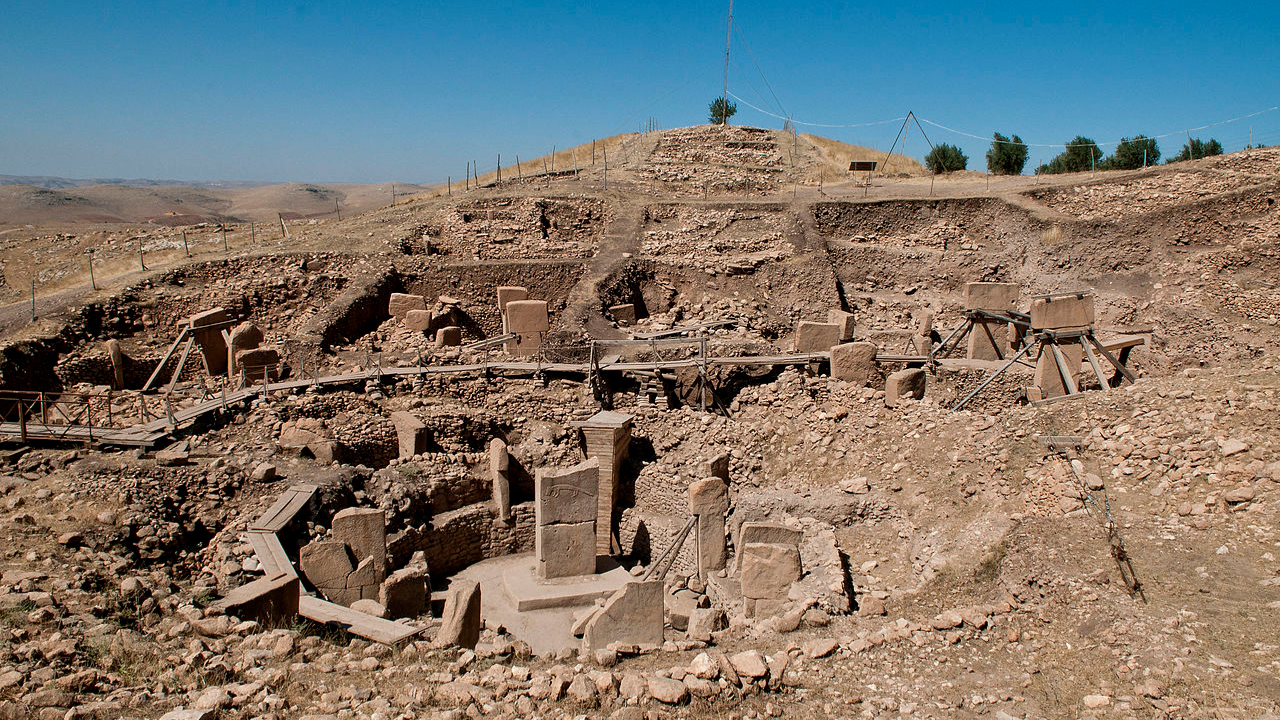
Göbekli Tepe functions as a 12,000-year-old anomaly that invalidates the linear progression model of human civilization. The traditional "Agricultural Revolution" thesis—which posits that farming created surpluses that subsequently enabled monumental architecture—is inverted here. The archaeological record at the Urfa region of Turkey demonstrates that the social technology of mass mobilization and complex symbolic communication preceded the domestication of plants and animals. This site represents a massive expenditure of caloric and organizational capital by pre-sedentary hunter-gatherers, shifting the historical focus from "how humans fed themselves" to "how humans organized high-density labor without a state apparatus."
The Energetic Cost of Megalithic Construction
To understand the builders of Göbekli Tepe, one must quantify the labor-to-yield ratio of the PPN (Pre-Pottery Neolithic) era. The limestone pillars, some weighing upwards of 20 tons, were quarried from nearby plateaus and transported to the summit of a germinal hill.
The "Labor Mobilization Variable" consists of three primary constraints:
- Caloric Logistics: Moving a 10-to-20-ton pillar requires an estimated crew of 500 individuals. In a world without domesticated grain (wheat, barley) or pack animals, this workforce had to be sustained by the surrounding landscape’s wild biomass. The logistics of feeding 500 to 1,000 laborers daily through hunting and gathering alone requires a sophisticated supply chain that likely exhausted local resources within a 30-kilometer radius.
- Specialized Craftsmanship: The high-relief carvings of gazelles, scorpions, and lions are not the work of opportunistic amateurs. They indicate a "Knowledge Class"—individuals whose primary contribution to the tribe was symbolic and technical rather than caloric.
- Technological Tooling: The absence of metal tools meant that these limestone monoliths were shaped using flint and obsidian. This necessitates an industrial-scale production of lithic tools, implying a secondary labor force dedicated solely to tool maintenance and sharpening.
This massive caloric expenditure suggests that Göbekli Tepe was not a byproduct of surplus, but a driver for its creation. The need to feed the builders of the temple likely catalyzed the selective breeding of wild grasses, leading directly to the birth of agriculture in the nearby Karaca Dağ mountains.
Structural Logic of the T-Pillar Design
The central characteristic of Göbekli Tepe is the T-shaped pillar. These are not merely decorative; they are stylized anthropomorphic representations. The presence of carved arms, belts, and loincloths on several pillars suggests a hierarchy of entities.
The spatial configuration follows a "Concentric Isolation" logic:
- The Enclosure: Large, circular structures built of stone walls.
- The Sentinels: Two massive central pillars, often taller than the surrounding ones, facing each other.
- The Perimeter: Smaller pillars embedded into the circular wall.
This layout dictates a specific movement pattern for participants, likely restricting access to the central space. In a sociological context, this represents the transition from egalitarian hunter-gatherer bands to a proto-hierarchical society. The central pillars do not have faces, suggesting they represent abstract concepts, ancestors, or deities rather than specific living leaders. This abstraction is a cognitive leap; it requires a shared fiction that can bind together disparate groups who are not related by blood.
Environmental Entropy and the Mechanism of Burial
The most significant data point in the Göbekli Tepe mystery is the intentional backfilling of the enclosures. Around 8,000 BCE, the site was systematically buried under thousands of tons of limestone rubble, soil, and animal bones. This was not a natural event; it was a deliberate "Decommissioning Protocol."
The structural reasons for this burial likely fall into two categories:
1. The Obsolescence of Social Technology
As agriculture became the dominant economic engine, the nomadic, hunting-focused rituals of Göbekli Tepe may have become obsolete. The site’s iconography is heavily skewed toward wild, dangerous predators (snakes, foxes, boars). A sedentary farming society values different symbols—fertility, rain, and domesticated cycles. When the old system no longer provided a return on the social investment, the site was "retired" to prevent its desecration or to mark a hard transition into a new era.
2. The Sanctification of Memory
In many PPN cultures, burial was a way of preserving the power of an object. By covering the site, the builders protected it from the elements and from rival groups. The material used for backfilling contains a disproportionately high amount of animal bone fragments, suggesting that the burial itself was accompanied by a massive, final feast—an "Exit Cost" that depleted the local wild game as the population shifted toward the plains and domesticate-reliant life.
The Geographic and Genetic Exit
The builders of Göbekli Tepe did not vanish in a literal sense. They underwent a "Functional Migration." Genetic studies of Neolithic populations suggest a steady flow of people from the Anatolian highlands toward Europe and the Levant.
The disappearance of the culture—as opposed to the people—is explained by the "Efficiency Trap." Hunter-gatherer rituals required a specific type of social fluidity and landscape. Once the builders successfully domesticated einkorn wheat (which originated within 60 miles of the site), they became tied to the land. The mobility required to maintain a regional pilgrimage site like Göbekli Tepe was lost to the demands of the harvest cycle.
The builders "vanished" by becoming the first farmers of the Fertile Crescent. The monumental architecture at Nevalı Çori and later the high-density urbanism of Çatalhöyük are the direct evolutionary descendants of the Göbekli Tepe organizational model. The technology of stone-carving and mass organization shifted from the temple to the city-state.
The Predictive Value of the Site
Göbekli Tepe serves as a proof-of-concept for the "Ideology-First" theory of human development. It suggests that whenever a population develops a sufficiently complex narrative, they will force an economic shift to sustain that narrative.
In a modern strategic context, this indicates that cultural and symbolic shifts are the leading indicators of economic transformation. We do not build tools and then find a use for them; we dream of a structure and then invent the tools required to manifest it.
The strategic imperative for understanding Göbekli Tepe lies in recognizing that the "builders" are the ancestors of every modern civilization. Their exit from the site was a pivot from a high-risk, high-reward nomadic existence to a low-risk, scalable agricultural one. This transition effectively locked humanity into a path of exponential growth and environmental management.
To analyze the next stage of any civilization, look for the "High-Cost Rituals" that lack a current economic justification. These are the crucibles where the next phase of human organization is being forged, just as the limestone plateaus of Turkey birthed the modern world through an unnecessary temple.

-0a221419-1920w.png)