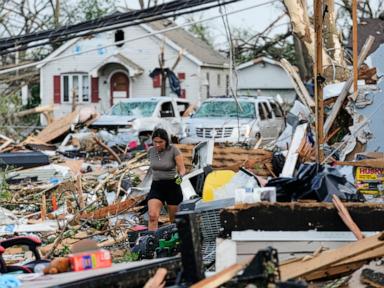
Every time a funnel cloud drops over the Midwest, media outlets run the exact same script. They parade out footage of splintered 2x4s, interview a shell-shocked homeowner staring at a missing roof, and nod solemnly as local officials talk about unpredictable acts of God. It is lazy journalism built on a lazier premise. We act surprised when a severe weather event tears through Wisconsin as if meteorology invented wind yesterday.
The lazy consensus is that Mother Nature is uniquely angry at America's Dairyland, and our only recourse is to rebuild the exact same toothpicks in the exact same spot and hope the atmospheric dice roll differently next time.
Stop blaming the wind. Start blaming the blueprint.
I have spent two decades consulting on structural resilience and municipal zoning across the Midwest. I have walked through subdivisions mere hours after a tornado ripped through them, watching insurance adjusters hand out checks for identical suburban homes that failed in identical, predictable ways. We are not losing homes to severe weather because nature is too powerful. We are losing them because we insist on building communities out of compressed cardboard and staples, then calling it progress.
The Economics Of Cheap Framing
Let us look at the structural reality behind the headlines of power outages and flattened roofs. The standard stick-built American home is a masterpiece of short-term cost-efficiency and long-term stupidity.
When a Wisconsin tornado cuts power to thousands of homes, the narrative focuses on the fragility of the grid. But look closer at the housing stock. We build exterior walls using thin vertical studs spaced sixteen inches apart, covered in a brittle layer of OSB board, wrapped in vinyl siding that a stiff breeze treats like an invitation. Then we slap a lightweight truss roof on top that relies almost entirely on gravity and a few metal toe-nails to stay attached to the frame.
When high-velocity winds hit that geometry, it acts as a sail. The roof lifts, the walls buckle outward, and the entire structure peels open like a tin can.
Imagine a scenario where a municipality mandated reinforced concrete insulated forms or steel-reinforced framing for every new residential build. Builders would scream bloody murder about the upfront costs. Developers would argue that affordability vanishes. But let us look at the actual math over a thirty-year mortgage. When you factor in repetitive storm damage, soaring insurance premiums in disaster-prone zip codes, and the total loss of personal equity every decade, cheap stick-building is the most expensive housing model ever devised.
We do not have a tornado crisis in Wisconsin. We have an amortization crisis. We build cheap because we want immediate profit, and we pay for it in debris cleanup and human misery every single summer.
The Myth Of The Unpredictable Act Of God
Forecasters love to talk about the unpredictability of mesocyclones and supercells. Radar technology has advanced by leaps and bounds, yet our municipal planning has regressed. We treat zoning permits like stamp collections, approving low-density sprawl across wide-open terrain where wind encounters zero natural friction until it slams directly into a subdivision.
Towns expand outward into flat agricultural acreage, removing every single windbreak, tree line, and natural contour. Then developers plant tiny saplings and call it a planned community. When a high-end wind event rolls across those open fields, it gathers momentum unchecked.
The insurance industry enables this cycle. By heavily subsidizing high-risk coastal and Midwestern rebuilding through pooled risk pools, they remove the price signal that should dictate where and how we build. If you build a wood-frame house in the middle of a wind corridor without a safe room or structural tie-downs, your insurance rates should reflect the literal probability of your living room ending up in your neighbor's cornfield. Instead, rates go up uniformly across the board, punishing careful builders right alongside structural gamblers.
Underground Infrastructure Is Non-Negotiable
Let us address the recurring headline that dominates every single storm report: thousands of homes losing power.
Every time a transformer blows or a wooden utility utility pole snaps like a toothpick, communities spend days in the dark. Utility executives go on local news programs to talk about dedicated crews working around the clock to restore service. It makes for good theater, but it ignores a basic engineering truth that every European nation solved decades ago.
Overhead power lines are a relic of the nineteenth century. Suspending high-voltage copper and aluminum from creosote-soaked timber in a region known for convective storms and ice loads is corporate negligence masquerading as budget constraints.
Burying power lines is expensive. I get it. The upfront capital expenditure required to trench utility grids beneath the frost line makes utility CFOs break out in hives. But calculate the economic paralysis of a county sitting without power for four days. Small businesses lose inventory. Hospitals burn through diesel fuel. Manufacturing plants halt production. The hidden productivity loss of a single major outage often exceeds the cost of underground retrofitting in targeted corridors.
Utility companies treat grid hardening as an optional upgrade rather than baseline maintenance because they know the ratepayers will foot the bill for temporary repairs indefinitely.
The Safe Room Reality Check
If you want to protect human life during a severe weather outbreak, stop relying on basement corners and interior bathrooms in standard homes.
Standard building codes still treat structural storm shelters as a luxury feature rather than a mandatory safety cell. A residential bathroom with drywall walls offers virtually zero protection against flying debris traveling at one hundred miles per hour. Yet millions of families treat it as a designated bunker.
Every new home built in a designated high-risk tornado zone should be required by code to include an engineered safe room anchored directly to the foundation slab using steel rebar and heavy-gauge steel doors. This is not complicated rocket science. The National Storm Shelter Association has published the specs for decades.
The pushback is predictable. People claim it eats up square footage or ruins the open-concept layout of a modern kitchen or master suite. We are literally trading human survival for quartz countertops and walk-in pantries.
The Hard Reset
We need to stop sensationalizing weather and start auditing our infrastructure. The next time a storm cuts a swath through the Midwest, do not look at the funnel cloud as the primary culprit. Look at the building codes that allowed houses to be stapled together in its path. Look at the utility monopolies that refuse to trench their grids. Look at the municipal planners who prioritize suburban expansion over structural resilience.
Nature does not negotiate with bad engineering. Build better or keep picking up the pieces.