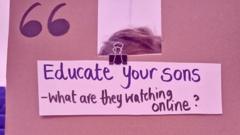
Every few months, a panic sweeps the institutional commentariat. A secondary school discovers a digital ranking sheet, a so-called rape list, circulated via encrypted chats or hidden Google docs by teenage boys. The standard playbook rolls out immediately. Op-eds bemoan the toxic halls of modern education. Pundits demand mandatory empathy seminars. Administrators promise stricter device bans and enhanced sensitivity training.
Everyone agrees on the lazy consensus: schools are failing to police adolescent morality, and social media is rotting young minds.
They are entirely, dangerously wrong.
Focusing the entire diagnostic lens on school corridors is an exercise in institutional cowardice. It allows adults to pretend that children operate in a vacuum, inventing malice from whole cloth inside classrooms. They do not. The adolescents building these lists are mirroring a culture built, scaled, and monetized by the very adults screaming the loudest about the output.
I have spent years inside institutional policy spaces, watching administrators scramble to draft zero-tolerance memos for problems they cannot even define. The truth is stark. Schools are not the incubators of this pathology. They are simply the crime scenes where the symptoms finally become too loud to ignore.
The Anatomy of a Moral Panic
To understand the absurdity of current interventions, look at how the data is handled. When a list surfaces, the immediate reflex is to categorize it as an unprecedented epidemic of teenage sexual violence.
It is not. It is adolescent status-seeking translated into the frictionless infrastructure of the digital age.
Decades before smartphones, middle and high schools were choked with crude ranking systems. Locker room tallies, physical notebooks passed in the back row, and whispered hallway hierarchies have existed as long as compulsory education has forced thousands of status-obsessed minors into a single concrete box. The primitive drive among adolescent males to signal dominance, secure peer approval, and weaponize status has not evolved an inch.
What changed is the medium.
When you hand a demographic wired for high-risk status competition a smartphone with zero supervision, zero friction, and infinite scale, a crude whisper becomes a permanent digital artifact. The mistake lies in treating the tool as the root cause. Banning phones or forcing fifteen-year-olds through a powerpoint presentation on consent does nothing to alter the underlying social incentives driving the behavior.
In fact, it often makes it worse. Institutional responses tend to treat adolescents as helpless objects of intervention rather than rational actors responding to incentives.
The Adult Hypocrisy Factor
Let us stop pretending that teenage boys are inventing this matrix out of thin air. They live in a hyper-monetized attention economy where outrage is currency and sexual commodification is the baseline aesthetic of mainstream media, music, and digital culture.
Every single day, young people consume algorithms designed by Silicon Valley engineers to maximize engagement through polarization, humiliation, and extreme spectacle. They watch influencers build entire media empires out of misogyny, cruelty, and dominance games. Then, adults act shocked when a fourteen-year-old boy tries to run a low-stakes simulation of the exact same power dynamics in his algebra class.
The adult response is pure bad faith. We build an economy that commodifies bodies, rewards controversy, and strips away third spaces for youth, leaving them to socialize entirely inside digital panopticons. Then, when the inevitable antisocial fallout hits the school printer, we point the finger at the principal for not holding enough assembly blocks.
Administrators are set up to fail because their entire toolkit belongs to the previous century. You cannot solve a decentralized cultural rot with a centralized disciplinary handbook.
Dismantling the Sensitivity Industrial Complex
The standard prescription for these incidents is a massive injection of sensitivity training. Millions of dollars flow into third-party consultants who swoop in, run workshops, and hand out handbooks filled with therapeutic jargon.
This is security theater.
Real behavioral change among adolescents does not happen through lectures from corporate compliance experts. It happens through friction, accountability, and the immediate, painful collision with real-world consequences imposed by trusted community figures.
When a school opts for a bureaucratic seminar over structural accountability, they send a clear signal: the system cares more about liability management than moral reality. The boys who draft these lists quickly learn how to game the sensitivity workshops, using the correct therapeutic buzzwords while the core behavior remains underground, pushed further into encrypted spaces where adults cannot see it.
If you want to stop the behavior, you have to dismantle the incentives. And that requires an honesty that modern institutions completely lack.
The Real Drivers of Adolescent Alienation
We need to talk about the collapse of social architecture.
For the past twenty years, we have systematically dismantled every physical space where teenagers could safely fail, test boundaries, and learn social friction under the watchful eyes of sane adults. Malls are gated off. Public parks are over-policed. After-school programs are defunded. Unstructured play has been replaced by hyper-scheduled tutoring and endless screen time.
We locked kids inside their bedrooms with high-speed internet connections and wondered why their social development warped.
When you isolate human beings behind glass screens and feed them algorithmic sludge, empathy withers. The digital sphere flattens human beings into profile pictures, objects to be ranked, liked, or discarded. A list of classmates ceases to be a list of real human beings with interior lives. It becomes a video game interface.
Fixing this requires more than punishing a handful of kids or firing a principal. It requires rebuilding physical community infrastructure and reclaiming childhood from the tech monopolies.
What Actually Works
Stop relying on policy memos. Stop hiring expensive consultants to talk about safe spaces.
First, restore friction. If a child's entire social life exists inside an unregulated digital ecosystem, the pathology will continue to scale. Schools must become phone-free zones, not as a polite suggestion, but as an absolute physical boundary. Give kids their hours back. Force them to look at each other's faces in the hallway, where cruelty has immediate, undeniable social consequences.
Second, stop hiding behind legalistic euphemisms. When adolescents engage in targeted harassment or gender-based intimidation, treat it with the seriousness of actual misconduct, not a teachable moment for the guidance counselor. Swift, transparent, non-negotiable consequences matter more than a thousand hours of restorative justice circles.
Third, parents must step off the sidelines. The modern parenting model—outsourcing moral education to the school board while handing toddlers tablets to keep them quiet—is the engine driving this entire crisis. You cannot parent via proxy and then act like a victim when the culture you permitted consumes your kid.
The rape lists in our schools are not a mystery. They are the logical outcome of a society that gave children digital megaphones, stripped away physical community, and then blamed the chalkboard when the noise got too loud.
Stop managing the symptom. Reclaim the real world.