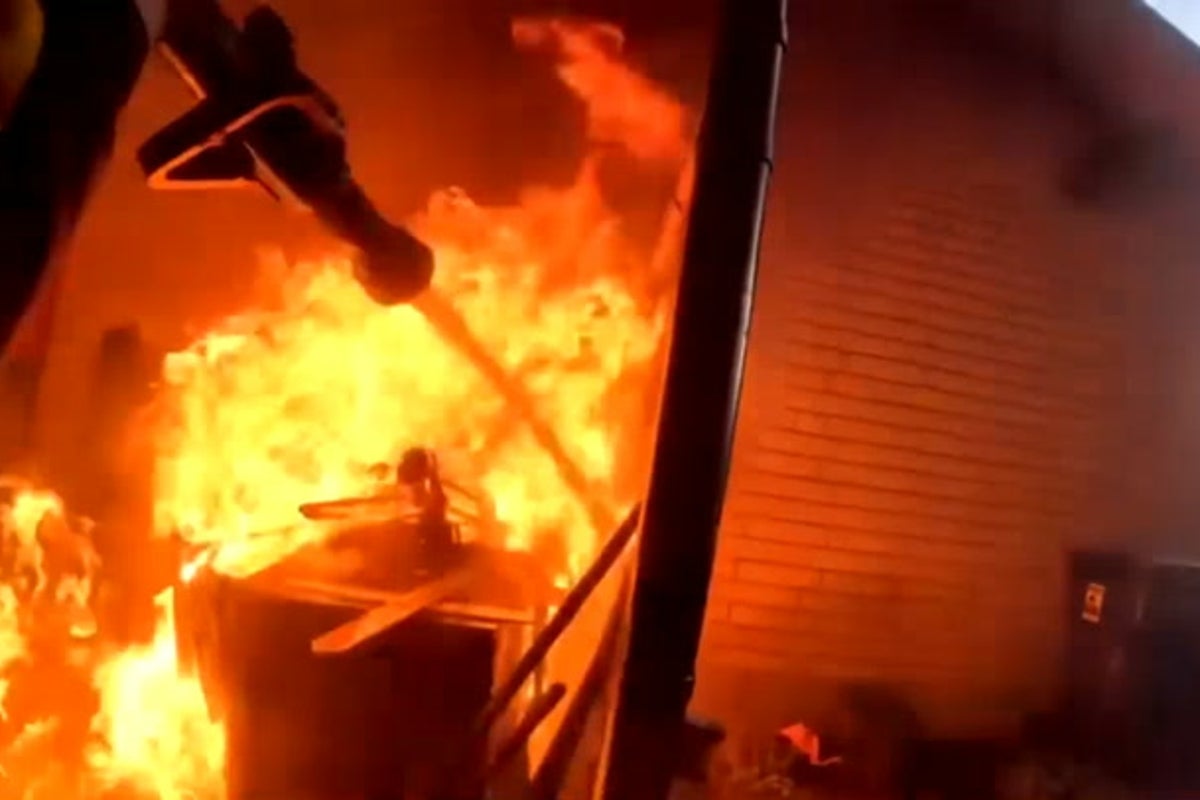
Every time a ridge goes up in smoke, the script writes itself. Firefighter bodycam footage drops, showing walls of orange flame devouring suburban cul-de-sacs. Sixty thousand people run for their lives. The headlines scream about unprecedented heat, historical drought, and an angry planet.
It is a comfortable narrative. It points upward, toward the sky, toward macro-trends that make every single person feel helpless and absolved of responsibility.
It is also entirely designed to keep bad policy alive.
I have walked through the aftermath of these burns. I have seen the melted vinyl siding, the cedar shake roofs right next to dry brush, and the municipal zoning maps that look like a developer wrote them in 1974. We are not losing Washington homes because the weather got 1.5 degrees warmer. We are losing them because we insist on building combustible matchboxes in natural fire corridors and refuse to do the dirty, unglamorous math of fuel management.
Let us clear out the polite fictions.
The Lazy Consensus Of The Smoke Machine
The standard media framing goes like this: Climate change causes extreme weather, extreme weather causes dry timber, dry timber causes catastrophic mega-fires, and therefore, we are victims of a meteorological destiny.
This argument is intellectually lazy. It treats nature as an external enemy rather than a dynamic system we chose to build a subdivision inside.
When a wildfire tears through a community, it rarely behaves like a wall of plasma that vaporizes stone. It travels by ember storm. Tiny pieces of burning wood lift off a crowning pine tree, fly a mile downwind, and land on something flammable. A dry pine needle bed in a gutter. A plastic patio chair. A wood-chip mulch bed sitting two inches away from a living room window.
If your home burns down, it is usually because your house invited the fire in.
We spend billions of dollars reacting to fires with retardant-dropping aircraft and massive staging operations, treating symptoms while ignoring the structural disease. That is not crisis management. That is theater.
The Engineering Failures We Ignore
Let us define terms. When disaster experts talk about the Wildland-Urban Interface (WUI), they are describing the exact boundary where human development slams into combustible wildlands. For decades, planners treated the WUI like a normal suburban housing tract, just with better views of the trees.
That is malpractice.
In my work evaluating municipal disaster resilience, I have seen cities approve developments surrounded by dense, overgrown underbrush, relying on single two-lane evacuation roads that inevitably jam the moment an order to flee is given.
The lazy consensus says evacuation is our primary safety tool. Watch the bodycam footage from Washington. Sixty thousand people crawling bumper-to-bumper down a mountain pass while black smoke blocks the midday sun. That is not safety; that is a traffic jam in a toaster oven.
Relying on evacuation as plan A means you have already lost the war. Plan A has to be structural hardening.
What Hardening Actually Looks Like
Real resilience is expensive, politically unpopular, and completely unphotogenic. It means telling homeowners they cannot have cedar siding or wood decks. It means forcing counties to ban wooden fences that act as fuse cords leading straight to the garage door.
Look at what works. Homes built with ignition-resistant materials—stucco, metal roofs, double-paned tempered glass windows, and enclosed eaves—frequently survive while their neighbors are reduced to ash. The fire rolls right past them because there is nothing easy for the embers to grab onto.
Yet, local governments routinely cave to developers who want to maximize profit by using cheap, flammable materials, passing the eventual catastrophe onto underfunded rural fire districts.
Imagine a scenario where a county board tells a high-end mountain developer: "You can build here, but every roof must be Class A fire-rated, every vent must have fine metal mesh to block flying embers, and your community needs a 100-foot defensible perimeter cleared of ladder fuels, or you get zero permits."
The developer would scream about property rights. The town council would fold under campaign donation pressure. And another subdivision would get built in the crosshairs.
The Fuel Problem We Refuse To Touch
You cannot talk about Western wildfires without talking about a century of catastrophic fire suppression. For generations, the forestry playbook was simple: put out every single fire by 10 AM.
All we did was bank the furnace.
Instead of frequent, low-intensity fires clearing out the underbrush naturally, we created dense, overgrown forests choked with dead timber and small trees acting as "ladder fuels" that carry flames from the forest floor straight up into the canopy.
When environmental lawsuits block mechanical thinning and prescribed burns under the guise of conservation, they are not protecting the forest. They are preserving an ecological powder keg.
Criticize the timber industry all you want, but ignoring the biological reality of fuel loading is like refusing to empty the grease trap in a commercial kitchen because you prefer a natural aesthetic. Sooner or later, the whole kitchen goes up.
Stop Trying To Fix The Weather
We cannot legislate the jet stream. We cannot negotiate with a drought cycle. Waiting for global emissions targets to drop enough to save a neighborhood in the Washington foothills is a suicide pact.
We have to stop treating wildfires as acts of God and start treating them as engineering problems with engineering solutions.
Clear the brush. Harden the structures. Redesign the evacuation bottlenecks before the smoke rolls in, not while it is blinding your rearview mirror.
Until we stop hiding behind the comforting abstraction of climate change and face our own terrible building and land-use choices, those bodycam videos will keep rolling, year after predictable year.