The whiteboard at the front of the classroom was a smear of white and grey. For seven-year-old Maya, the letters her teacher wrote didn't have edges. They bled into each other like watercolor paint dropped on a wet page. She didn't complain because she assumed everyone saw the world this way—as a soft, unfocused place where you guessed the words by the shape of the blurry blob on the wall. When she fell behind in reading, the school labeled her easily distracted. When she tripped over the curb on the way home, her parents told her to watch her step.
She wasn't distracted. She wasn't clumsy. She just couldn't see.
Maya is hypothetical, but her reality is shared by hundreds of millions of people across the globe. We live in an era of staggering technological advancement, yet we are failing at one of the simplest medical interventions in human history: providing two pieces of shaped glass to the people who need them.
The scope of this failure is staggering. According to the World Health Organization, more than one billion people worldwide live with vision impairment simply because they do not have access to a pair of glasses. In the United States alone, millions of children and adults navigate their days through a fog, cut off from literacy, job opportunities, and basic safety.
The problem isn't a lack of lenses. We can manufacture reading glasses for pennies. The problem is the final mile. It is the vast, quiet chasm between a centralized supply chain and the doorstep of a person living in rural poverty or an urban care desert.
To fix it, innovators are looking at an unexpected savior. It is an institution older than the country itself, staffed by workers who already visit every single household six days a week.
The Anatomy of an Invisible Crisis
We treat vision loss as a natural, minor inconvenience of aging or a routine rite of passage for school children. We joke about misplacing our reading glasses. We view the optometrist’s chair as a mundane chore.
This casual attitude masks a brutal economic reality.
When a person cannot see clearly, the trajectory of their life alters. Consider the child who cannot read the board; they are statistically far more likely to drop out of school. Consider the artisan whose hands begin to blur in their late forties; their productivity plummets, dragging their family toward financial instability.
Globally, uncorrected vision impairment costs the economy an estimated $411 billion annually in lost productivity. Yet, the human cost is far heavier. It is the isolation of not recognizing a friend’s face across the street. It is the constant, low-level anxiety of navigating a world where danger doesn't sharpen until it is a foot away.
Why does this crisis persist?
In theory, the solution is simple. You test the eyes, you grind the plastic, you hand over the frame. But practice reveals a massive logistical breakdown. Traditional eye care relies on a highly concentrated infrastructure. Optometrists congregate in affluent suburbs and urban centers. They require expensive, delicate machinery that doesn't travel well down dirt roads or into underfunded community centers.
For a low-income family, getting an eye exam isn't just about paying for the appointment. It means taking a day off work without pay. It means navigating complex public transit systems. It means choosing between the cost of a prescription and the cost of groceries.
The current system demands that the patient come to the care.
What if we flipped the equation?
The Uniform at the Gate
Every morning, hundreds of thousands of postal workers shoulder heavy bags and step onto the streets. They know which porches have loose boards. They know which dogs bark out of habit and which ones mean business. They see the elderly residents who rarely leave the house, and they notice when the mail starts piling up.
The postal network is an astonishing feat of human logistics. It is a capillary system that reaches into the deepest corners of the nation, binding remote mountain cabins and high-rise apartments into a single, cohesive network.
This brings us to a radical proposal gaining traction among public health advocates: leveraging the postal service to solve the vision crisis.
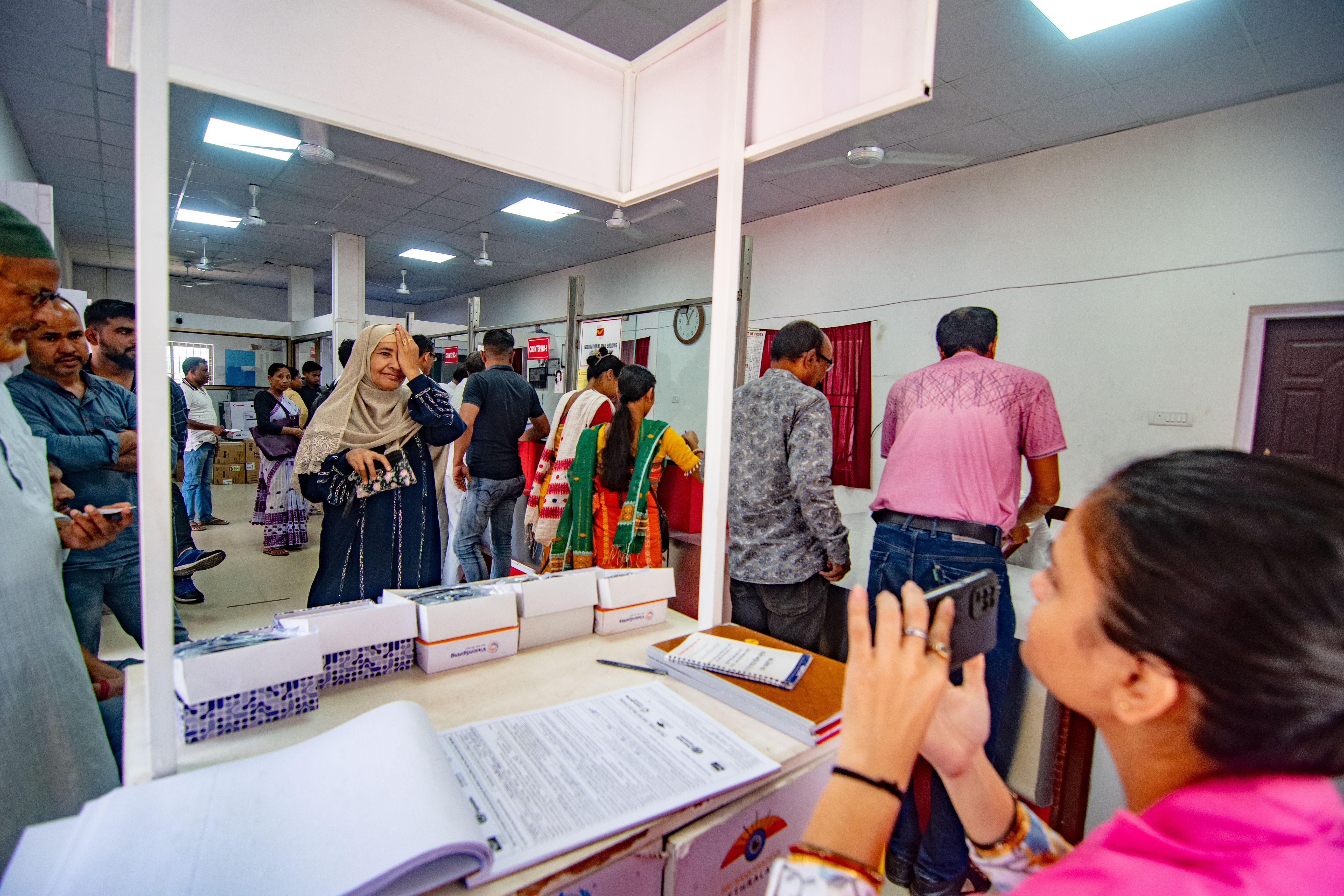
The concept hinges on transforming mail carriers from mere couriers into the frontline scouts of public health. Imagine a mail carrier carrying a lightweight, digital vision-screening tool—a device no larger than a smartphone. During their routine stops, or through specialized community outreach days, they could perform a basic, sixty-second vision check for residents who haven't seen an eye doctor in decades.
If the screening flags a problem, the postal infrastructure takes over. The data is beamed to a remote optometrist. The prescription is filled at a centralized hub. A few days later, the exact same mail carrier walks up the steps and drops a pair of custom glasses into the mailbox.
The logistics are beautiful in their simplicity. The heaviest lift in public health—building trust and establishing a presence in a community—has already been done by the post office over the course of centuries.
The Friction of Reality
It sounds like a silver bullet. But as any rural health worker will tell you, theory shatters quickly when it hits the mud of the real world.
The postal service is already strained. Carriers are rushed, measured by strict metrics that track every second of their routes. Asking a worker who is already tracked by GPS to pause and administer a vision test introduces immediate friction. Unions would rightly demand compensation and training for these expanded roles.
Furthermore, a screening tool is not a comprehensive eye exam. A basic vision test can catch myopia or presbyopia, but it misses glaucoma, macular degeneration, and diabetic retinopathy—blinding diseases that require a specialist's touch. There is a dangerous risk of giving people a false sense of security, delivering a pair of cheap reading glasses while a silent disease destroys their optic nerve.
Then there is the question of trust. While people trust the mail carrier to deliver a letter, do they trust them with their health data?
These are not insurmountable barriers, but they require us to look closely at past failures. Previous mobile health initiatives often collapsed because they were treated as temporary charity rather than permanent infrastructure. For the post office to become a conduit for health, it must be funded, protected, and integrated into the broader medical framework.
A Lens on the Past
The idea of using postal workers for public service isn't entirely unprecedented. In various pockets of global history, the post office has served as the bedrock of civic life. During the early 20th century, the United States Post Office operated a massive savings bank system, providing secure financial services to millions of immigrants and low-income workers who were ignored by commercial banks.
In Japan, the postal service has long offered a service called Himawari, where carriers check on the well-being of elderly residents in rural areas during their daily rounds, reporting back to local social services if something seems amiss.
We have forgotten that the post office is not merely a shipping business competing with corporate giants. It is a public good designed to bind a society together.
When we view the postal service through that historical lens, using it to distribute vision care stops looking like a quirky experiment and starts looking like a natural evolution. The infrastructure is sitting there, idling in plain sight. We are simply choosing not to utilize it to its full capacity.
The Moment the World Snaps into Focus
To understand what is truly at stake, you have to look past the logistics, the pilot programs, and the economic white papers. You have to stand in the room when the glasses are put on for the first time.
There is a distinct, universal human reaction that happens in that exact second.
The shoulders drop. The brow, permanently furrowed from years of squinting, relaxes. The head tilts back slightly as the brain processes a sudden, overwhelming flood of visual data.
An elderly woman looks down at her hands and sees the intricate patterns of her skin for the first time in a decade. A young boy looks out the window and realizes that trees have individual leaves, rather than just being massive green shapes against the sky.
It is a moment of profound emotional catharsis. It is the restoration of autonomy.
We tolerate the vision crisis because it is quiet. It doesn't make the evening news. It doesn't spread like a virus. It is a slow, silent drain on human potential that takes place behind closed doors, in classrooms where children quietly give up, and in homes where the elderly slowly withdraw from the world.
The tools to fix this are already in our hands. The lenses are cheap. The mail trucks are already driving down the street. The carrier is already walking up the path. We only need the collective imagination to place the solution in their bag, alongside the letters and the bills, and let them deliver the world back to the people who have lost it.