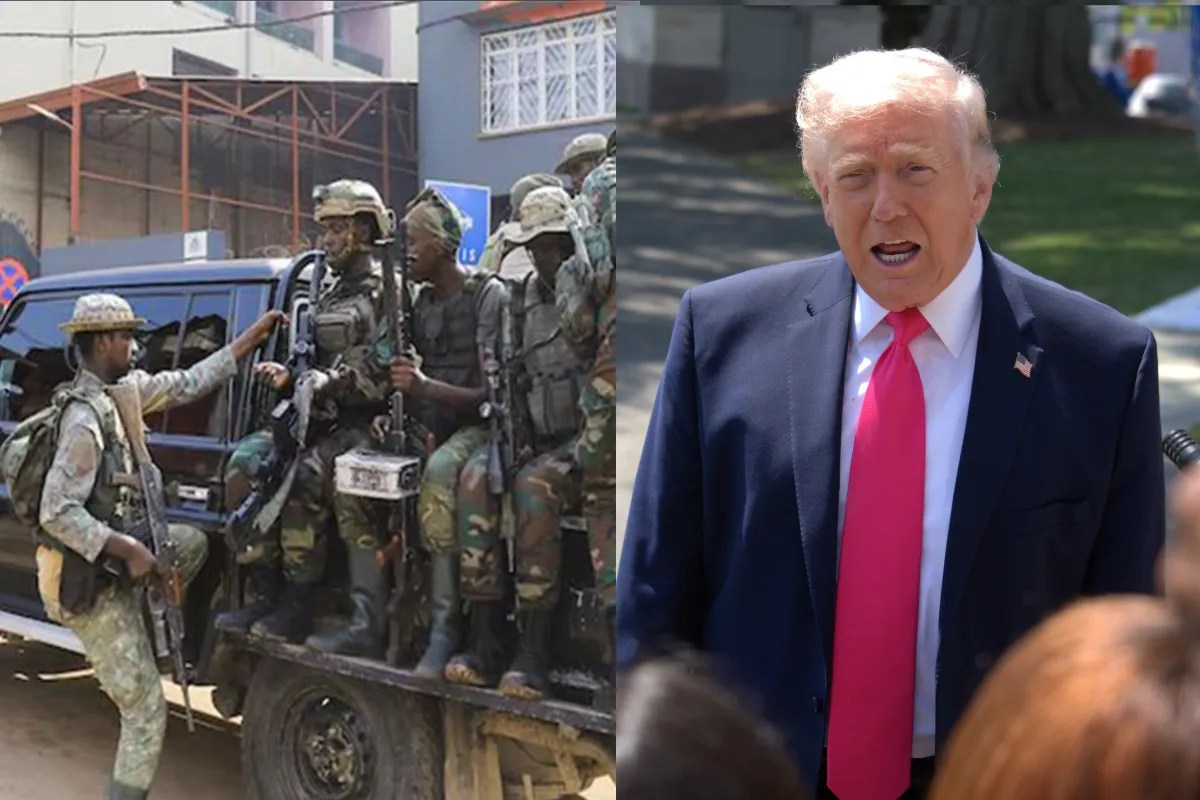
The dirt in the eastern hills of the Democratic Republic of Congo does not look like history. It looks like rust. It sticks to the soles of your boots, thick and heavy, stained by a geology so rich it feels like a curse. For thirty years, this earth has swallowed secrets, shells, and bodies.
Now, a courtroom in The Hague is being asked to weigh the weight of that mud.
When the news broke that the DRC was taking Rwanda to the International Court of Justice, the headlines did what headlines always do. They flattened it. They turned a multi-generational tragedy into a sterile legal fixture. They talked of "inter-state litigation," "sovereignty infractions," and "geopolitical friction."
But geopolitical friction does not wake up at four in the morning to the sound of mortars. It does not walk fifty miles through the bush with a toddler strapped to its back, looking for a patch of grass that isn't cursed by gunfire. To understand why a nation finally pulled the emergency brake and dragged its neighbor before the highest court on Earth, you have to leave the marble halls of the Netherlands behind. You have to stand on the red clay of North Kivu.
The Cost of the Invisible Border
Consider a woman named Marie. She is a construct of a thousand testimonies, a composite of the mothers who inhabit the displacement camps outside Goma, but her reality is absolute. Marie used to grow beans. She had a house with a tin roof that sang when the tropical rain hit it. Today, she lives under a sheet of white plastic stamped with a humanitarian logo.
Her life was not upended by an abstract political disagreement. It was dismantled by the M23 rebel group, a militia that the DRC—and numerous United Nations reports—asserts is financed, armed, and directed by the Rwandan government. Rwanda denies this. They call it an internal Congolese problem.
But Marie knows the caliber of the bullets that ripped through her village. She knows the language spoken by the men who ordered her to leave everything behind. For her, the border between Rwanda and the DRC isn’t a line on a map drawn by colonial powers in Berlin. It is a living, breathing valve that opens to let conflict in and closes when the world tries to look too closely.
The legal brief filed at the ICJ is thick with dates and coordinates, but its true currency is human displacement. Over six million people have been upended within the DRC. That is not a statistic; it is an entire European nation packed into makeshift tents, cooking over charcoal scraps, waiting for a peace that never comes.
A History Written in Gold and Blood
The roots of this move to the international court do not belong to this year, or even this decade. They go back to 1994, to the tectonic shockwave of the Rwandan genocide. When the perpetrators of that slaughter fled across the border into the Congolese forests, they brought the virus of war with them.
Since then, the eastern DRC has been treated like a bargain basement for the global economy. Beneath Marie’s ruined bean field lies coltan, gold, and tin. Your smartphone contains a piece of this landscape. The electric vehicles designed to save the planet rely on the minerals buried beneath communities that are being destroyed.
This is the great irony of the conflict. The region is unimaginably wealthy, yet its people are among the poorest on earth. Armed groups, allegedly backed by regional neighbors, control the mines. They smuggle the wealth across the border, where it suddenly becomes legal, clean, and ready for export to global markets.
The DRC’s legal strategy is an admission of exhaustion. For decades, military campaigns failed. Regional peace initiatives in Luanda and Nairobi stalled in hotel conference rooms while the mortar fire continued on the ground. By turning to the ICJ, the Congolese government is trying to change the language of the fight. They are swapping old rifles for international law.
But the real problem lies elsewhere. Can a court order stop a bullet?
The Anatomy of a Denial
Walk into Kigali, the capital of Rwanda, and you enter a different universe. The streets are spotless. The tech hubs are buzzing. The narrative here is one of miraculous recovery and disciplined progress.
The Rwandan state views the accusations from Kinshasa through a lens of existential survival. They argue that the DRC has failed to police its own territory, allowing the FDLR—a rebel group containing the remnants of the 1994 génocidaires—to operate freely near the Rwandan border. To Kigali, the Congolese government is using international courts as a scapegoat for its own administrative paralysis and military incompetence.
It is a dizzying hall of mirrors. Each side uses the other’s real failures to justify its own actions.
"We are asking for the law to do what armies could not," a Congolese lawyer remarked recently, his voice carrying the exhaustion of a man who has spent years reviewing satellite images of burned villages. "We want the world to acknowledge that aggression leaves a paper trail."
The legal mechanics are slow, agonizingly so. The ICJ moves with the speed of a glacier. It takes years for a case to reach a final judgment. For the families living under plastic sheets in Goma, a verdict in 2029 offers cold comfort against the rain falling tonight.
The Fiction of Neutrality
It is tempting to look at this African conflict as something distant, an ancient tribal feud that defies modern logic. That is a comforting lie. The conflict in the eastern DRC is intensely modern, hyper-capitalist, and deeply connected to global systems.
When a rebel group takes a hill in North Kivu, the price of tech stocks in New York and Tokyo vibrates. When a neighborhood is shelled, the supply chain for green energy shifts. The world is not a bystander in this court case; the world is the consumer driving the market that funds the war.
The DRC's move to the ICJ is an attempt to force the international community to look into that mirror. It demands an answer to a fundamental question: Does international law apply to the resource-rich fringes of the globe, or is it merely a luxury reserved for Western capitals?
Consider what happens next. If the court rules in favor of the DRC, it could lead to crippling sanctions against Rwanda, changing the economic balance of Central Africa. If it dismisses the case, it will signal to every militia leader and regional power that the borders of the Congo are open for business, just as they have been for a century.
The tension on the ground does not wait for judges to deliberate. In the camps, the children play a game with empty bullet casings, stacking them like toy soldiers in the mud. They do not know the names of the judges in The Hague. They do not understand the intricacies of jurisdiction or state responsibility. They only know the rhythm of the horizon—when it is safe to walk, and when it is time to hide.
The red clay remains, heavy and wet, holding the footprints of those who fled and the weight of a continent's unpunished grief.