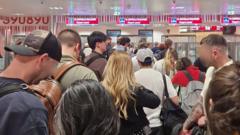
The air inside Terminal 1 is always exactly twenty-four degrees, but by hour four, it starts to feel much hotter.
Sarah didn’t expect to spend the first afternoon of her honeymoon studying the acoustic dampening panels of the Frankfurt airport ceiling. She had mapped out the perfect evening: a rented Volkswagen, a winding drive into the Rhineland, and a quiet dinner overlooking the Rhine. Instead, she is trapped in a human tide that has spilled out of the immigration hall, backed up through the corridors, and clogged the arteries of one of the world's most sophisticated transport hubs.
In front of her, an older man sinks onto his hard-shell suitcase, his head buried in his hands. Behind her, a mother softly negotiates with a toddler whose patience evaporated somewhere around hour two. Nobody is moving. Every twenty minutes, the crowd shuffles forward three paces, a collective lurch of false hope that dies the moment the line stalls again.
This is the reality of the European Union’s Entry/Exit System, known in bureaucratic circles as the EES.
When Brussels pitched this sweeping digital overhaul, it wasn't supposed to look like a refugee camp in terminal lighting. The promise was alluringly simple: replace the antiquated, ink-stained routine of manual passport stamps with a sleek network of biometric kiosks. A flash of a camera. A scan of four fingerprints. A digital record stored securely in a central database. The European Commission confidently assured the world that the entire process would take an average of seventy seconds per traveler.
Seventy seconds to digitize a border. Seventy seconds to make Europe safer, smarter, and faster.
But the math of a computer simulation rarely survives its first encounter with a tired family carrying three suitcases and a stroller.
Stefan Schulte does not sleep well these days. As the president of the airport trade association ACI Europe and the chief executive of the company that runs Frankfurt Airport, his job is to keep the human traffic of a continent moving. Right now, he is watching the machinery seize up.
"Right now, EES is what keeps me and many other airport CEOs across Europe awake at night," Schulte admitted during an industry gathering in Prague. The tone from airport executives across the continent has shifted from quiet anxiety to open alarm. They are staring down a summer peak that stretches far past the early weeks of September, and the numbers simply do not add up.
Consider the mechanics of the first-time enrollment. If you are a non-EU traveler—a British vacationer heading to Greece, an American businessman landing in Amsterdam, a Canadian student arriving in Lisbon—you cannot simply walk up to an automated gate. You must be initiated into the system.
An border agent must watch as you align your fingers on a glass pane. The scanner misreads the print. Clean the glass. Try again. The camera needs to capture your face, but the lighting in the terminal creates a shadow under your chin. Adjust the angle. Stand still. The digital kiosk, meant to be a tool of hyper-efficiency, turns into a bottleneck.
At peak arrival hours, when three or four transatlantic flights drop hundreds of passengers simultaneously into a single terminal, the seventy-second promise shatters. The Airports Council International conducted a survey across forty-five major hubs in twenty EU states. The data revealed that wait times have ballooned up to three and a half hours at peak traffic times, solely due to the EES onboarding procedure. In extreme cases, travelers have reported standing in lines for up to six hours.
A system built to accelerate travel has instead anchored it to the floor.
The real danger is not just the discomfort of a long wait; it is the systemic cascading failure that follows.
When an immigration line stretches to four hours, it doesn't just delay the passenger. It triggers a domino effect that hits the entire aviation ecosystem. Airlines face a logistical nightmare. Passengers who are trapped in the terminal cannot board their planes. Bags must be pulled from cargo holds if a passenger misses their flight, causing departure delays that ripple across European airspace.
Some carriers are already watching flights take off with empty seats because their passengers are still stuck three floors below, staring at a biometric screen. Airline executives have pleaded with European member states for flexibility, pointing to isolated instances where emergency protocols were used to temporarily suspend biometric checks just to clear the terminal floors before they became a fire hazard.
Yet, the official word from the political capital of Europe remains curiously detached from the tarmac. The European Commission has repeatedly maintained that the system is functioning well, noting that tens of millions of successful entries have been logged since the phased rollout began.
To the bureaucrats, the software is working. To the people on the ground, the terminal is broken.
"EU Home Affairs Commissioner Magnus Brunner and home affairs ministers must stop pretending the situation is manageable and that the EES is working just fine," Schulte warned. "It is not."
The core problem is an institutional refusal to grant local authorities the permanent flexibility they need. Right now, individual governments hold the power to suspend the biometric checks during periods of extreme congestion, but the process to trigger those exemptions is tangled in red tape. While an airport waits for a ministry to sign off on a temporary suspension, the lines grow by another thousand yards.
Airports are asking for the power to hit the pause button the moment the queue hits a predetermined threshold. It is an argument grounded not in tech-phobia, but in basic human decency. Travelers who have saved for a year to visit Europe are being welcomed with an administrative hazing ritual.
The system will eventually stabilize. Aviation experts suggest it could take one to two years for the global traveling public to be fully indexed, at which point returning visitors will slide through the gates with the ease the politicians initially promised.
But a bridge that takes two years to build doesn't help the person trying to cross the river today.
As the summer heat intensifies, the airports of Europe are running out of floor space. If individual governments do not give border control agents the immediate, unmitigated authority to bypass the digital kiosks when terminals reach capacity, the system faces what industry chiefs call a complete structural collapse.
Back in Frankfurt, Sarah and her husband finally reach the front of the hall. Her passport is scanned, her fingers are pressed against the illuminated glass, and the camera flashes. The machine registers her presence in the bloc. It takes roughly two minutes.
She steps through the gate into Germany, her honeymoon schedule in ruins, the sun already dipping below the horizon. The seventy seconds are over. The lost hours of her afternoon, however, are gone for good.