Everyone is screaming about the optics. The international community is drafting angry memos. Animal rights organizations are chaining themselves to metaphorical gates.
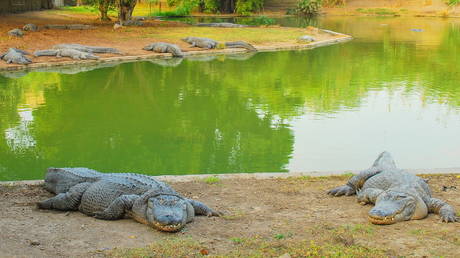
Israel’s Environment Minister Idit Silman recently reclassified the Nile crocodile as a "specially managed wild animal". This obscure administrative maneuver was designed to clear a legal path for National Security Minister Itamar Ben-Gvir's proposal to surround prisons holding Palestinian detainees with moats filled with literal apex predators. The initial pilot is targeted for Ketziot Prison in the southern desert.
The lazy consensus from the media and the public? It is a medieval stunt. It is political theater. It is the unhinged fantasy of a far-right politician trying to sound tough on terror.
You are all missing the plot.
If you have spent any time auditing high-threat physical security infrastructure, you know the uncomfortable truth. You have watched governments burn nine-figure budgets on autonomous drone patrols and seismic ground sensors that fail the moment the weather turns.
The crocodile plan is not a joke. It is a ruthless, mathematically flawless indictment of the modern prison-industrial complex.
Stop laughing at the absurdity. Start looking at the balance sheet.
The Financial Death Spiral of Modern Corrections
Let’s talk about capital expenditure (CAPEX) versus operating expenses (OPEX).
You want to secure the perimeter of a Level 5 facility. You do not just build a wall. You build an integrated technology stack. A standard high-security perimeter relies on Perimeter Intrusion Detection Systems (PIDS).
You install microphonic cables on the inner fence to detect cutting or climbing. You deploy volumetric microwave sensors between the inner and outer fences to detect mass movement. You mount thermal imaging arrays on fifty-foot poles. You tie it all together with a proprietary software suite that requires constant patching, licensing fees, and server maintenance.
Do you know what happens to a $400,000 thermal camera system when a heavy sandstorm rolls through the Negev desert? It goes blind.
Do you know what happens to a highly sensitive fiber-optic taut-wire fence when the desert winds hit sixty miles per hour? It generates cascading false alarms until the control room operators get so fatigued they simply turn the system off.
Technology is fragile. Technology is expensive. But technology is not even the biggest line item.
The true financial hemorrhage in the prison system is human labor. Guarding thousands of inmates requires an army. That army requires union negotiations, hazard pay, pension liabilities, shift rotations, sick leave, and healthcare. Human guards get tired. Human guards get bribed. Human guards make mistakes.
Now, look at the Israel Prison Service (IPS) proposal through a purely economic lens.
An adult Crocodylus niloticus (Nile crocodile) costs roughly $20,000 on the open market, while a juvenile runs about $8,000.
A crocodile does not require a pension. A crocodile does not go on strike. A crocodile does not experience alarm fatigue. It is a self-replicating, self-sustaining biological asset perfected by 200 million years of evolution to do exactly one thing: detect and neutralize movement in its territory.
This is not a cartoon villain scheme. This is a desperate agency looking at a broken budget. The IPS themselves admitted that replacing traditional security layers with a biological moat would significantly reduce ongoing guarding costs.
They are right. The math is brutal, but it works.
The Psychology of the Perimeter
Critics inside the government, notably the Environmental Protection Ministry’s legal adviser, attorney Neta Drori, warned there is no professional precedent for using crocodiles as a security measure at modern prisons. The Israel Nature and Parks Authority opposed the plan immediately, stating firmly: "We are supposed to protect them, not have them protect us".
They are absolutely right on the law. But they do not understand the mechanics of physical deterrence.
Physical security is primarily a psychological game. Containment relies on rational actor theory. When an inmate plans an escape, they calculate the odds. They memorize the blind spots in the camera coverage. They time the perimeter patrol vehicles. They know that if they breach the outer fence, the armed response time is exactly 120 seconds. It is a calculated risk.
Replace that predictable, sterile, technological perimeter with a murky water barrier containing two dozen territorial apex predators.
The psychological friction applied to the escape calculation instantly approaches infinity.
You cannot out-negotiate a crocodile. You cannot study its shift patterns. You cannot bribe it. Crocodiles possess Integumentary Sensory Organs (ISOs) across their scales that can detect the exact location of a single drop of water hitting the surface of a pond from fifty feet away. If you enter their water, they know you are there instantly.
The calculation shifts from "evasion" to "certain biological dismemberment." As a pure deterrent, it out-performs any biometric scanner on the market.
The Florida Precedent
Ben-Gvir’s proposal reportedly drew inspiration from the so-called "Alligator Alcatraz" in the United States, a detention facility located in the Florida Everglades.
The comparison is deeply flawed, and analyzing why exposes the exact point where the Israeli government's plan transitions from cold economic logic into operational delusion.
The American facility was built in an environment where alligators already existed naturally. The biological perimeter was a byproduct of the geography. The environment supported the animals with zero human intervention.
Israel is attempting to force a biological asset into an artificial, hostile environment. The proposed pilot is for Ketziot Prison. Ketziot is located in the harsh, arid expanse of the Negev desert.
You cannot simply drop an apex predator into a concrete trench in the desert and expect it to act like a plug-and-play security camera.
The Ectothermic Vulnerability
Here is the fatal operational flaw that the politicians are ignoring.
Crocodiles are ectothermic. They are cold-blooded. They rely entirely on external environmental temperatures to regulate their metabolism.
During the summer in the Negev, a crocodile is a hyper-lethal, lightning-fast biological weapon. But what happens in January? Winter nights in the southern Israeli desert regularly drop to near freezing.
When a crocodile's core temperature drops, its metabolism plummets. Environmental groups pointed this out immediately, noting that the animals will slow down, become lethargic, and stop eating entirely. A freezing crocodile is not a security asset. It is a floating log.
To maintain the deterrent effect year-round, the Israel Prison Service would have to artificially heat thousands of gallons of water in an outdoor desert moat. The energy required to maintain a massive body of water at a tropical 85 degrees Fahrenheit through a desert winter would be astronomical.
The moment you have to build industrial boiler systems to keep your biological security assets functional, you have entirely wiped out the OPEX savings that justified the project in the first place. You are back to burning money.
The Arrogance of Institutional Ignorance
The administrative maneuvering required to even get this far is staggering. Minister Silman bypassed the professional position of the Nature and Parks Authority and ignored her own legal adviser to reclassify these animals.
Why? Because the Israel Prison Service convinced the politicians they could handle it.
According to internal communications, IPS officials claimed they were prepared to manage the crocodiles based on their extensive experience operating canine units.
This is institutional arrogance bordering on the absurd.
A Belgian Malinois is a pack animal. It has been selectively bred for thousands of years to seek human approval, understand complex commands, and operate within a hierarchical structure. If a dog gets sick, you put a muzzle on it and take it to a standard veterinarian.
A Nile crocodile is a solitary, prehistoric ambush predator that views its handlers strictly as caloric intake. There is no loyalty. There is no training.
The logistical nightmare of veterinary care for a one-ton reptile inside a maximum-security prison is unmanageable. How do you safely extract a sick crocodile from a moat surrounded by high-voltage fences? How do you manage the water filtration required to process the staggering amount of biological waste generated by dozens of apex predators?
If the water quality degrades, the animals die. If an avian flu or waterborne pathogen sweeps through the moat, your entire perimeter security apparatus goes offline overnight.
And then there is the uninsurable risk of a containment breach. Flash floods happen in the desert. Infrastructure fails. If a catastrophic weather event damages the perimeter and a Nile crocodile washes into civilian infrastructure, the legal liability will eclipse any money saved on guard salaries.
Attorney Neta Drori was completely accurate when she stated that the IPS simply has no expertise in raising dangerous wild animals. You cannot run a zoo inside a Supermax facility and expect both to function efficiently.
The Signal in the Noise
You can hate the politics behind this proposal. You can despise the optics of treating human beings—regardless of their crimes—to medieval intimidation tactics. You can mourn the erosion of conventional, civilized penal norms.
But dismissing this as nothing more than a stunt is intellectually bankrupt.
We have reached a breaking point in physical security. The cost of maintaining human guards and maintaining complex technology has become so bloated, so deeply inefficient, and so fundamentally flawed that deploying prehistoric monsters is now being treated as a competitive economic alternative by a modern nation-state.
The crocodiles are not a sign that society is going backward. They are a flashing red warning light. They prove that our current model of technological security has entirely collapsed under its own weight.
When a multi-million dollar fiber-optic fence cannot financially compete with a $20,000 reptile, the system is dead. Pay attention to the math. It bites much harder than the animals ever will.