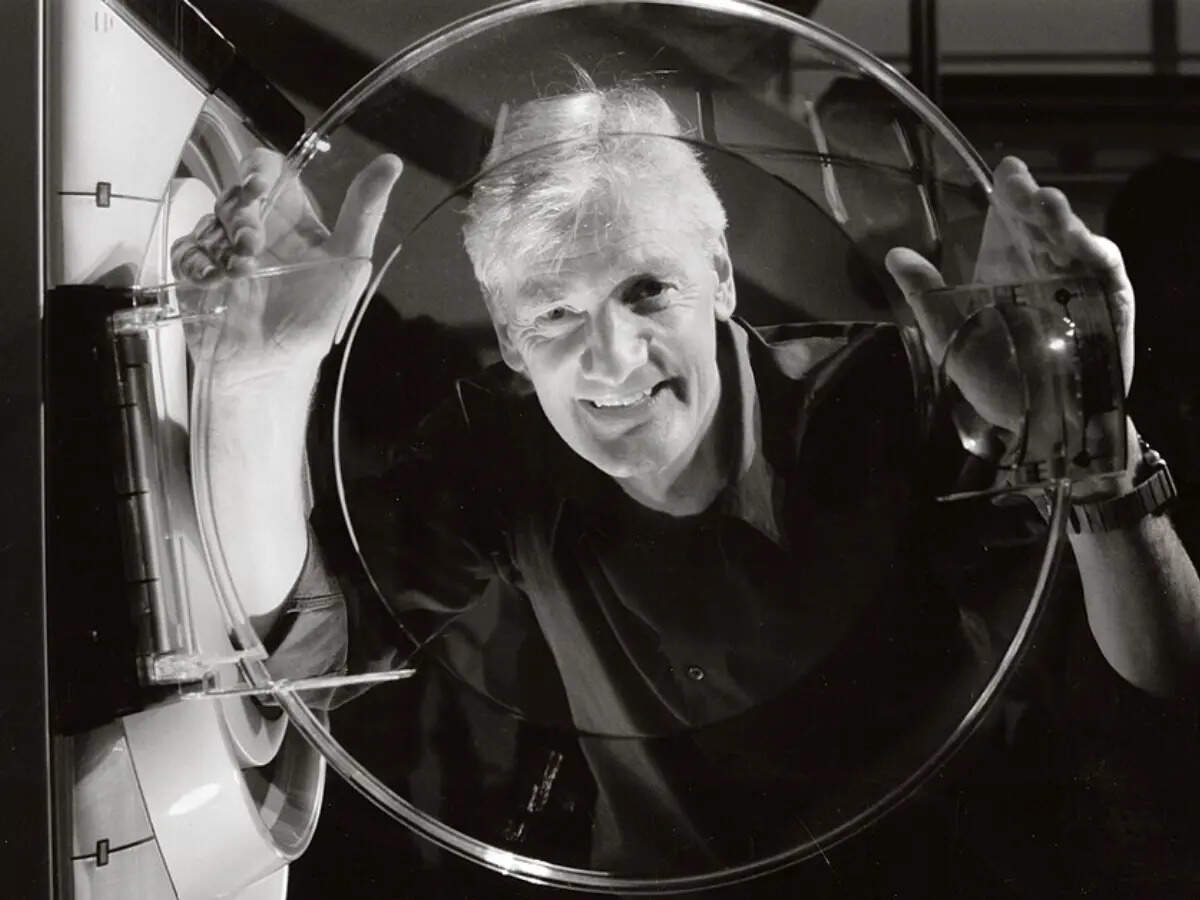
James Dyson did not succeed because he was a visionary. He succeeded because he was willing to be a failure for five consecutive years. While the popular narrative paints his struggle as a romantic quest for a better vacuum, the reality was a cold, grinding war against the physical properties of air and the financial limits of his own sanity. Most entrepreneurs quit after the third or fourth failed attempt because they view failure as a signal to stop. Dyson viewed the 5,126 failed versions of his Dual Cyclone vacuum not as mistakes, but as a mandatory data set. He was betting on the fact that if you eliminate every way a machine can fail, the only thing left is a machine that works.
This is the rule of iterative exhaustion. It is a brutal, expensive, and psychologically damaging way to build a company, but in an era of software-driven shortcuts, it remains the only way to dominate a hardware market.
The Mirage of the Eureka Moment
Society loves the myth of the lone genius struck by a bolt of lightning. It makes for a good story, but it is a lie. Dyson’s "discovery" of cyclonic separation wasn't an original thought; he saw the technology used in a local sawmill to remove sawdust from the air. The insight wasn't the cyclone itself. The insight was the realization that the entire floor-care industry was built on a flawed revenue model—the vacuum bag.
Vacuum bags are designed to fail. As soon as a microscopic layer of dust coats the inside of the bag, the suction drops. Manufacturers knew this. They loved it. Selling the machine was a one-time transaction, but selling the bags was a lifelong annuity. Dyson decided to kill the annuity to perfect the machine.
He started with a cardboard model held together with duct tape. It worked, marginally. Between 1978 and 1983, he lived in a state of perpetual debt. He wasn't just building prototypes; he was fighting the Second Law of Thermodynamics. Every time he solved a problem with the airflow, a new issue emerged with the centrifugal force or the seal of the bin. He was deep into his 2,000th prototype when the novelty wore off and the crushing weight of reality set in.
Why 5,127 is a Specific Kind of Hell
To understand the scale of this persistence, you have to look at the numbers. If you build 5,127 prototypes over 1,825 days, you are averaging nearly three new versions every single day, including weekends and holidays.
This isn't "failing fast" in the way Silicon Valley describes it. Failing fast usually means pivotting to a new idea when the first one doesn't get traction. Dyson did the opposite. He stayed perfectly still on one idea and changed the execution.
The Cost of Iteration
The financial burden was staggering. He wasn't a billionaire then; he was a man with a growing family and a mounting pile of bank loans. He ended up losing his house to keep the project alive. Most business analysts would call this "sunk cost fallacy." They would argue that after the 1,000th failure, the probability of the 1,001st being a success is statistically insignificant.
They are wrong. In hardware engineering, every failure narrows the search space.
Imagine a vault with a 5,000-digit combination. Every wrong number you try is technically a "failure," but it is also one less number you ever have to try again. Dyson wasn't gambling; he was brute-forcing the laws of physics.
The Engineering of Obsession
The prototypes were not radical departures from one another. Most were incremental shifts.
- 1mm changes in the diameter of the cyclone cone.
- Slightly different angles for the air intake to maximize velocity.
- Material swaps to reduce friction and static buildup.
Dyson kept a meticulously detailed journal of every single iteration. If Prototype 2,402 lost suction, he had to know exactly why. He couldn't afford to guess. This level of detail is what separates a hobbyist from an industrialist.
The technical challenge was that air behaves differently at high speeds. Inside a Dyson cyclone, air travels at speeds approaching 900 miles per hour. At that velocity, air becomes "sticky." It creates turbulence in places where you expect a smooth flow. He was trying to manage a miniature hurricane inside a plastic canister.
The Industrial Sabotage Factor
Even after he cracked the code with prototype 5,127, the battle wasn't over. The established players—Hoover, Electrolux, and Miele—didn't want his technology. They didn't just reject him; they actively tried to bury the invention.
Why? Because the "No Loss of Suction" claim was a direct attack on their profit margins. One major manufacturer told him that if a bagless vacuum were a good idea, they would have already built it. This is a classic incumbent trap. They weren't looking for a better product; they were looking to protect a legacy supply chain.
Dyson was forced to license the technology in Japan first, under the name "G-Force." It was bright pink and cost $2,000. It became a status symbol in Tokyo apartments. Only after proving the market existed in the East could he find the leverage to launch his own brand in the UK in 1993.
The Fallacy of the MVP
In the current business climate, we are told to ship the "Minimum Viable Product." The idea is to get a rough version into the hands of users and iterate based on feedback.
Dyson’s 5,127 prototypes prove that for physical products, the MVP is often a death sentence. If he had shipped Prototype 500, the vacuum would have been mediocre. It would have clogged. The brand would have died in infancy.
Hardware demands excellence because you cannot "patch" a vacuum cleaner once it is in a customer's closet. You have to get the physics right the first time. The obsession with prototypes was a defensive strategy against the inevitable lawsuits and competitive clones that would follow. By the time his competitors started trying to copy him, he already knew 5,126 ways their copies would fail.
The Psychological Toll of Persistence
We talk about Dyson’s success, but we rarely talk about the person who has to wake up for the 3,000th time and admit they still haven't solved the problem. This requires a specific type of personality—one that is somewhat detached from the social need for validation.
You have to be comfortable being the person everyone thinks is crazy. Your neighbors, your bank manager, and likely your peers all think you are wasting your life. Dyson’s rule for invention isn't about being smart. It’s about being stubborn enough to exhaust the possibilities.
The Feedback Loop of Failure
Most people process failure emotionally. They feel "bad" when something doesn't work. Dyson processed failure as a mechanical technician.
- Isolate the variable: Only change one thing per prototype.
- Measure the delta: Did it perform better or worse than the previous version?
- Document the cause: Why did that specific change result in that specific outcome?
- Reset: Move to the next variable.
If you change three things at once and the machine works, you don't actually know why it works. You have gained a result but lost the knowledge. To build a multi-billion dollar empire, you need the knowledge.
The Legacy of the 5127th Attempt
Today, Dyson’s company isn't just about vacuums. They do hair dryers, air purifiers, and lighting. But the DNA is identical. They are still an engineering firm that happens to sell consumer goods. They still spend hundreds of millions of dollars on R&D for products that may never see the light of day.
The "Billionaire Invention Rule" isn't a secret formula. It is the willingness to endure a high volume of low-stakes failures to avoid one high-stakes catastrophe.
When you look at a Dyson product, you aren't looking at a sleek piece of industrial design. You are looking at the survivor of an brutal evolutionary process. You are looking at the one version that didn't die in the workshop.
If you are currently working on a project and you are on your tenth version, or your twentieth, and you feel like quitting, ask yourself if you have actually exhausted the variables. If you haven't, you aren't failing; you are just still in the middle of the data collection phase.
True innovation is a war of attrition. The winner is simply the person who refuses to leave the battlefield until the physics surrender.
Pick up the tools. Build the next one.