The betting markets are screaming. On Kalshi, a platform where traders put cold hard cash on the line for political and economic outcomes, the sentiment is shifting toward a reality that few in Washington want to admit. Crude oil prices are no longer just reacting to supply and demand. They are reacting to a geopolitical powderkeg that looks increasingly likely to blow past the historical highs seen during the height of the Iran-Iraq war. While analysts in suits on Wall Street keep trying to model a return to stability, the "smart money" is betting that West Texas Intermediate (WTI) will pierce the $125 per barrel mark before this year sees its end.
This is not just another spike. We are looking at a fundamental breakdown of the global energy transit system. If you want to understand why $125 is the floor and not the ceiling in a true escalation scenario, you have to look past the headlines and into the mechanics of the Strait of Hormuz and the aging infrastructure of the American Strategic Petroleum Reserve.
The Kalshi Signal and the Death of Expert Consensus
For years, traditional energy analysts have relied on OPEC+ production quotas and US shale output to predict price action. They missed the mark because they treated oil like a commodity. It is not. Oil is a weapon of statecraft.
The traders on Kalshi are not looking at spreadsheets. They are looking at satellite imagery of troop movements and the rising cost of maritime insurance. When these traders push the probability of $125 oil into the double digits, they are pricing in a specific kind of catastrophe. They are pricing in the closure of chokepoints.
Historical precedents are often cited to calm the nerves of the public. We are told that the 1970s cannot happen again because the US is now a net exporter. This is a half-truth that masks a dangerous vulnerability. While the US produces record amounts of crude, our refineries are largely geared toward heavy sour crude from abroad, not the light sweet crude coming out of the Permian Basin. We are still tethered to the global market, and if that market loses 20 million barrels a day through the Strait of Hormuz, the price at a pump in Ohio will not care how much oil is being fracked in Texas.
Why the Iran Wartime Highs are the New Benchmark
During the Iran-Iraq war, the world saw what happens when two energy giants decide to commit industrial suicide. Production didn't just slow down; it vanished. Today, the stakes are higher because the global economy is leaner. We run on "just-in-time" energy.
The Hormuz Factor
Nearly a fifth of the world’s oil consumption passes through a narrow strip of water between Oman and Iran. If a conflict drags on, as Kalshi traders expect, this waterway becomes a graveyard for tankers.
- Insurance premiums for ships in the Persian Gulf have already tripled in previous minor skirmishes.
- Freight rates skyrocket when captains refuse to sail without naval escorts.
- Physical supply disappears when the "dark fleet" used by sanctioned nations is suddenly sidelined or targeted.
If Iran decides to leverage its geographic position, $125 oil is an optimistic estimate. In a total blockade scenario, some models suggest prices could reach $200. The reason traders are coalescing around $125 is that it represents the "attrition price"—the level where the global economy begins to break, but the oil still flows at a trickle.
The Strategic Petroleum Reserve is an Empty Tank
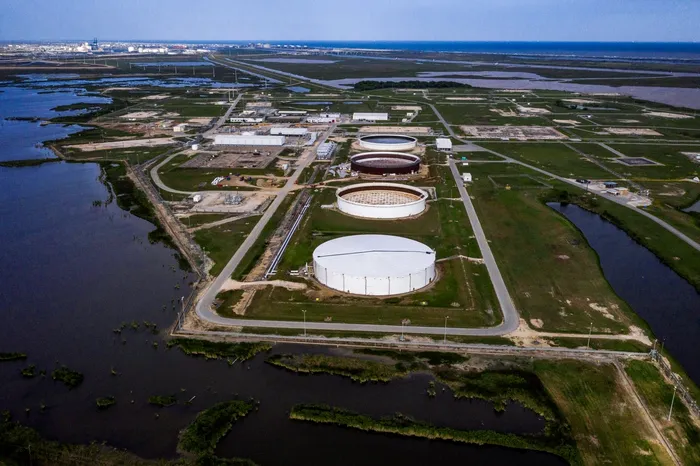
In previous decades, the United States had a massive insurance policy. The Strategic Petroleum Reserve (SPR) was designed to blunt the impact of a Middle Eastern war. However, that policy has been cashed in.
After years of releases intended to keep domestic gas prices low for political reasons, the SPR sits at its lowest level in forty years. We have lost our shock absorber. If a major supply disruption occurs tomorrow, the White House cannot simply flip a switch and flood the market with millions of barrels. The physical limitations of the salt caverns and the degraded state of the pumps mean that the "emergency" supply is more of a suggestion than a solution.
Traders know this. They see a world where the US has used its last bullet before the war even started. This lack of a domestic safety net is a massive tailwind for the $125 thesis.
The Shale Myth and Production Reality
There is a persistent belief that US shale producers can simply "turn on the taps" to save the day. This is a fundamental misunderstanding of how the oil business works in the 2020s.
- Capital Discipline: Publicly traded oil companies are no longer in the business of chasing volume. After a decade of burning through cash, shareholders demand dividends and buybacks. They will not authorize massive new drilling programs just because the price hits $100.
- Labor and Equipment: You cannot drill a hole without rigs and crews. Both are in short supply. The supply chain for steel casing and fracking sand is still recovering from years of underinvestment.
- Depleting Tier-1 Acreage: The best spots in the Permian have already been drilled. Producers are moving into Tier-2 and Tier-3 land, where the returns are lower and the decline rates are faster.
We are entering an era of "expensive oil." The days of $40 or $60 WTI providing a comfortable baseline are gone. The cost of extraction is rising, and the risk premium is being permanently re-evaluated.
The Geopolitical Shift from West to East
The most overlooked factor in the $125 prediction is the changing nature of oil diplomacy. For fifty years, the "Petrodollar" ensured that the US had a say in how Middle Eastern oil was priced and moved. That era is ending.
Saudi Arabia and the UAE are increasingly looking toward China and India as their primary customers. These nations are willing to pay a premium for guaranteed supply, and they are increasingly willing to settle trades in currencies other than the dollar. This fragmentation of the oil market creates "pockets" of volatility. If a conflict breaks out, the US may find itself outbid for the very barrels it once took for granted.
The Role of Speculative Capital
It is also vital to understand that oil prices are a reflection of the "paper market" as much as the "wet market." When Kalshi traders bet on $125, they influence the behavior of hedge funds and institutional investors.
As the narrative of a "protracted conflict" gains steam, we see a massive influx of speculative capital into long positions. This creates a self-fulfilling prophecy. The more people believe $125 is inevitable, the more they buy futures contracts, driving the spot price higher. This is the feedback loop that leads to the parabolic moves seen in 2008 and 1979.
The Fragility of the European Energy Grid
While much of the focus is on US prices, the real pressure point is Europe. The continent has spent the last few years frantically decoupling from Russian energy, leaving it heavily reliant on LNG and Middle Eastern crude.
If the conflict drags on, Europe will be forced to compete with Asia for every remaining drop of non-Russian oil. This global bidding war is what pushes WTI toward that $125 mark. Even if the US is technically "energy independent," we are not insulated from global price parity. If Brent crude hits $140 in London, WTI will follow it upward, regardless of how much oil is sitting in a tank in Cushing, Oklahoma.
The Technical Breakdown
Look at the charts. Oil has been forming a massive "cup and handle" pattern on the long-term monthly view. Technical analysts see the $125 level as the natural point of resistance before a potential move to all-time highs.
The moving averages are beginning to curl upward, and the Relative Strength Index (RSI) suggests that while oil is becoming "overbought," it can stay that way for a long time during a geopolitical crisis. Traders aren't just guessing; they are following the path of least resistance. With inventories low and tensions high, that path points straight up.
The Inevitability of Demand Destruction
At $125, something happens that hasn't happened in a significant way for years: demand destruction. This is the point where the average consumer stops driving, stops flying, and cuts back on discretionary spending.
However, there is a lag. People still have to go to work. Trucks still have to deliver food. The global economy can "absorb" $125 oil for a few months, but it cannot survive it for a year. The Kalshi traders betting on this high price are essentially betting on a global recession. They are betting that the conflict will last long enough to push prices to a point that breaks the consumer.
It is a grim outlook, but it is one grounded in the reality of a world that has neglected its energy security for too long. We have spent a decade pretending that we could move away from fossil fuels without first ensuring a stable transition. Now, the bill is coming due, and it is being delivered in the form of a $125 barrel of oil.
The transition from a peacetime economy to a wartime energy footing is never smooth. It is marked by volatility, shortages, and a radical repricing of risk. If you are waiting for things to "get back to normal," you are missing the signal. $125 is the new normal.
The data suggests that we are not just seeing a temporary spike driven by fear. We are seeing a structural realignment of the most important commodity on earth. The traders on Kalshi aren't just gambling; they are acting as a lighthouse, warning of the jagged rocks ahead. The question is no longer whether oil will hit $125, but how long it will stay there and what will be left of the global economy when it finally comes down.
Protect your capital. Watch the Strait. Stop listening to the pundits who say this is "transitory." In the world of energy, nothing is transitory when the tankers stop moving. Underestimating the duration of this conflict is the fastest way to lose everything in this market. The math is clear, the history is written, and the price tag is $125.