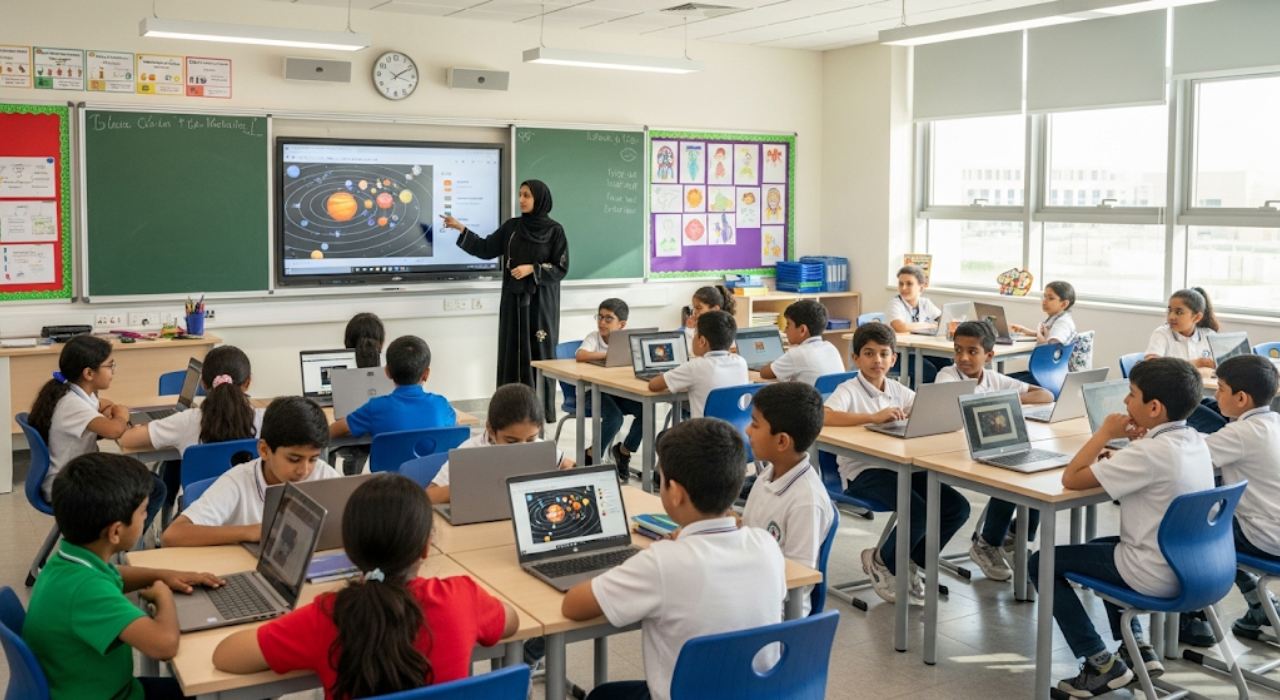
The gates swung open today. Across the United Arab Emirates, over one million students flooded back onto campuses, marking the end of a long, forced hiatus caused by regional instability. But the scene inside those schools is far from the standard rhythm of academic life. It is a calculated, high-stakes experiment in maintaining continuity under pressure.
The return is not merely a logistical shift. It is a reaction to the raw anxiety of the past fifty days. During that period, distance learning became the mandatory default, a measure dictated by shifting geopolitical sands. Now, authorities have signaled a full-scale push to restore routine. Yet, the routine itself has been fundamentally altered.
The New Architecture of Caution
Schools are no longer just places of instruction. They are fortresses of precaution. Walk through any campus today and the changes are immediate. Clear signage dominates hallways. Designated safe zones have been carved out of libraries and multipurpose rooms. These are not just suggestions; they are the new operating standard.
The Ministry of Education has implemented a four-phase strategy to manage this return. It starts with the absolute readiness of physical facilities. Before a single student could re-enter a building, inspections had to pass, drills had to be finalized, and safety procedures had to be drilled into staff. The focus is on rapid, coordinated responses. If an alert is issued, there is no ambiguity. Students are moved, not just to safety, but to specific, pre-assigned zones. These areas are far from windows, away from exterior walls, and supervised by personnel whose only duty is managing that space.
Teachers, once solely responsible for academic delivery, are now the frontline of this safety infrastructure. They are tasked with maintaining calm, managing movement, and conducting precise, rapid attendance check-ins during any incident. This adds a profound psychological weight to the teaching profession. It is not enough to teach mathematics or literature; they must now facilitate an environment of controlled security.
The Friction of Flexibility
Not every institution is functioning at the same pace. The return is uneven, reflecting the reality that some schools were better prepared for the administrative burden than others. Some private institutions delayed reopening to complete necessary upgrades to their safety protocols. Others have chosen to maintain a hybrid model, allowing students to continue learning from home.
This hybrid approach is a pragmatic compromise. It acknowledges that parental trust, once shattered by volatility, cannot be fully restored by a government decree. By keeping the online option alive, authorities and school operators are managing risk. They are also managing parent expectations. For those who choose to send their children back, the trade-off is clear. They gain the social and academic benefits of in-person schooling. The cost is adherence to a rigid, often restrictive set of rules.
Outdoor activities are largely paused. Canteens have been shuttered in many locations. Assemblies, those staples of school spirit, are non-existent. These are not minor inconveniences. They are the elimination of the soft, social edges of schooling. They strip the environment down to the bare essentials of survival and instruction.
The Burden of the Digital Pivot
The reliance on remote learning during the past two months exposed cracks in the system that are now being papered over by this return. While educators and officials highlight the improvements in engagement that physical presence brings, the shadow of the digital pivot remains. Many students struggled. Screen fatigue is no longer a buzzword; it is a clinical reality that parents documented across the country.
The sheer pressure to resume in-person schooling also speaks to the economic and social necessity of the classroom. When schools close, the workforce loses its capacity. Parents, forced to manage childcare alongside their own professional duties, became a vocal lobby for this reopening. The state has responded to this need for stability. However, the move also reflects a desire to reclaim the narrative of normalcy. The UAE is projecting an image of resilience, a country where the education system can absorb regional shocks and continue to operate, albeit with significant modifications.
The Risks of the Protocol
There is a inherent fragility in this strategy. The reliance on strict adherence to rules—by students, by staff, and by parents—is a tall order. When a system depends on human performance during periods of high stress, the probability of failure increases. What happens when a parent panics and decides to pull their child out during a school day? The regulations are explicit: they are not permitted to do so. Schools are instructed to prevent collection during active alerts to ensure the safety of the wider population.
These directives create a tension between individual parental rights and institutional safety mandates. This friction will likely be the source of significant operational friction in the coming weeks. The authorities have already warned motorists about the severity of traffic rules, emphasizing that the roads around schools are high-priority zones. A fine of 1,000 dirhams and 10 black points for passing a stopped school bus is a clear indicator of how the government is tightening the grip on student safety.
We are watching a process of forced adaptation. The long-term impact on students who are now being conditioned to view their school not as a community space but as a zone of constant, monitored caution is an open question. Educators are being asked to provide emotional support while simultaneously acting as enforcement officers for safety protocols.
The system is currently holding. Whether it can maintain this level of intensive management without burning out the very professionals it relies on—the teachers—is the real test for the remainder of this academic year. The doors are open, but the environment is entirely changed, and the country is effectively betting that this rigid framework is enough to keep the learning going while the world outside remains anything but predictable.