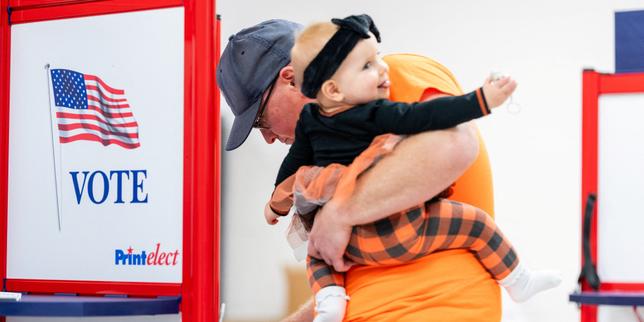
More than 52 million Americans had already cast their ballots days before the 2026 midterm elections officially opened on Tuesday, November 3, shattering previous non-presidential records and ultimately surging past 67.6 million early votes before polls closed. While initial headlines treated the 52-million milestone as a simple horse-race indicator of Democratic enthusiasm, the underlying data tells a far more complex story about structural shifts in American voting behavior, legal warfare over mail ballots, and an electorate reacting sharply to economic and geopolitical shocks.
The numbers themselves were staggering long before Election Day arrived. By the final weekend of October, early turnout had already eclipsed the 45.9 million total early ballots cast in the entire 2022 midterm cycle. When the University of Florida Election Lab finalized its post-election tallies, the full scope of the shift became unmistakable: 33,734,487 Americans voted early in person, while another 33,919,346 returned mail ballots. Out of at least 123.5 million total ballots cast nationwide—representing 49.1 percent of the voting-eligible population—more than half the electorate decided the outcome before the first Tuesday in November even began.
Why Conventional Punditry Misread the 52 Million Milestone
Standard election-week coverage framed the surge around a single surface-level metric. In states that track party registration, Democrats held a commanding 11-point lead in the early-vote pool at the 52-million mark, accounting for roughly 46 percent of returned ballots compared to 35 percent for Republicans and 19 percent for independents. Cable news panels immediately split into predictable camps, with one side declaring an insurmountable blue wave and the other insisting that Republican voters were simply waiting for Election Day.
Both interpretations missed the structural reality underneath the spreadsheets.
First, early voting has permanently ceased to be an emergency convenience or a pandemic-era anomaly. Across three consecutive federal cycles, voting before Election Day has hardened into the default habit for a majority of active American voters. State-level data from places like Indiana proves that this is not merely a coastal phenomenon; overall turnout in the state jumped from 34.04 percent in 2022 to 40.89 percent in 2026, driven largely by a 9 percent statewide spike in absentee and early ballots even as traditional Election Day in-person voting actually declined.
Second, raw party registration numbers in early voting frequently mask which voters are actually showing up. Political analysts have spent decades warning campaigns not to confuse cannibalization with expansion. Cannibalization occurs when reliable, high-propensity voters who would have cast a ballot on Election Day simply shift their vote to an earlier Tuesday. Expansion occurs when campaigns successfully pull low-propensity or occasional voters into the electorate who otherwise might have stayed home.
In 2026, both forces collided at once. In battleground states like Michigan, early voting jumped 32 percent compared to 2022, adding roughly 409,000 extra ballots before Election Day. In Maine, early participation surged by 44 percent. Those numbers did not come solely from habitual voters changing their calendars. They reflected an electorate mobilized by acute frustration over consumer prices, tariff policies, and the U.S.-Israeli military conflict with Iran—issues that dominated voter interviews from suburban Texas to college towns in the Midwest.
The Legal Battle Over Mail Ballots That Backfired
To understand why more than 23 million Americans had already returned mail ballots by November 1—and why nearly 34 million eventually did so—you have to look at the intense courtroom battles that preceded the election.
Throughout the spring and summer of 2026, the Trump administration attempted to impose sweeping restrictions on mail-in voting ahead of the midterms. Voting rights organizations and Democratic state officials challenged those directives across multiple federal jurisdictions, triggering a volatile series of conflicting rulings between May and August. The standoff only ended in October, weeks before ballots went out, when the U.S. Supreme Court rejected the administration's bid to enforce the new mail-voting curbs for the November cycle.
The Streisand Effect at the Ballot Box
High-profile federal efforts to restrict mail voting and challenge voter rolls in states like California had an unintended operational consequence. Rather than suppressing mail participation, months of front-page litigation reminded voters of mail-ballot deadlines earlier than usual, prompting over 61.3 million Americans to request mail ballots nationwide.
Instead of dampening enthusiasm, the legal uncertainty created urgency. Voters who might have waited until the final week to drop off an absentee ballot requested their paperwork early and returned it immediately to ensure their votes were logged before any new administrative challenges could materialize. At the same time, state-level disputes over voter roll accuracy—including a late-October legal filing that exposed how federal data sweeps in California had erroneously flagged eligible citizens as suspected non-citizens—further polarized the mechanics of voting itself.
Demographic Fault Lines Beneath the Surface
When political scientists at the Brennan Center for Justice and Tufts University's CIRCLE dissected the 2026 turnout data after the dust settled, they uncovered demographic shifts that the headline 52-million figure completely obscured.
The Collapse of the Racial Turnout Gap in the South
Nowhere was the divergence sharper than in Georgia. While overall national turnout reached its second-highest midterm rate since 1914—trailing only the 50 percent benchmark set in 2018—county-level analysis showed radically different behavior across racial lines.
In Georgia, Black voter turnout surged dramatically compared to 2022, while white voter turnout actually declined. More than 29 percent of white Georgians who voted in the 2024 presidential election stayed home in 2026, compared to roughly 24 percent of Black 2024 voters. Simultaneously, 12.8 percent of Black voters who cast ballots in Georgia in 2026 had not voted at all in 2024, nearly double the rate of new or returning white voters (6.9 percent).
The result was historic. The turnout gap between white and Black voters in Georgia dropped to its lowest point in any midterm election in two decades, narrower even than in every presidential cycle of that span except when Barack Obama topped the ticket. Similar spikes in majority-minority counties appeared across other jurisdictions previously covered under Section 5 of the Voting Rights Act.
Youth Turnout and the Cost-of-Living Revolt
Young voters aged 18 to 29 proved equally decisive, matching the 27 percent national midterm turnout rate seen in 2022 and trailing only 2018's modern record of 31 percent. Crucially, however, their partisan alignment snapped back sharply after drifting rightward two years earlier.
- National House Margin: Voters under 30 backed Democratic U.S. House candidates by a 36-point margin (66 percent to 30 percent).
- State-Level Surges: In Georgia's statewide races, Democratic support among youth topped 70 percent, while in Mississippi's unexpectedly competitive U.S. Senate contest, it exceeded 75 percent.
- Demographic Reversals: White youth and young men—two groups that had shifted noticeably toward Donald Trump in 2024—swung heavily back toward Democrats.
Over 80 percent of young voters polled in exit surveys stated they wanted either substantial change or a complete overhaul of how the country was being run. Economic anxiety led their list of concerns, reinforced by opposition to the war in Iran and frustration over healthcare costs.
| Turnout Metric | 2022 Midterms | 2026 Midterms | Net Change |
|---|---|---|---|
| Total Early Votes Cast | ~45.9 million | 67.65 million | +21.75 million |
| Overall Eligible Turnout Rate | ~46.0% | 49.1% | +3.1 percentage points |
| Youth Turnout Rate (18–29) | 27.0% | 27.0% (est.) | Flat (2nd highest in 30 yrs) |
| Net Senate Seat Shift | +1 Dem | +9 Dem (projected) | Largest wave since 1958 |
The Operational Reality Campaigns Can No Longer Ignore
For political operatives, the 2026 early-voting explosion exposed a fatal flaw in traditional campaign budgeting. For decades, American political campaigns hoarded up to 40 percent of their television and digital advertising budgets for the final 10 days before Election Day, operating under the assumption that undecided voters make up their minds during the final weekend.
That calendar is dead.
When 52 million people have already locked in their choices before November even starts—and nearly 68 million do so before Election Day morning—late-breaking attack ads and last-minute rally blitzes reach an increasingly shrinking slice of the electorate. During the final days of the 2026 campaign, President Trump maintained an exhausting schedule of rallies in traditional Republican strongholds like Iowa and Kansas, supplemented by Election Eve telephone rallies aimed at rescuing vulnerable GOP incumbents. Yet in state after state, millions of ballots were already sitting sealed inside county election vaults.
Early voting also radically alters the cost of voter contact. Every time a voter casts an early ballot, state election boards update their public voter files—often daily. Sophisticated field operations immediately scrub those voters from their canvassing lists, phone banks, and targeted digital ad audiences. Campaigns that fail to integrate real-time early-vote data waste millions of dollars trying to persuade citizens who have already voted, while starving their field teams of resources needed to chase down low-propensity holdouts.
The Gray Areas and Unresolved Risks of Mass Early Voting
Celebrating high turnout does not require ignoring the operational strains that come with stretching an election across six weeks. The 2026 cycle laid bare serious vulnerabilities in how American states administer early and mail ballots.
First, ballot curing and rejection rates remain deeply uneven across state lines. Roughly 61.36 million mail ballots were requested in 2026, yet only 33.92 million were ultimately returned and counted. While many voters who requested a mail ballot simply opted to vote in person instead, hundreds of thousands of mail ballots still face heightened scrutiny over signature mismatches, missing witness details, or postmark delays. States with strict rules that prohibit election workers from notifying voters of minor clerical errors continue to discard legitimate ballots at disproportionately high rates among younger and first-time voters.
Second, information asymmetry cuts both ways when voters cast ballots in September or early October. Voters who locked in their choices six weeks before November 3 did so before final debates, late-breaking economic reports, or unexpected political developments—such as the last-minute primary-loser endorsement shakeup in Michigan's Senate race—ever occurred. Early voting maximizes access, but it permanently forfeits a voter's ability to react to late-campaign facts.
Finally, staggered counting rules continue to fuel post-election distrust. States like Florida and Georgia process and scan mail ballots as they arrive, allowing them to report massive early-vote totals within minutes of polls closing. Other battleground states still bar election officials from opening or tabulating mail envelopes until Election Day morning, guaranteeing multi-day counting delays that partisan actors routinely exploit to allege fraud without evidence.
The 52-million early-vote milestone of 2026 was never just a statistic about enthusiasm. It was proof that the American Election Day has permanently dissolved into an Election Month—and any campaign, lawmaker, or election administrator still planning around a single Tuesday in November is fighting a war that is already over.


