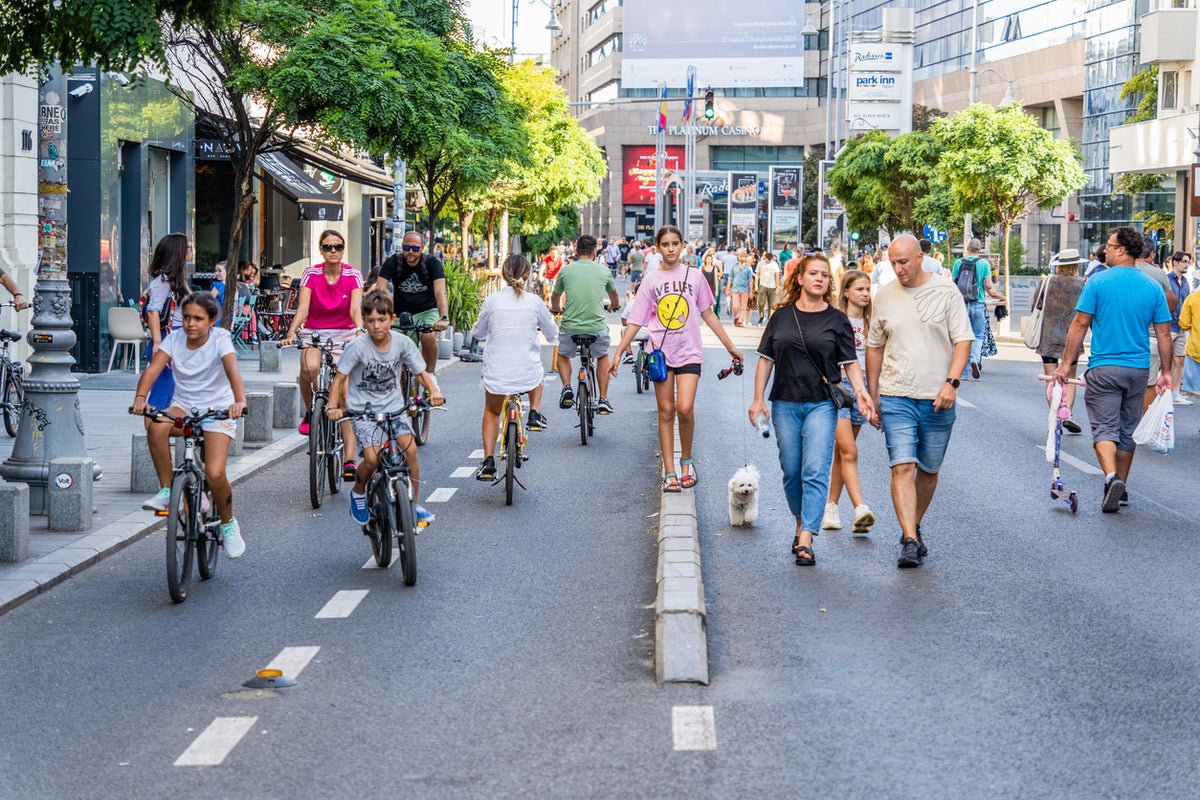
Cities that banish cars from their urban cores solve their most pressing crises of air pollution, pedestrian deaths, and declining local commerce. Yet, most city council attempts to pedestrianize streets collapse under a wave of local merchant outrage, political cowardice, and terrible planning. Simply painting a bike lane or throwing down a few plastic planters is not urban planning; it is cheap public relations. To build truly functional cities, municipal governments must stop treating street closures as temporary weekend experiments and start rebuilding the underlying transit infrastructure that makes car ownership obsolete in the first place.
Decades of auto-centric planning have left us with a collective case of stockholm syndrome. We accept that millions of square meters of prime public space should be used to store idle, privately owned metal boxes. We accept that our children cannot play outside because a two-ton SUV might crush them. When a city proposes reclaiming even a single block for human beings, the pushback is fierce, immediate, and remarkably predictable.
The Economic Myth That Kills Street Closures
Every time a city proposes removing parking spaces to create a pedestrian plaza, local merchants predict immediate bankruptcy. They believe their customers arrive by car. They are almost always wrong.
Decades of retail data show a massive disconnect between how shop owners think their customers travel and how those customers actually arrive. In London, studies by Transport for London found that shopkeepers overestimated the share of customers arriving by car by more than double. While merchants believed 41% of their clientele drove, the actual number was just 12%. The vast majority walked, cycled, or took public transit.
In Madrid, the launch of the "Madrid Central" low-emission zone met with fierce resistance from business groups. They claimed the restrictions would destroy Christmas sales. Instead, during the first holiday season after the ban, sales in the city center increased by 9.5% year-over-year. People do not buy things from cars; they buy things when they are on foot. Pedestrians can stop, look at window displays, and walk inside on a whim. Drivers are focused on finding parking, avoiding traffic, and getting out of the area as quickly as possible.
But we must acknowledge the gray areas. The transition period is painful, and some businesses do suffer. A hardware store selling heavy timber or an appliance shop relying on curbside loading cannot easily pivot to a car-free model. When cities ignore these specific logistics, they doom their pedestrianization plans. A successful transition requires dedicated, timed delivery windows for freight, cargo-bike delivery subsidies, and micro-hubs on the periphery. Without these concessions, the merchant backlash will remain a potent political force that can roll back even the most promising initiatives.
The Traffic Displacement Trap
Opponents of pedestrianization often raise a logical concern. If you close a major street to cars, won't that traffic simply spill over onto the next street, creating gridlock in surrounding neighborhoods?
This fear ignores a well-documented phenomenon in traffic engineering known as reduced demand. Just as building more highway lanes attracts more cars (induced demand), reducing road capacity actually causes traffic to evaporate. When driving becomes slower and more difficult than taking the train or riding a bike, people change their behavior. They combine trips, travel at different times, or switch to alternative modes of transportation altogether.
But this evaporation only occurs if viable alternatives exist.
When Paris Mayor Anne Hidalgo pedestrianized the banks of the Seine, critics warned of historic gridlock. While traffic did temporarily increase on nearby avenues, the overall volume of cars in the city center dropped as residents adapted. Paris succeeded because the city simultaneously built hundreds of kilometers of protected bike lanes and heavily subsidized public transit.
If a city with a broken subway system and no bike infrastructure tries the same thing, the result is disaster. The cars do not evaporate. They simply bottleneck in poorer, adjacent neighborhoods, shifting the burden of noise and toxic exhaust onto residents who have the least political power to complain.
The Class Divide in Pedestrian Planning
There is a dark side to the car-free movement that wealthy urban planners rarely talk about. It is the issue of spatial and economic equity.
Most pedestrian plazas and car-free zones are implemented in affluent, central tourist districts. These are areas already blessed with excellent subway connections, high-end retail, and walkable layouts. The residents who live there are wealthy enough to afford soaring rents. When these neighborhoods are closed to cars, property values climb even higher.
Meanwhile, working-class residents are pushed further to the periphery. They live in transit deserts where a car is not a luxury, but a lifeline needed to reach hourly-wage jobs that cannot be done remotely. To these workers, congestion pricing and street closures feel like a direct tax on their survival.
Consider Barcelona's famous Superblock initiative. The program groups nine city blocks together, restricting through-traffic to the perimeter and turning internal streets into green, pedestrian-first spaces. It is a brilliant design. But it has also triggered severe gentrification. As the air became cleaner and the streets quieter, real estate speculators moved in. Long-term tenants were priced out, replaced by boutique hotels, trendy cafes, and tourist rentals.
If we only build car-free oases for the rich, we are not solving the urban crisis. We are merely exporting the pollution and danger of automobile traffic to poorer neighborhoods. Pedestrianization must be planned regionally, starting with massive transit expansions to the outer suburbs before the first bollard is ever installed downtown.
Designing for Utility Instead of Aesthetics
Walkable streets must be designed as utility networks, not amusement parks.
Far too many cities treat pedestrianization as an exercise in beautification. They hire expensive design firms to install decorative paving, artistic benches, and selfie-friendly installations. This approach treats the street as a destination rather than a thoroughfare.
A functional street must accommodate the daily mechanics of urban life. It must allow garbage trucks to collect waste, emergency vehicles to reach fires, and disabled residents to access specialized transport.
Pontevedra, a small city in northwestern Spain, offers a masterclass in how to do this right. In 1999, Mayor Miguel Anxo Fernández Lores looked at a city clogged by 30,000 cars a day and decided to pedestrianize the entire historic center. He did not start by planting trees. He started by analyzing the logistics of the city.
Pontevedra created a system of free, peripheral parking lots located just a ten-minute walk from the center. They restricted vehicles in the core to a maximum speed of 30 kilometers per hour, eliminated curbs to make the entire city wheelchair accessible, and set up a strict 30-minute parking limit for delivery drivers. The results were staggering. Traffic emissions fell by 70%, the city gained thousands of new residents, and pedestrian deaths dropped to zero.
Pontevedra succeeded because it treated the street as a complex logistical machine, not a park.
Real Transit Sovereignty Requires Friction
No safe, comfortable transition exists. If a city wants to rid itself of car dependency, it must be willing to make driving difficult.
Politicians love to talk about "balanced transport solutions" that please everyone. This is a coward's lie. You cannot make a street safer for a child on a bicycle without taking space away from a driver. You cannot speed up a bus without taking a lane away from single-occupancy vehicles. Urban space is finite.
The first six months of any major pedestrianization project will be a public relations nightmare. The media will run stories about angry drivers, confused tourists, and frustrated delivery workers. The political temptation to back down will be immense.
But cities that hold the line always win. Once the initial confusion subsides, the benefits become undeniable. The air gets cleaner. The streets become quieter. Kids play outside again. Local businesses find themselves with more customers than they ever had when their storefronts were blocked by parked cars.
The car-free city is not a utopian dream. It is a highly practical, historically proven model of urban organization that we abandoned for a brief, disastrous half-century of automotive excess. Reclaiming our streets is not about turning back the clock. It is about recognizing that our cities should be built for the people who live in them, not the machines that pass through them.