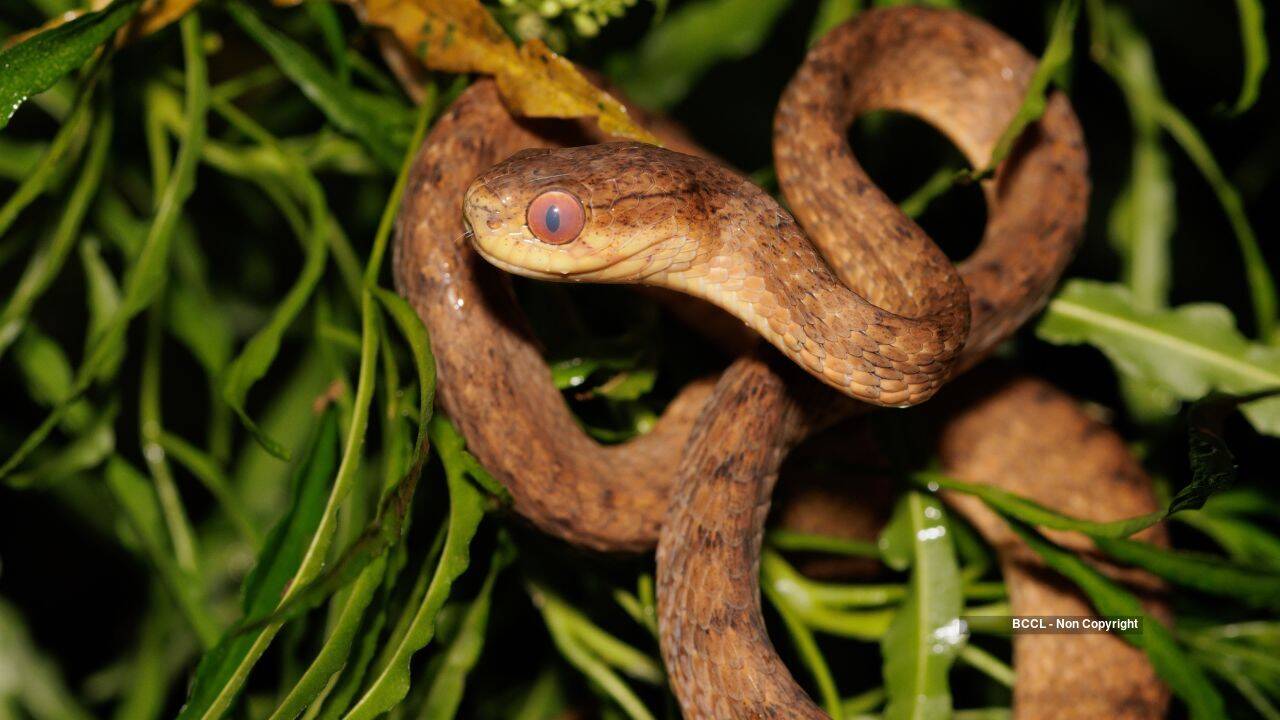
Sometime shortly after the smoke cleared from World War II, a handful of brown tree snakes slipped quietly onto the isolated Pacific island of Guam, likely stowed away inside military cargo. That minuscule founding group launched an ecological catastrophe. Today, in certain pockets of the territory, those reptiles have multiplied into staggering densities reaching up to 30,000 snakes per square mile. For decades, evolutionary biologists shook their heads in disbelief at this explosion. Standard ecological models dictate that such a tiny starting population must trigger a brutal genetic bottleneck, plunging the animals into destructive inbreeding and stripping away the adaptive flexibility required to conquer a foreign landscape.
Yet the snakes did the exact opposite. They obliterated native bird populations, turned quiet island forests silent, and regularly knocked out local electrical grids by scaling utility poles.
Biologists spent years trying to solve the paradox. How could an inbred population achieve such monstrous numbers without collapsing under the weight of its own genetic uniformity? Recent work published in Science Advances by researchers from the University at Buffalo and the U.S. Geological Survey finally cracks open that black box. By deploying advanced long-read genomic sequencing, scientists uncovered more than 19,000 structural variants hidden deep within the reptile genome, offering a masterclass in how evolutionary biology often operates outside traditional textbooks.
The Blind Spot of Early Science
To understand why this discovery changes everything, we have to look at how geneticists used to read the biological playbook. For decades, standard DNA sequencing relied on a magnifying glass approach that scanned genomes for single-letter mutations. Researchers counted tiny base-pair swaps, where an adenine swapped for a guanine, tracking point mutations across short fragments of DNA.
That method worked fine for tracking straightforward pedigree lines. But it completely missed the structural architecture of the genome.
Entire chapters of genetic text can be copied, deleted, inverted, or completely relocated to different chromosomes. These major rearrangements are known as structural variants. When scientists applied older tools to the Guam invasion, the snakes looked impoverished. Their family tree appeared dangerously narrow.
Long-read sequencing changed the entire equation. By reading much longer contiguous stretches of DNA at once, researchers could suddenly see the macro-structure of the genome.
It proved equivalent to comparing two historical manuscripts. Old sequencing read the books letter by letter and declared them identical, completely missing the fact that entire paragraphs had been duplicated, rearranged, or weaponized in one version. In the brown tree snake, those structural variants accounted for changes affecting nearly eight times more of the genome than simple single-letter swaps.
Weapons in the Genetic Code
Those 19,000 hidden variants were not scattered randomly across the biological code. They clustered heavily around specific functional traits, most notably immune system function and olfaction.
An invasive predator thrown into a completely new ecosystem faces an immediate baptism of fire. New pathogens, unfamiliar prey species, and shifting environmental stresses stand ready to wipe out any newcomer lacking physiological resilience. The heavy concentration of structural variants in immune-related genes gave these snakes a biological shield, allowing them to absorb novel local pathogens without suffering mass mortality events.
Simultaneously, the heavy variation in olfaction genes rewired how the predators interacted with their surroundings. Brown tree snakes hunt primarily through chemical cues, flicking their forked tongues to sample ambient air molecules and track prey across the dark canopy. Enhanced genetic plasticity in sensory pathways meant individual snakes could rapidly optimize their tracking mechanics, turning the quiet forests of Guam into an open buffet.
Furthermore, this sensory shift addresses another longstanding behavioral mystery. In their native Australian and South Pacific habitats, brown tree snakes frequently engage in cannibalism, occasionally consuming members of their own species. On Guam, however, researchers noted a distinct suppression of this behavior. The structural variants in their smell pathways likely fine-tuned their chemical recognition, allowing siblings and close relatives to identify each other as kin rather than dinner, preventing self-destructive predation from cutting down their numbers during the peak of the invasion.
The Conservation Paradox
This biological reality check forces a radical rethink far beyond the shores of Guam. For years, conservation biologists have measured the extinction risk of endangered species by looking strictly at traditional genetic diversity metrics. If a threatened mammal or bird population shrank to a tiny number of individuals, managers routinely wrote them off as evolutionary dead ends doomed by inbreeding depression.
The Guam snake data suggests we may be severely misreading the resilience of vulnerable wildlife.
If an infamous invasive predator can harbor thousands of structural variants capable of bypassing a genetic bottleneck, rare and endangered species might possess hidden reserves of genetic flexibility that standard tests cannot see. A species on the brink of extinction might look completely uniform on the surface while carrying a subterranean reservoir of structural variants waiting for the right environmental pressure to unlock.
This realization demands a shift in how field biologists evaluate wild populations. Measuring single-letter mutations is no longer enough to determine whether a species can bounce back from the brink. Genome architecture matters.
The Unresolved Mystery
Despite these breakthroughs, a glaring question remains unanswered. Did those 19,000 structural variants evolve after the snakes touched down on Guam, or were they already carried in the luggage of the original founding few?
Building structural variants typically takes many generations of slow genetic drift and selection pressure. Yet rapid adaptation events during severe population bottlenecks have been documented in other biological contexts, suggesting that intense environmental stress can sometimes accelerate genomic rearrangement. Pinning down the exact timeline requires exhaustive genomic comparisons with ancestral populations still residing in the native Australian range, work that is currently grinding forward in laboratories.
The Guam invasion stands as a stark reminder that nature rarely fits neatly into rigid theoretical models. While wildlife managers continue the grinding, expensive war to suppress the millions of snakes still wrapping around utility poles and devouring island ecosystems, the biology underneath has evolved past our old ways of measuring it. The genome is not a fragile string of letters waiting to break under pressure. It is a dynamic, shifting architecture capable of rewriting itself in the dark