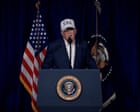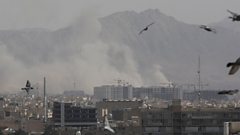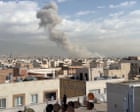
The United States is currently engaged in the most aggressive military intervention in the Middle East since the 2003 invasion of Iraq. On February 28, 2026, President Donald Trump announced the start of "major combat operations" against Iran, a campaign the Pentagon has dubbed Operation Epic Fury. This is not a mere skirmish or a series of surgical strikes like those seen in years prior. It is a full-scale assault aimed at decapitating the leadership of the Islamic Republic, dismantling its nuclear infrastructure, and forcing a total collapse of the current regime.
The strategy hinges on a high-stakes gamble that airpower and targeted assassinations can trigger a popular uprising. In his address, Trump explicitly called on the Iranian people to "take over your government," promising them that "the hour of your freedom is at hand." However, beneath the rhetoric of liberation lies a grim reality of regional destabilization and the very real possibility of a protracted conflict that could pull the entire globe into a tailspin. For a different view, consider: this related article.
The Strategy of Decapitation
The primary objective of the initial wave of strikes was the removal of the supreme decision-making authority in Iran. Reports have confirmed the death of Supreme Leader Ayatollah Ali Khamenei following a strike on his compound in Tehran. This move was intended to create an immediate power vacuum, paralyzing the command and control of the Islamic Revolutionary Guard Corps (IRGC).
By removing the figurehead who has held absolute power for decades, the Trump administration expects the internal fissures of the Iranian government to widen into a chasm. The logic is simple: without a clear successor and with the military top brass in the crosshairs, the regime will implode. But history suggests that leadership decapitation rarely leads to a peaceful transition. Instead, it often results in chaotic infighting among mid-level commanders or the rise of even more radical elements who have nothing left to lose. Further analysis on the subject has been provided by Al Jazeera.
Maximum Pressure Meets Maximum Force
The road to Operation Epic Fury was paved with the failure of diplomacy. For over a year, the Trump administration pursued a policy of "maximum pressure," combining crushing economic sanctions with threats of military action. In June 2025, the U.S. carried out Operation Midnight Hammer, which targeted nuclear facilities at Fordow, Natanz, and Isfahan. While those strikes were sold as a way to bring Iran back to the negotiating table, they instead accelerated the regime's resolve to harden its defenses.
The failure of the Geneva talks in late February 2026 was the final straw. Negotiators had demanded that Iran not only stop enrichment but also dismantle its entire missile program and end support for regional proxies. Tehran countered with offers of economic concessions and limited enrichment pauses, which Washington viewed as a stalling tactic. When the talks collapsed, the massive armada assembled in the Persian Gulf was given the order to engage.
The Economic Toll of a Regional War
While the focus remains on the kinetic operations in Tehran and Isfahan, the global economy is already feeling the aftershocks. The threat of Iran closing the Strait of Hormuz—a narrow waterway through which 20% of the world's oil flows—has sent energy markets into a frenzy.
If the conflict remains limited to Iranian territory, the impact might be contained. However, Iran has already begun retaliating by launching ballistic missiles and drones at U.S. bases and allies across the region, including sites in Kuwait, Qatar, the UAE, and Saudi Arabia. If oil infrastructure in these countries is hit, analysts predict a "historic" spike in oil prices, potentially reaching $130 per barrel. For the American consumer, this translates to gas prices well over $4 per gallon, threatening to erase the economic gains of the past year.
The Missile and Proxy Network
One of the most dangerous aspects of this operation is the "Axis of Resistance." Iran has spent decades building a network of proxies in Lebanon, Iraq, Syria, and Yemen. These groups are not just footnotes in a briefing; they are well-armed militias capable of inflicting significant damage.
- Hezbollah in Lebanon possesses an arsenal of over 150,000 rockets and missiles aimed at Israel.
- Kataib Hezbollah and other Iraqi militias have already threatened a "war of attrition" against U.S. forces in the region.
- The Houthis in Yemen continue to threaten international shipping lanes in the Red Sea.
Trump’s address promised to "annihilate" the Iranian navy and "raze" its missile industry. But these proxies operate in the shadows, and airpower alone cannot eliminate them. A campaign that starts in the air may very well end in a grueling ground war that the American public was promised would never happen again.
The Humanitarian Crisis and the Call for Uprising
The administration is banking on the "great, proud people of Iran" to do what decades of sanctions could not. By providing "overwhelming strength and devastating force," Trump believes he is giving the Iranian public the window they need to overthrow the theocracy.
Yet, the message is contradictory. While telling the public the hour of their freedom is at hand, the strikes are also turning Iranian cities into combat zones. "Stay sheltered. Don’t leave your home. It’s very dangerous outside. Bombs will be dropping everywhere," Trump warned. A population under bombardment is rarely in a position to organize a coherent political revolution. The risk of a massive humanitarian catastrophe—millions of displaced persons and thousands of civilian casualties—is the high price of this gamble for regime change.
The Legality and Mandate of the Strike
Critics have quickly pointed out that this operation was launched without a clear mandate from Congress. The administration is relying on the 2001 Authorization for Use of Military Force (AUMF) and the president's inherent Article II powers to defend against "imminent threats." However, the definition of an imminent threat has been stretched to include the potential for future nuclear development, a legal theory that remains highly controversial.
Domestically, the war has already become a flashpoint. While some praise the president's decisiveness, others see it as a betrayal of his earlier promises to end "forever wars." The political fallout will likely depend on the speed and success of the operation. If it drags on, or if American casualties mount, the initial support for "protecting the homeland" could quickly evaporate.
The U.S. military is currently hunting for Iranian leadership and mobile missile launchers across a territory the size of Alaska. The regime is battered, its Supreme Leader is dead, and its nuclear program is in ruins. But as the smoke clears over Tehran, the question is not just whether the old guard has fallen, but what—if anything—will be left to take its place.
Wait for the first confirmed reports of ground troop deployments or a blockade of the Strait of Hormuz before making any final assessment on the success of this campaign.