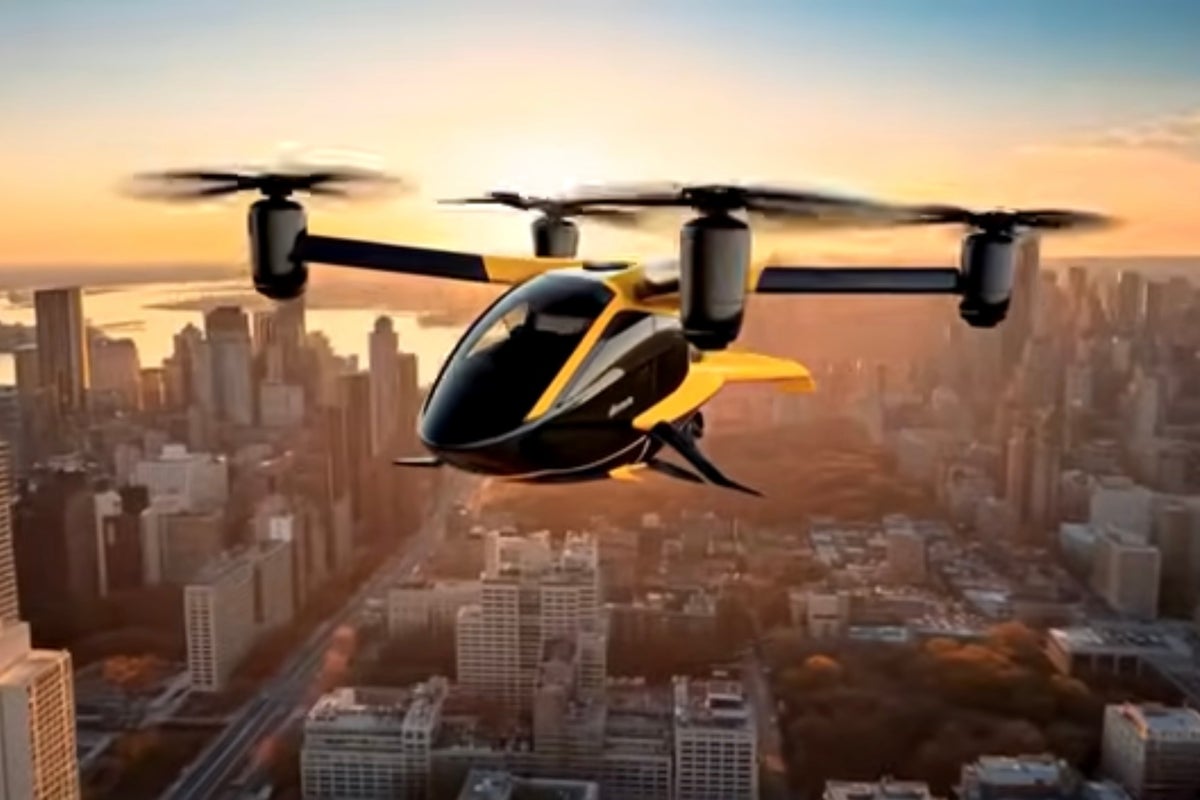
Political strategists and aerospace lobbyists are quietly positioning Oklahoma as the proving ground for a transport revolution that sounds like science fiction. The goal is to establish a testing corridor for electric vertical takeoff and landing aircraft, commonly known as flying cars. This initiative aims to bypass coastal regulatory gridlock by utilizing the state’s open airspace and permissive local government. However, the multi-billion-dollar ambition faces immediate, hard realities of physics, federal airspace law, and failing municipal infrastructure that political willpower alone cannot fix.
The concept of advanced air mobility has shifted from venture capital pitch decks into national policy platforms. Prominent political figures have proposed building new freedom cities on federal land, complete with fleets of vertical-lift vehicles. Oklahoma has emerged as the preferred theater for this experiment. The state already hosts significant aerospace infrastructure, including major military repair depots and active drone testing zones. Local officials are aggressively courting manufacturing startups with tax incentives and promises of minimal bureaucratic red tape.
Yet, behind the optimistic press releases lies a stark disconnect between political rhetoric and engineering reality. The airspace above the American heartland is not an open playground. It is a highly regulated environment controlled strictly by federal authorities who care little about local economic development goals.
The Federal Airspace Barrier That Politicians Ignore
Local legislation cannot override federal aviation regulations. While state leaders can offer land and tax breaks, they cannot grant airworthiness certificates or authorize commercial flight corridors. The Federal Aviation Administration operates on a mandate of absolute safety, meaning any novel aircraft design undergoes years of grueling scrutiny before carrying a single passenger.
The regulatory pipeline is clogged. Dozens of startups have spent hundreds of millions of dollars attempting to clear the hurdle of type certification. The process requires proving that a novel aircraft is as safe as a modern commercial airliner. For a vehicle with tilting rotors, complex fly-by-wire software, and experimental battery packs, establishing that level of reliability is an monumental task.
Consider the issue of low-altitude air traffic management. Modern air traffic control systems are built to monitor commercial jets traveling along predictable, high-altitude highways. Introducing thousands of automated or semi-automated passenger drones into the lower atmosphere requires an entirely different infrastructure. This network must handle micro-weather patterns, complex wind shears around buildings, and sudden battery degradation without a single collision.
The federal government is moving at its traditional, cautious pace. While local boosters talk about operations beginning within the next few years, the framework for widespread, autonomous low-altitude flight is still a decade away from reality.
The Heavy Reality of Battery Weight
The core technical challenge of electric flight comes down to a fundamental law of physics known as energy density. Liquid aviation fuel packs an enormous amount of energy into a relatively light mass. As a conventional airplane burns fuel, it becomes lighter, making it more efficient during the later stages of a flight.
Batteries do not work that way. An electric aircraft battery weighs exactly the same at the end of a flight as it did at takeoff.
+-----------------------------------------------------------------------+
|  ENERGY DENSITY COMPARISON                                            |
+-----------------------------------------------------------------------+
| Jet A-1 Fuel: Approx. 43 MJ/kg                                        |
+-----------------------------------------------------------------------+
| Top-Tier Lithium-Ion Batteries: Approx. 0.9 to 1.1 MJ/kg              |
+-----------------------------------------------------------------------+
This massive discrepancy forces severe design compromises. To lift a meaningful payload, an electric aircraft requires a massive battery pack. But that very battery pack adds so much weight that the vehicle requires more power just to stay aloft, which in turn demands an even larger battery. This spiral of diminishing returns severely limits the range and capacity of these vehicles.
Most current designs can carry only two to four passengers for distances under fifty miles before needing a lengthy recharge cycle. This makes them less of a widespread transport solution and more of an expensive alternative to short-haul helicopter routes. The idea that middle-class commuters will skip highway traffic by hopping into personal flying vehicles is a mathematical impossibility under current battery limitations.
The High Cost of Ground Infrastructure
Building a network for these aircraft involves far more than just painting a bullseye on an empty parking lot. Vertiports require massive capital investment to handle the unique demands of high-voltage electric aviation.
A viable vertiport needs high-capacity charging stations capable of delivering megawatts of power simultaneously. The existing electrical grid in rural and suburban Oklahoma was never designed to handle those kinds of sudden, intense loads. Upgrading transformers, running heavy-duty transmission lines, and securing backup power generation systems requires millions of dollars per site.
Noise pollution presents another barrier to public acceptance. While electric rotors are quieter than traditional helicopter blades, they still generate a distinct, high-frequency whine during vertical takeoff and landing. Placing these facilities near residential areas or business districts will trigger intense zoning battles and legal challenges from local communities.
The economics of the model are fragile. If a vertiport can only handle a few flights per hour due to charging delays and airspace restrictions, the cost per passenger will remain prohibitively high. The service inevitably becomes a luxury utility for wealthy executives rather than a democratic mass transit system.
The Strategy Behind Choosing the Heartland
Why Oklahoma? The decision by political groups to focus on this specific region is calculated.
The state offers a unique combination of flat terrain, low population density outside major hubs, and an existing cluster of unmanned aerial systems research facilities. By embedding their initiatives within an established aerospace ecosystem, proponents hope to shield themselves from accusations of chasing a fantasy project.
Furthermore, Oklahoma’s leadership has shown a willingness to adapt state laws to accommodate emerging tech industries. By creating a regulatory oasis, the state hopes to pull investment away from traditional aerospace hubs in California and Washington. It is a classic economic development play dressed up in the language of futuristic transportation.
"The true value of these testing zones isn't the aircraft themselves, but the data generated. Whoever controls the operating system for low-altitude flight controls the future of logistics."
This insight highlights the real game being played. The ultimate goal is likely not passenger transport at all, but automated cargo delivery. Moving packages across vast, sparsely populated rural areas presents far fewer safety risks and regulatory hurdles than moving human beings over crowded cities. The consumer flying car narrative serves as high-profile marketing for a much more pragmatic logistics play.
The Missing Link in Rural Transit
The political promise of this technology is often framed around connecting isolated rural communities with major economic centers. The argument suggests that flying vehicles will allow residents of small towns to access high-paying jobs and specialized healthcare in cities without enduring long drives on poorly maintained roads.
This argument ignores the economic realities of rural America. The communities that supposedly benefit most from this technology are the least likely to afford the service. A ticket on an electric aircraft will not compete with the cost of a gallon of gasoline or a bus pass.
Investing public funds or political capital into luxury air transport while surface roads, bridges, and traditional public transit systems rot from neglect is a policy failure. The immediate transport needs of the public are grounded in reality, requiring asphalt, steel, and reliable regional rail, not experimental flight corridors.
The corporate entities pushing these projects rely on a steady stream of government subsidies and defense contracts to stay solvent. By tying their fortunes to political movements, they secure long-term funding streams that keep them afloat even when their commercial products fail to materialize on schedule. It is a subsidy hunt masked as pioneering innovation.
The coming years will reveal whether the dust of the Oklahoma plains will see actual fleets of advanced aircraft or merely a series of abandoned concrete pads. The transition from a political talking point to an operational aviation network requires solving problems that cannot be smoothed over by a press conference. The laws of physics do not negotiate, and the federal registry moves for no one.