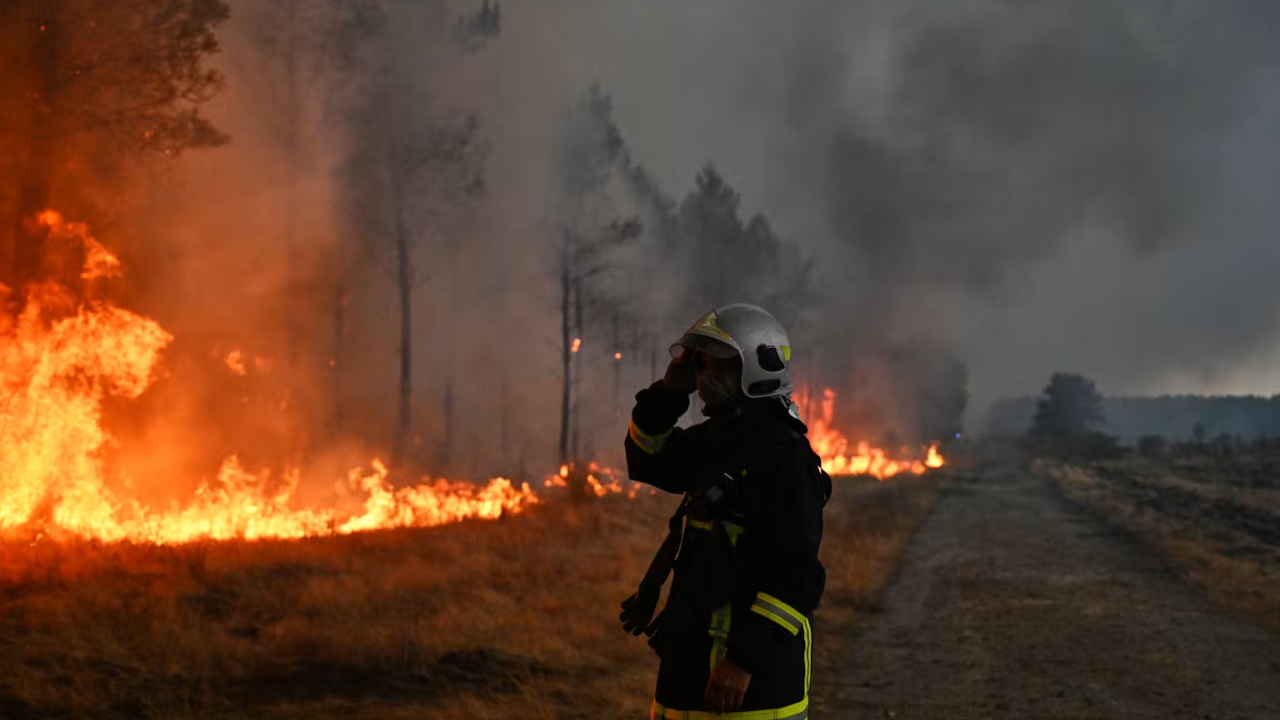
When the smoke from Canada's 2023 wildfire season choked cities thousands of miles away, most people assumed it was just a typical forest fire. It wasn't. The numbers tell a terrifying story. Across that single catastrophic season, flames torched roughly 15.1 million hectares of land. That footprint is seven times larger than the country's twenty-year average.
Yet the scorched trees are only half the narrative.
Recent scientific data published in Geophysical Research Letters reveals that the true engine behind those massive plumes wasn't standing timber. It was dirt.
Let's look at what actually happened beneath the surface and why the fallout changes everything we know about northern ecosystems.
The Hidden Engine Inside the Soil
For decades, forest fire tracking focused entirely on what you can see. Flames race through pine needles. Crowns explode into orange skies. Firefighters drop water from planes onto blazing canopies.
That focus misses the deep hazard.
Research led by scientists at McMaster University, including Alemu Gonsamo and Zilong Zhong, shows that roughly 74 to 76 percent of the carbon released during the 2023 season came from belowground organic soils and peatlands.
Think about that for a second. Three out of every four tonnes of carbon pumped into the atmosphere came from the dirt, not the trees.
The fires released an estimated 554 million tonnes of carbon total. When converted into carbon dioxide equivalents, that volume exceeds two billion tonnes. That single summer's output was roughly three times higher than Canada's entire reported human-made greenhouse gas emissions for 2022.
Why Peatlands Became a Ticking Bomb
Canada stewards about twenty percent of the world's soil organic carbon. Much of this is locked inside massive peatland complexes like the Hudson Bay Lowlands, which alone hold an estimated 30 billion tonnes of carbon.
Under normal, healthy conditions, peatlands act as natural firebreaks. They are soggy, waterlogged, and miserable for a fire to cross.
Climate change shattered that defense. Long heatwaves and severe droughts lowered water tables across northern regions. Thick moss and organic soils dried out completely.
When a lightning strike or human spark hit those dried-out areas in 2023, the fire didn't just sweep across the surface. It bored down.
These underground burns are nightmares for emergency crews. They don't roar. They smoulder. They can burn secretly beneath the roots for weeks or months, completely invisible from an airplane flying overhead.
The Dangerous Feedback Loop
Ancient carbon changed hands in 2023. Carbon that took millennia to accumulate beneath the forest floor vanished into the sky in a matter of days.
This creates a brutal loop.
- Higher global temperatures dry out northern peatlands.
- Dry peatlands catch fire easily and burn deep underground.
- Massive quantities of ancient carbon flood the atmosphere.
- That extra carbon accelerates global warming, drying out more peatlands.
We are watching a fundamental shift in northern geography. Landscapes that spent thousands of years acting as carbon sinks are actively flipping into carbon sources.
Traditional forest management models can't fix this. You cannot water-bomb a fire that is burning three feet underground in a remote northern bog.
What Comes Next
We have to stop treating northern fires as seasonal anomalies. They are systemic structural collapses.
If national emissions accounting ignores belowground soil combustion, our climate models are flying blind. Protecting forests by planting new saplings is useless if the dirt beneath our feet keeps burning down to the bedrock every time a summer heatwave hits.
Curbing the intensity of future fire seasons requires aggressive global emissions reductions. Without structural changes to how we tackle climate policy, 2023 won't look like an outlier. It will look like the baseline.