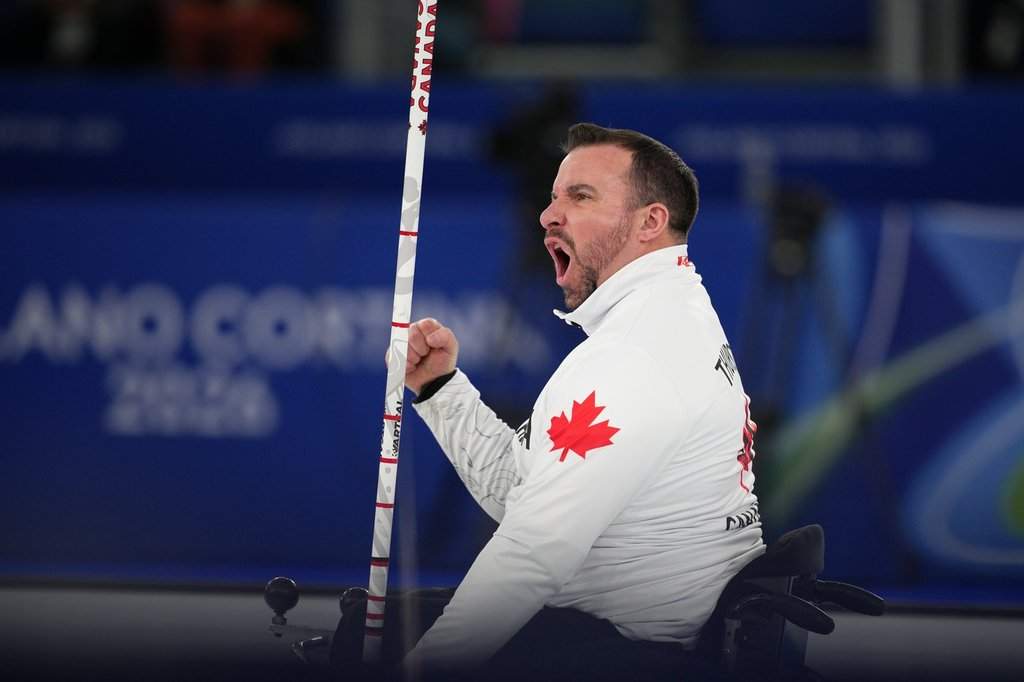
You don't go undefeated at the Paralympics by accident. It's basically impossible. Yet, that's exactly what Mark Ideson and his Canadian rink just pulled off in Cortina. After twelve years of chasing the top step, Canada finally reclaimed wheelchair curling gold with a 4-3 victory over China. But the score doesn't even begin to tell the story of a final end that was absolute chaos.
Think about the pressure. You're tied 3-3 in the eighth. The clock is screaming toward zero. You have the hammer, but there’s total confusion about which rock is sitting shot. Most people would have played it safe or waited for a measurement. Instead, Ideson released his final stone with just 2.5 seconds left on the game clock. If he'd held it a moment longer, Canada would've forfeited the game. It was the definition of "clutch."
The Cardiac Canadians and the Perfect Run
This wasn't just another win. Canada became the first team in Paralympic history to go 11-0. They didn't just win; they dominated a field that has become incredibly deep since the sport's debut in 2006. For years, China was the wall no one could climb, having won the last two Paralympic golds.
The nickname "Cardiac Canadians" stuck for a reason. Throughout the week in Italy, they found ways to win when things looked grim. They weren't just relying on talent; they were relying on a decade of shared scars.
- Mark Ideson (Skip): The veteran presence who had to deliver under a ticking clock.
- Ina Forrest (Second): Now a three-time gold medalist and the most decorated wheelchair curler ever.
- Jon Thurston (Third): The man who kept his cool when the measure was in doubt.
- Collinda Joseph (Lead): A 60-year-old powerhouse proving that age is just a number in elite sport.
- Gilbert Dash (Alternate): The rookie who fitted into this veteran unit like he'd been there for years.
Breaking the Chinese Stranglehold
China has been the gold standard for nearly a decade. They play a heavy, aggressive game that forces you into mistakes. In the final, neither team could pull away. It was a tactical chess match where points were traded like punches in a heavyweight fight.
The turning point was the sheer guts of the Canadian strategy. In the eighth end, with the house cluttered, China's skip Wang Haitao missed a difficult raise. It left a Canadian stone near the button, but it was too close to call with the naked eye. Canada could have "thrown it away"—basically wasted their last shot and relied on a measurement.
But Ideson and Thurston didn't want to leave it to the officials. They chose to play a precise tap-back to guarantee the point. It was a high-risk move. One wrong angle and they knock their own stone out, giving China the gold. Ideson hit it perfectly.
Why this gold matters more than the others
Canada won the first three Paralympic wheelchair curling golds from 2006 to 2014. Then, the rest of the world caught up. We settled for bronze in Pyeongchang and Beijing. There was a growing narrative that the "Canadian era" was over and that China had permanently taken the throne.
This 11-0 run in Milano-Cortina 2026 shuts that down. It proves that the Canadian system—which focuses heavily on process and mental resilience—still works. It’s also a massive win for Ina Forrest. At 63, she’s not just "still playing"; she’s the best in the world at her position. Her ability to read the ice is basically a superpower at this point.
What you can learn from the Cortina final
Honestly, most amateur curlers—and athletes in general—overthink the big moments. They let the clock dictate their nerves. What the Canadian team showed was a total commitment to their "process."
When the clock was ticking down, they didn't panic. They communicated clearly, made a decision, and executed. They’ve spent thousands of hours in empty rinks for that one three-second window. It’s a reminder that under pressure, you don't rise to the occasion; you sink to the level of your training.
If you’re looking to follow in their footsteps or just want to support the sport, now's the time. Wheelchair curling is growing across Canada, with more clubs than ever offering "stick curling" and accessible ice times.
Go watch the replay of that final end if you can find it. Pay attention to the communication between Ideson and Thurston right before that last shot. It’s a masterclass in how to handle a crisis. Then, get out to a local club and see why this sport is so addictive. You don't need to go 11-0 to appreciate the work that goes into a single perfect draw.