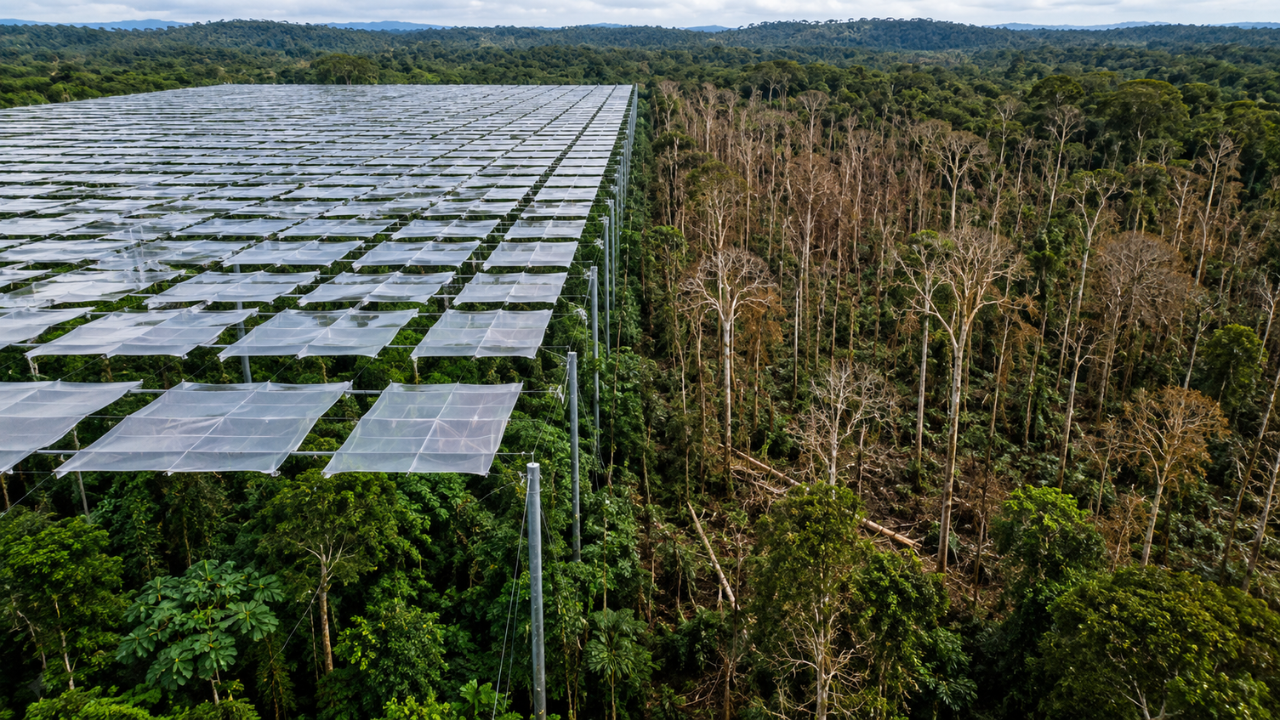
Scientists placed 6,000 plastic panels above a patch of the Amazon rainforest to simulate severe drought by blocking rainfall, and the underlying biomass plummeted by a staggering one-third. This brutal intervention, designed to test how the world's largest tropical forest responds to climate collapse, laid bare a terrifying vulnerability. When water stops falling, the system does not just slowly adjust; it shatters.
For decades, ecological models treated the Amazon as an infinite sink, an immortal green engine capable of absorbing endless punishment from industrial carbon emissions and shifting weather patterns. Researchers behind the massive canopy-exclusion experiment wanted hard data to replace hopeful guesses. Instead, they got a crisis. The experiment triggered an immediate cascade of biological failures, proving that regional drying pushes the forest past its breaking point much faster than standard climate projections ever predicted.
The Mechanics of Artificial Drought
Setting up a rain-exclusion roof inside a dense, humid jungle is an administrative and logistical nightmare. Crews hauled thousands of transparent panels into the remote canopy, rigging them overhead to divert precipitation away from specific test plots while allowing sunlight to filter through. The goal was isolation. They wanted to strip away water without altering the light regime, creating a controlled vacuum of moisture in a place where water defines existence.
The forest reacted with brutal swiftness. Without rain, the upper soil layers dried into dust within weeks. Deep roots tried to compensate, plunging further into the subsoil, but the moisture deficit quickly overwhelmed their hydraulic architecture.
Trees rely on a continuous column of water pulled up from the roots to the leaves, held together by molecular tension known as xylem pressure. When the soil dries out completely, that tension breaks. Air bubbles form inside the water transport tubes, a fatal condition called embolism.
Forest floors transformed from rich, spongy carpets of decomposing matter into brittle, sun-baked barrens. Microorganisms that depend on constant moisture and organic turnover starved. Fungi retreated deep into dormant spores or died outright. Without these microscopic decomposers, nutrient cycling ground to a halt. The living biomass above ground—the trunks, the vines, the massive emergent trees—began to cannibalize its own internal reserves just to survive the dry assault.
Why Biomass Collapsed by a Third
A thirty-three percent drop in biomass is not a minor fluctuation. It represents an ecological catastrophe occurring in real time. Trees did not just shed leaves to conserve water; whole canopies died, branches snapped under their own dead weight, and massive trunks collapsed into the understory.
The primary driver behind this sudden mortality is the loss of hydraulic integrity. Tropical tree species evolved in a wet world. They lack the extreme drought-tolerance adaptations found in arid scrubland vegetation. When forced to endure months of total water starvation beneath the experimental panels, their internal plumbing simply failed.
The Domino Effect on Forest Microclimates
- Humidity Drops: As the canopy dies back, the traditional transpiration shield vanishes, spiking local temperatures.
- Pest Invasions: Stressed trees emit chemical distress signals that invite wood-boring beetles and opportunistic pathogens.
- Fuel Accumulation: Dead branches dry out completely, turning the experimental plots into tinderboxes ready to ignite at the slightest spark.
The sudden thinning of the canopy allowed blistering equatorial sunlight to penetrate straight to the floor, scorching understory species that had spent millennia evolving in deep, cool shade. This created a vicious feedback loop. Higher temperatures dried the remaining soil even faster, accelerating the mortality rate of adjacent trees that were not even directly beneath the panels.
The Flawed Logic of Controlled Ruin
Critics of the project argue that artificially starving a living forest of rain creates conditions that never happen in nature. Natural droughts are accompanied by cloud cover, atmospheric pressure changes, and relative humidity shifts. A plastic roof blocking rain while ambient humidity fluctuates differently creates a distorted laboratory artifact rather than a true preview of climate change.
Yet, defenders of the research point to a harsher reality. Climate change is not a gentle, uniform drying process. It arrives in brutal, jagged shocks. The Amazon is already experiencing longer dry seasons, punctuated by severe meteorological anomalies. If the experimental plots show a one-third loss of biomass under simulated drought, what happens when multi-year regional drying hits the basin for real?
The answer challenges the fundamental premise of carbon offset programs. Corporations and governments routinely purchase credits tied to Amazonian forestry preservation, assuming the trees will remain standing as permanent carbon sinks. If regional drying can wipe out a third of a plot's biomass in a compressed timeframe, those carbon credits are built on sand. The stored carbon does not stay locked in wood; it returns to the atmosphere as decaying timber rots or burns, turning the forest from a carbon sink into a carbon bomb.
The Broader Fallout for Global Weather Systems
The implications stretch far beyond local tree mortality. The Amazon generates its own weather through a massive biotic pump. Trees suck water from the earth and transpire it into the atmosphere, creating flying rivers of vapor that drift westward to water agricultural heartlands across the continent.
When you break the forest in one place by stripping away its water, you weaken the entire atmospheric pump.
If large swaths of the basin lose a third of their biomass, transpiration drops off a cliff. The flying rivers stall. Droughts in the southern Amazon begin to bleed into the agricultural breadbaskets of Brazil and Argentina, choking crop yields and upending global food markets. The experiment under the 6,000 panels was local, but the warning it broadcasts is planetary.
We are watching the structural integrity of the planet's lungs get tested to destruction, and the preliminary results suggest the margin for error is already gone.