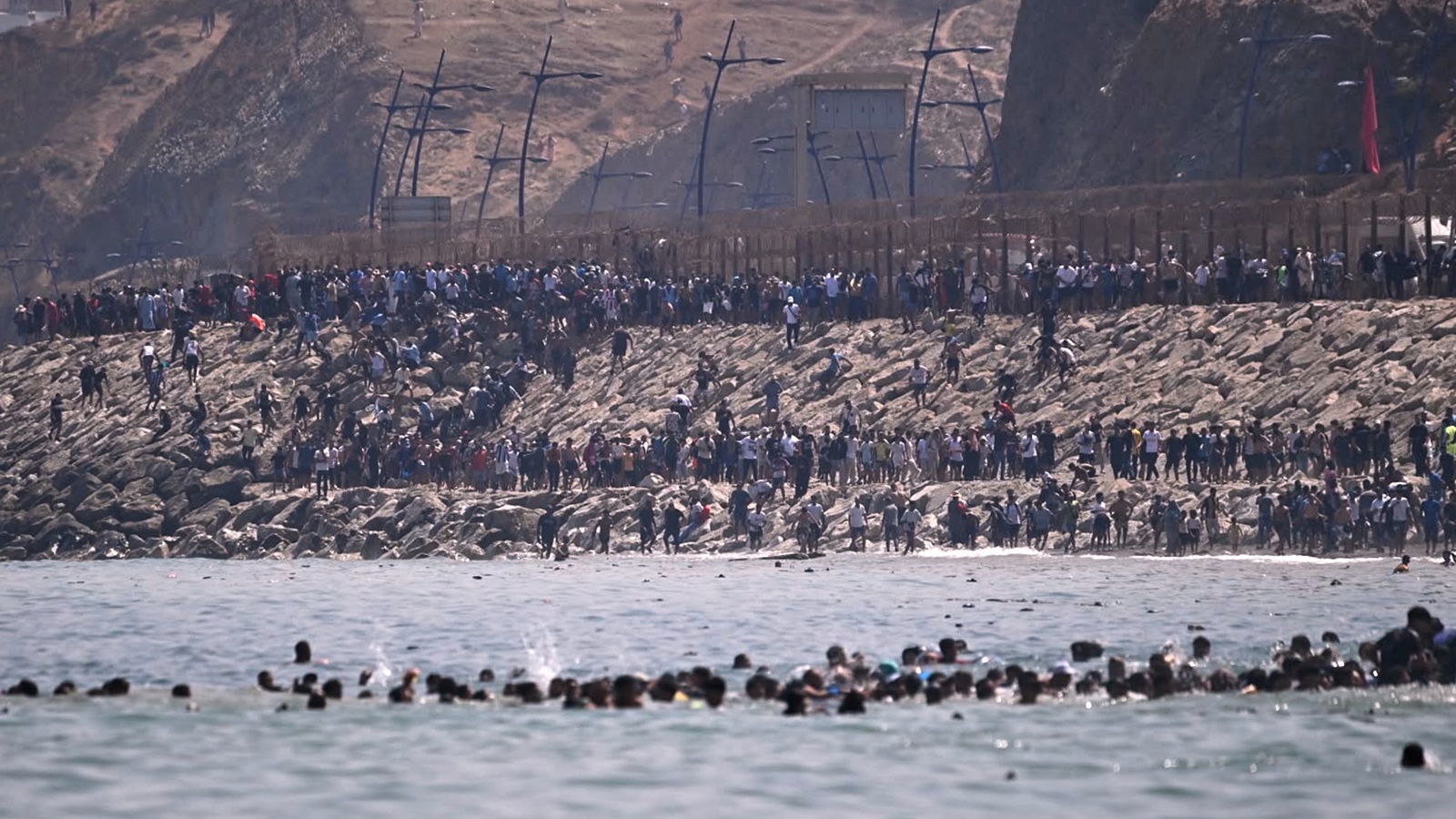
Every mainstream headline covering the mass arrivals across the border fences separating Morocco from Spain's North African enclave of Ceuta frames the event as a systemic failure. Reporters point to broken gates, overwhelmed security personnel, and sudden surges of humanity as evidence of a frontier collapsing under pressure.
They are entirely wrong.
The border didn't break. It did exactly what it was engineered to do.
When thousands of people swim around breakwaters or sprint across dry land into European territory overnight, the knee-jerk media reaction is to treat it as an emergency glitch in sovereign defense. I have spent years tracking migration corridors, border infrastructure spending, and bilateral statecraft in the Mediterranean. I have watched politicians stand in front of flashing cameras, feigning shock while signing multi-million-euro containment checks that achieve nothing except shifting the pressure valve five miles down the coast.
The lazy consensus says borders fail because states lack walls, surveillance towers, or political will. The brutal truth is that borders like Ceuta operate as dynamic pressure release valves, political bargaining chips, and economic safety valves wrapped in concertina wire.
Let us dismantle the mythology surrounding these surges and look at the structural machinery running beneath the surface.
The Architecture Of Managed Chaos
To understand a border crossing like Ceuta, you have to abandon the childish notion that international boundaries are rigid lines drawn on maps to keep people apart. Modern state borders are porous economic membranes. They are designed to let capital, goods, and seasonal labor flow freely while putting on a theatrical display of sovereign control for domestic voters.
When thousands cross into Ceuta from Morocco in a single wave, the media acts as if Rabat lost control of its northern provinces overnight. Think about that for a second. Morocco maintains one of the densest security presences in North Africa. A gnat doesn't cross a regional highway without intelligence services knowing about it, let alone thousands of young men organizing on public beaches.
The surge happens because statecraft requires leverage.
Borders in this region function through calculated friction. When Rabat wants diplomatic concessions, agricultural tariff adjustments, or security funding from Madrid and Brussels, the pressure on the northern fence mysteriously lightens. When European funds clear and diplomatic favors are banked, security tightens up with surgical precision.
Calling this a security failure is like calling a pressure cooker explosion a design flaw when you intentionally weld the steam valve shut and turn up the heat.
Dismantling The Border Wall Fetish
Politicians love walls because concrete is photogenic. Slap up a ten-meter fence topped with razor wire, slap a state seal on it, and you can run for re-election on a platform of tough-minded defense.
It is all smoke and mirrors.
Physical barriers do not stop movement; they merely tax it. They alter the cost-benefit analysis of crossing. When you build a higher fence, you don't eliminate traffic; you professionalize the smuggling networks, drive up the price of illicit transport, and force desperate people into more dangerous maritime routes.
During the Ceuta surges, the images beamed across global news feeds showed swimmers navigating cold coastal waters around the Benzú and Tarajal breakwaters. The fence on land was too fortified, so the crowd adapted fluidly to the aquatic route.
This is basic hydraulics applied to human geography. Block one channel, and the fluid finds another seam. Yet, security contractors and defense manufacturers rake in billions selling governments the exact same failed hardware upgrade year after year. I have watched public funds incinerated on thermal cameras and motion sensors that get blinded by coastal fog or bypassed by a pair of wire cutters bought at a local hardware store.
The market for border security thrives on perpetual crisis. If a wall actually worked, the industry would go bankrupt.
The Economic Safety Valve Nobody Mentions
Let us address the uncomfortable economic reality that European policymakers whisper about behind closed doors but never utter on television.
Southern European economies have massive underground labor demands. Agriculture, construction, tourism, and care work rely heavily on a shadow workforce of unpapered labor. These sectors want cheap, flexible workers who can be hired off the books with zero labor rights, zero pension contributions, and zero legal recourse.
At the same time, Morocco faces structural youth unemployment and regional economic stagnation. The youth crowding the beaches near Fnideq looking across the bay toward Ceuta are not invading an empire; they are responding to a structural labor vacuum.
European agriculture in regions like Almería would collapse in a single harvest season without an influx of flexible labor. Yet, the political class must maintain the theater of an invasion to appease xenophobic voting blocs.
The result is a grotesque double game. Economies inhale undocumented labor through the lungs while the state tries to choke the throat with bureaucratic red tape and razor wire. The Ceuta border collapse is the physical manifestation of this hypocrisy. It is the moment the valve blows because the pressure between labor demand and legal restriction became too immense to contain quietly.
Why The Legal Framework Is Designed To Fail
If you ask mainstream pundits how to fix the situation, they offer predictable platitudes:
- Increase Frontex funding.
- Streamline deportation flights.
- Pay transit countries more money to act as Europe's prison guards.
Every single one of these proposals treats the symptom while supercharging the disease.
International asylum laws, drafted in the wake of the Second World War, were built for a world of stationary nation-states and traditional warfare, not for a era defined by climate shocks, currency collapses, and hyper-connected digital economies. When a system is entirely detached from physical reality, compliance breaks down.
When people arrive in Ceuta, they enter a legal purgatory. Spain is legally obligated to process asylum claims, yet the processing centers are intentionally under-resourced to create intentional bottlenecks. The goal is not to process people efficiently; the goal is to create a miserable bureaucratic quagmire that deters the next wave through sheer psychological exhaustion.
It is deterrence by attrition. And it fails constantly because the baseline motivation of a person fleeing economic desolation or political oppression will always outweigh the deterrent effect of a bleak holding cell in a Spanish enclave.
The Alternative Reality We Refuse To Build
If we want to stop these chaotic, dangerous border collapses, we have to throw out the entire paradigm of fortress containment.
Imagine a scenario where migration is treated like modern trade logistics rather than an illicit military invasion. What happens if we replace razor-wire theater with functional, high-volume labor mobility corridors?
If you legalise and regulate seasonal labor movement, you pull the rug out from under the criminal smuggling networks overnight. You turn dangerous midnight swims into managed ferry rides with background checks, tax compliance, and return guarantees. You drain the swamp of the underground labor market by giving workers legal standing, protecting them from exploitation while stabilizing wage structures for domestic workers.
It sounds radical only because our current political discourse is trapped in a 19th-century mindset of territorial gatekeeping.
Instead, we double down on failure. We send more money to authoritarian regimes to police their own citizens, outsourcing human rights abuses to third-party states so European politicians can wash their hands of the dirty work.
The Ultimate Reality Check
The next time you see footage of a border breach in Ceuta, do not ask how the fence was breached. Ask who benefits from the theater of the breach.
Ask why billions of euros are spent on steel and sensors while legal channels for movement are narrowed into microscopic keyholes. Ask why politicians panic when the system works precisely as its perverse incentives dictate.
The border isn't broken. It's doing exactly what it was paid to do: create a permanent crisis, enrich the security-industrial complex, and keep the supply of desperate labor flowing just beneath the surface.
Stop treating the symptom as the disease. The wall was never meant to keep them out. It was meant to keep you watching.