Space exploration schedules slip. It happens. But when China updates the timeline for the Chang'e-7 mission to drill for ice near the lunar south pole, people pay attention. You aren't looking at a minor paperwork delay. You're looking at a massive, highly complex robotic undertaking getting the time it needs to actually succeed.
Most headlines frame this as a setback. They shouldn't. Pushing a launch back to ensure the machinery can survive the brutal, shadowed craters of the moon's south pole is just smart engineering. If you rush a robotic drill designed to hunt for water ice in pitch-black, freezing depressions, you're basically burning cash.
Let's look at what's actually happening behind the scenes of the China National Space Administration and why this timeline shift matters for the future of lunar habitation.
The Reality of the Lunar South Pole
Water ice is the holy grail of space colonization. Without local water resources, every drop consumed by astronauts or converted into rocket propellant has to climb out of Earth's heavy gravity well at an exorbitant cost. The lunar south pole holds trapped volatiles in permanently shadowed regions where sunlight never hits.
Temperatures down there drop to cryogenic extremes. Standard electronics fail. Lubricants freeze solid. Solar panels can't generate power because there is no direct light, meaning rovers and landers must rely on vertical peaks of eternal light or nuclear power sources.
When engineers examine the hardware required to land, hop across craters, and deploy a mini-flying probe alongside a heavy drill, they find edge cases that simulators miss. Adjusting the schedule means the hardware gets rigorous thermal-vacuum testing. It means the drill bits won't shatter on unexpected bedrock.
What Chang'e-7 Is Actually Doing
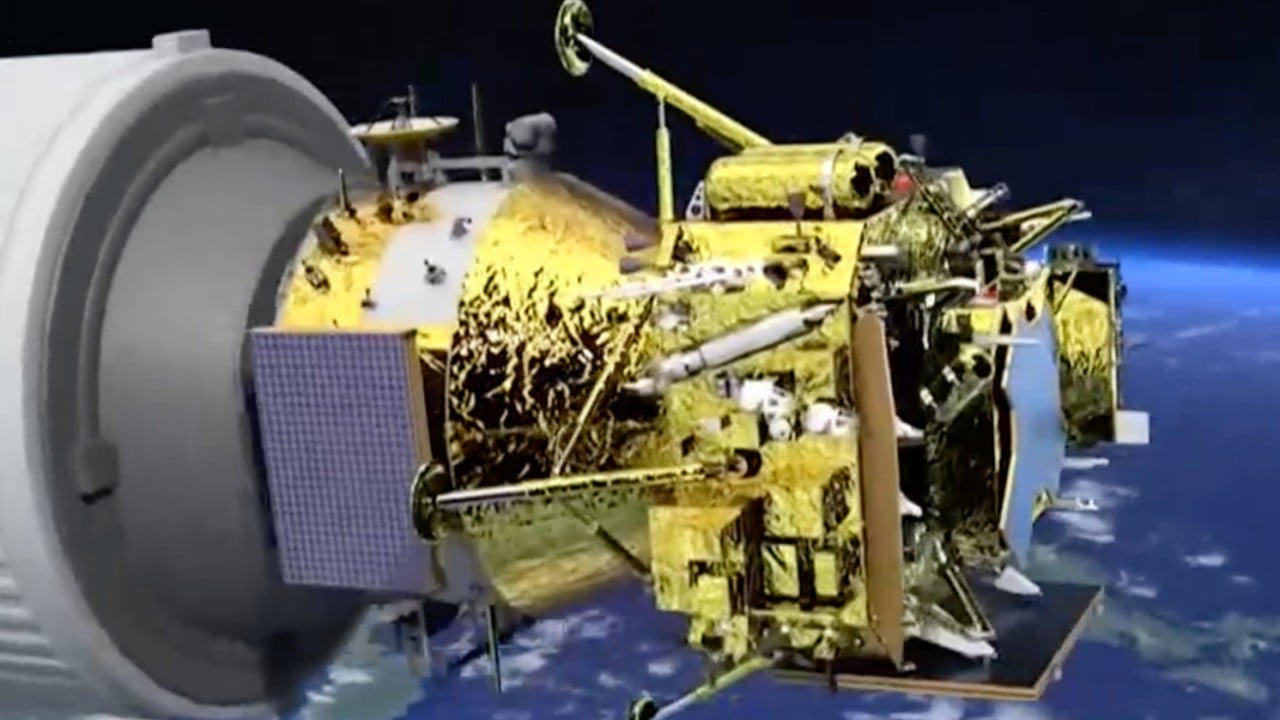
You won't just see a single rover rolling around. The Chang'e-7 suite is a multi-spacecraft flotilla.
We are talking about an orbiter, a lander, a rover, and a small hop probe designed to leap into shadowed craters where rovers fear to tread. The core mission objective involves landing near Shackleton Crater or a similarly dramatic geological feature, sniffing out hydrogen signatures, and physically extracting core samples to prove water ice availability.
Why does this delay make sense? Because the payload complexity is staggering. Designing a hopping probe that can survive a controlled crash-and-bounce or precise descent into a dark abyss is not trivial. You want the team to take an extra year rather than watch a billion-dollar lander tip over on a hidden boulder.
The International Space Race Heats Up
Nobody operates in a vacuum. NASA's Artemis program has its eyes locked on the exact same real estate. The Artemis III landing zones cluster around these very same south pole water traps.
When China adjusts its timeline, international observers try to read tea leaves about geopolitical competition. Sure, the space race is real. Every successful lunar landing builds diplomatic leverage and technical prestige. But physics dictates the timeline more than politics. If your drill mechanism needs redesigning, national pride won't make it work any better in a minus two hundred degree vacuum.
We are watching a slow-motion gold rush. The countries that master resource extraction on another celestial body write the rulebook for commercial space utilization.
What Comes Next for Deep Space Robotics
Expect more schedule adjustments across global space agencies over the next decade. Space is hard. Anyone telling you interplanetary timelines are fixed in stone is selling something.
Pay attention to how the engineering teams solve power distribution and thermal management in deep craters. Those solutions will dictate how fast we build permanent lunar bases. If Chang'e-7 launches with a bulletproof drill system because they took the time to fix it now, the wait will be worth every single second.